Alert
Alerts
Stage 10 : The british soldier
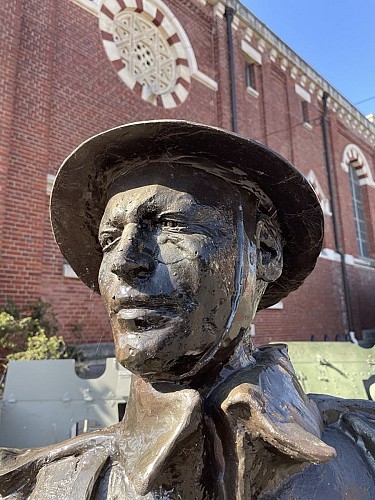
Description
Wlakbehind the statue, have a proper look at the river Ancre, and head towards the bar "Les 3 Pigeons".
Once there, turne left. Pass the basilica, just beyond you'll discover our last character, the british soldier.
The british soldier, "Tommy", wears a helmet on his head, the of which gives him the nickname "the fried egg", "the Brodie".
Indeed, it serves for everything but protection ; it serves as a bowl and he can even shave with the water in it.
It is equipped with trousers and a tunic with a closed collar, khaki color. The buttons are made of brass, representing the badge of the soldier's regiment and he wears a felt coat.
This uniform was completed with calf bandages, which were not easy at all; they were wrapped around the feet and calves ; they had no boots. Trench foot developed when the foot was left to macerate for several days in cold, damp socks and shoes. The foot then became pale, clammy, swollen, numb and cold, often requiring amputation.
Most soldiers wore their cartridge pouches slung across their chests.
July 1st 1916, was the darkest day for the british army, with 20 000 soldiers killed.
It was remembered for the scale of the human losses.
These young men, full of hope, left their homes to defend our country, driven by a sense of duty and a spirit of camaraderie. There was no compulsort army ; they all enlisted voluntarily, often among brothers, friends, sports clubs, etc.
Today, all these young soldiers are considered as heroes and every july 1st ceremonies are eld to honor them.
Your journey is completed.
Our witnesses of the past still embody hope, pain, courage and tragedy today.
These portraits of lives turned upside down, these fragments of humanity caught in the whirlwind of war, invite us to put the small worries of everyday life into perspective. They also become witnesses to a bygone era, but to an indelible memory.
Each step of this tour is a gateway to history. A journey that allows us to remember and pay tribute to those who lived through these chaotic moments. Bronze, a cold and timeless material, thus becomes, a warm link between the past and the present.
Like guardians of memory, transmitters of history, these statues are not simply monuments, but voices which, from the silence, whisper to us to never forget.
Thank you for letting them whisper once again, and if you want to learn more, we recommend the Musée Somme 1916, just behind the statue of the british soldier.
Go down 10 meters underground and, thanks to scenes from life, immerse yourself in the stories of other characters. Then head to the battlefields of the Somme.
Technical Information
Altimetric profile
Data author
