Alert
Alerts
The Village of Pont-en-Royans
Description
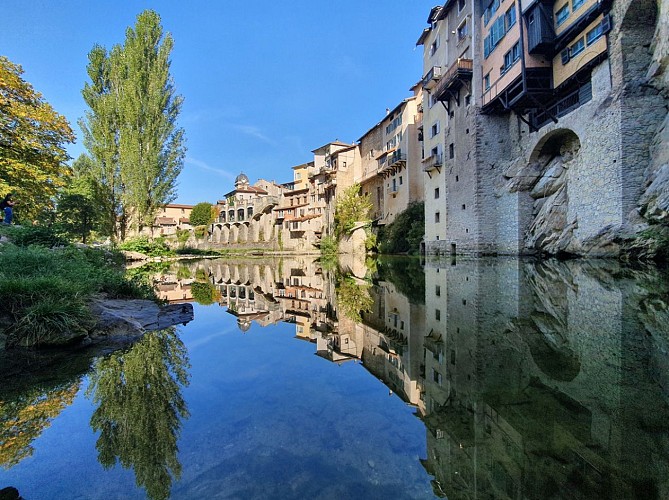
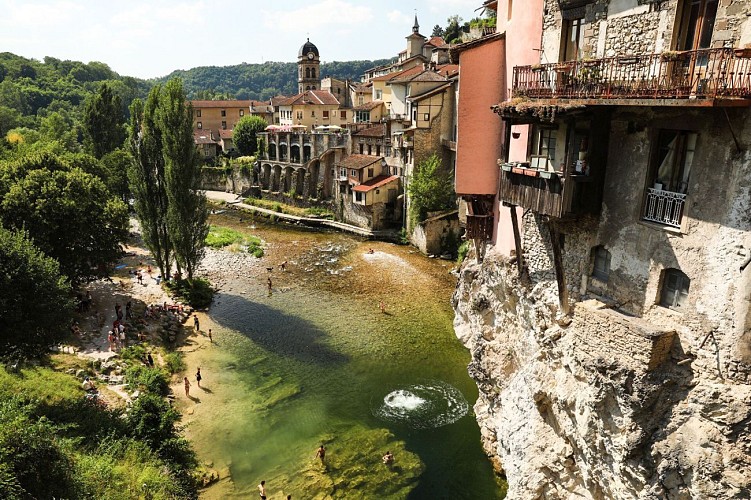
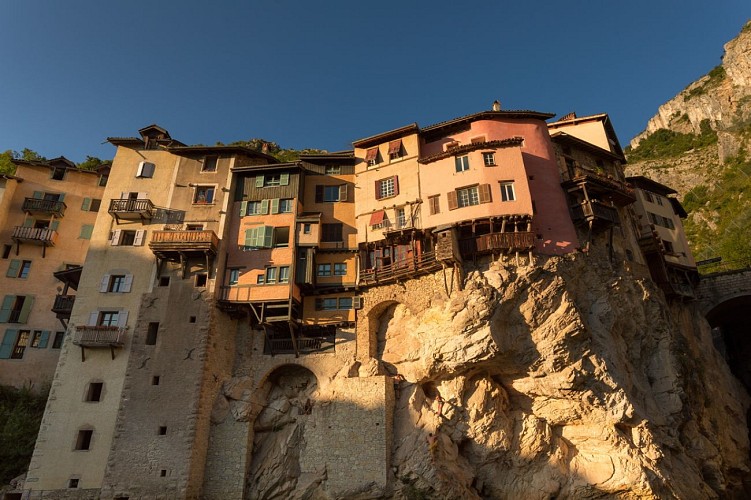
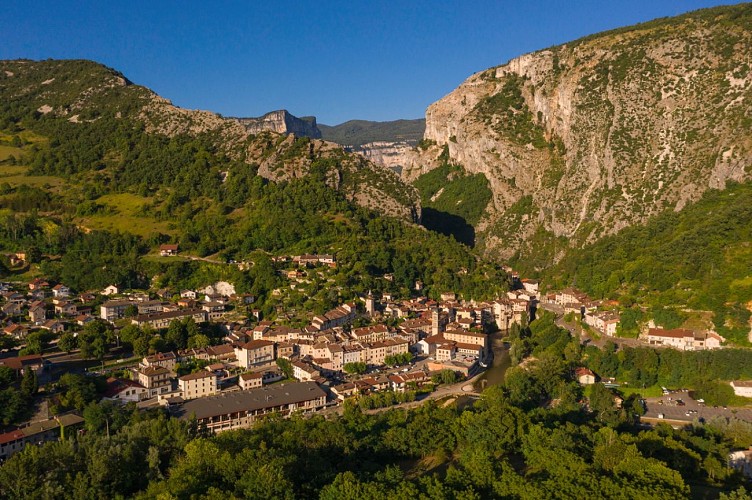
Located at the entrance to the Bourne Gorges and along the road to the Choranche Cave, this medieval village is characterized by architecture that is unique in the Dauphiné region: houses with colorful facades that seem to hang over the abyss.
The name Pont-en-Royans derives directly from the bridge spanning the Bourne torrent. As early as the Early Middle Ages, the bridge was built between two rocky piers, while nearby inns and their stables, shops, and a thriving village began to emerge—a village whose priory was first mentioned as early as the 11th century. In the 12th century, the Béranger family built a small fort atop the rocky spur overlooking the strait on the right bank and adopted the motto “I guard the bridge.” Trade, the protection of the castle, and the ingenuity of the people who, as early as the 16th century, built this hilltop village to facilitate the timber trade, led to the prosperity of Pont, which became the political and economic capital of the Royans region.
One of the first trades developed by the mountain dwellers was the transport and trade of timber. Workers cut wood in the forests of the Vercors and hauled the tree trunks by donkey and mule to Pont-en-Royans. It was not possible to float logs downstream from Pont-en-Royans. The logs were tied together to form rafts, which the workers then boarded as they set out from Pont-en-Royans. The timber was transported to the south of France—more specifically to Beaucaire—for the construction of boats formerly known as galleys. Pont-en-Royans has always been a crossroads as well as a strategic location for trade between products from the plains and the mountains. Probably established shortly after the Revolution in the former Sassenage fortified house, the mill located on Place de la Halle used a waterwheel to power a facility for beating, carding, and spinning wool. The wheel was swept away during the flood of 1851. In 1858, the building became a woodturning workshop run by an immigrant from the Jura region: Claude Mary MAYET. The thriving business employed up to 48 people before moving to Sainte-Eulalie-en-Royans in 1902. The building, where the finished products were still stored, caught fire in 1912.
Bombed in 1944, the building was razed to the ground. Today, the media library and the contemporary art space—aptly named La Halle—are located in a room of the former mill.
The site, listed as a historic monument since 1944, had impressed Stendhal. Ramparts, narrow streets, terraced gardens, and a bridge all contribute to the town’s rich cultural heritage. A hike up to the old feudal tower of the “Trois Châteaux” offers a sweeping panoramic view of the Royans region.
The Water Museum showcases the village’s hydroelectric heritage. In fact, the building once housed a convent, which later became a priory and was transferred to the Order of Saint Anthony in 1289. When the Order merged with the Order of Malta in 1780, it passed to the latter. Subsequently, the site was converted into a factory—a silk mill. The buildings were expanded during this period. The silk mill operated until 1918. The Compagnie Générale d’Électricité moved into the same premises and remained there until the 1990s, after which the Water Museum opened its doors in 2002. Today, an electrical company that manufactures outlets and switches is located not far from the museum, employing about forty people; this is
the Legrand company.
Technical Information
Altimetric profile
Additional information
Distinctions
listed
Price(s)
Free access.
Updated by
Office de Tourisme de Saint-Marcellin Vercors Isère - 18/11/2026
tourisme.saintmarcellin-vercors-isere.fr/
Report a problem
Open period
All year round daily.
Contact
Phone : 04 76 385 385
Email : tourisme@smvic.fr
Website : http://pontenroyans.fr
Animals
Yes. Pets are allowed only on a leash.
Data author
