Alert
Alerts
Remains of the fortified enclosure
Description
Pont-du-Château features the remains of fortified walls structured concentrically around the present-day château-town hall.
In the 12th century, Pont-du-Château was the most important stronghold in Limagne. Suger, who accompanied King Louis VI 'the Fat' in Auvergne, referred to it as 'Castrum peroptimum' (a leading stronghold). Pont-du-Château, which belonged to Count Guillaume VI of Auvergne, was defeated by the King. In 1363, it was the first stronghold in Auvergne to be taken by the English.
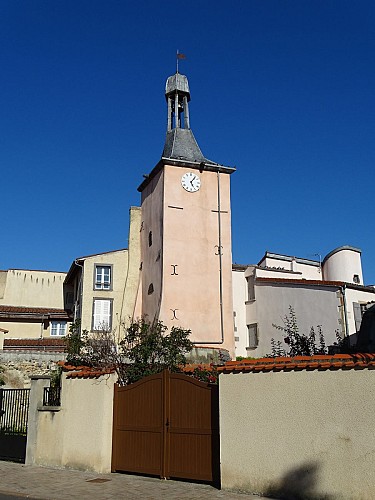
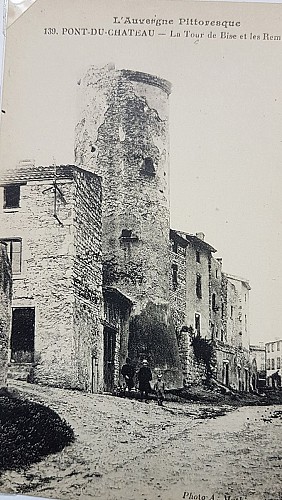
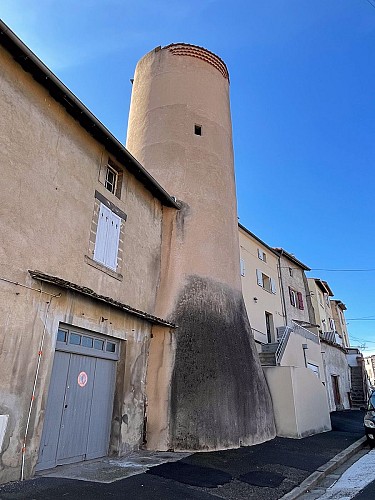
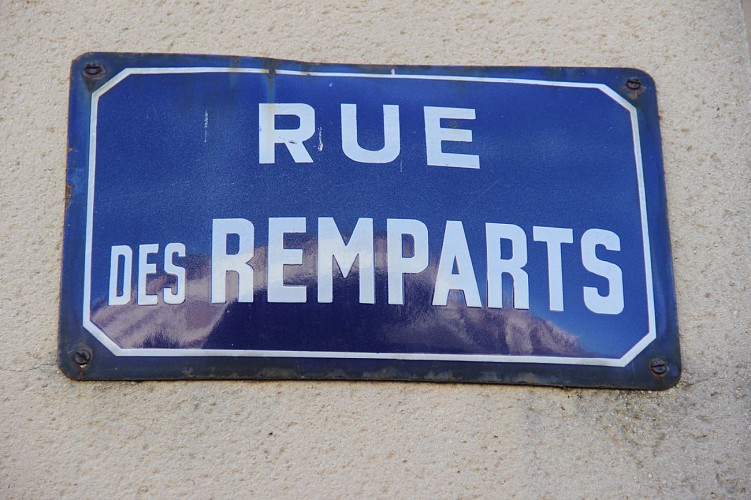
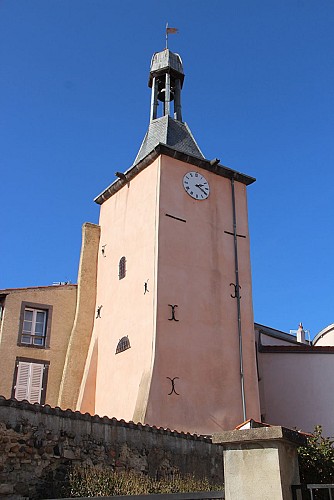
The town developed during the Middle Ages around its fortress, with its powerful square keep located on the site of the present-day château–town hall. The topography reveals a system of streets structured concentrically around the château, which sits on a promontory overlooking the Allier. Pierre Mondanel, a historian of the town, claimed he could trace the lines of the outer walls in the layout of the streets, comparing the design to the layers of an onion. The belfry (listed on the register of historic monuments in 1982) may have been a former tower in one of the town’s outer walls. Another tower, known as the Tour Cochon, located on rue des Remparts, is more definitively identified as part of the outer fortifications. The wall was protected by ditches, which were developed over the centuries. A city gate was likely located on rue de l’Hôtel-de-Ville, near rue des Remparts.
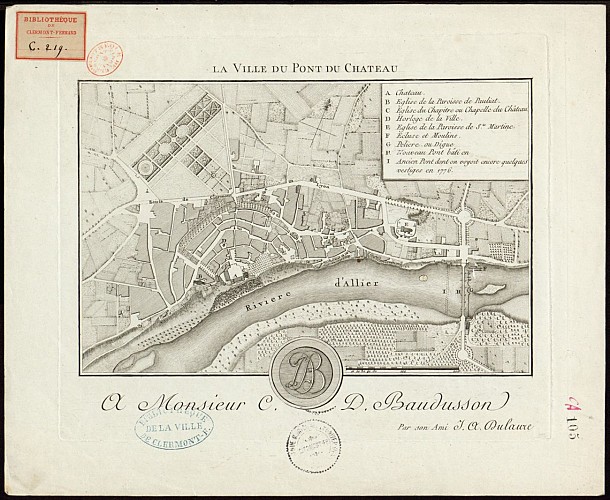
In 1954, the municipality acquired a collection of 37 remarkable plans of the town. Commissioned in 1758 by Philippe-Claude de Montboissier-Beaufort-Canillac, they were executed by Gilbert Baudusson, his son Côme-Damien, and Jacques-Antoine Dulaure (1755–1835), surveyors. The latter was also a geographer, historian, and future deputy. He wrote the book 'Description des principaux lieux de France' (Description of the Main Sites in France) in 1789, of which Book 5 is dedicated to Auvergne.
Technical Information
Altimetric profile
Additional information
Updated by
Clermont Auvergne Volcans - 02/10/2025
www.clermontauvergnevolcans.com
Report a problem
Contact
Phone : 04 73 83 73 62
Website : www.pontduchateau.fr/decouvrir-pont-du-chateau/visites-decouvertes-infos-touristiques/
Facebook : www.facebook.com/villedepontchateau/?locale=fr_fr
Tips
Bus line 36, René Cassin stop
History, culture and heritage
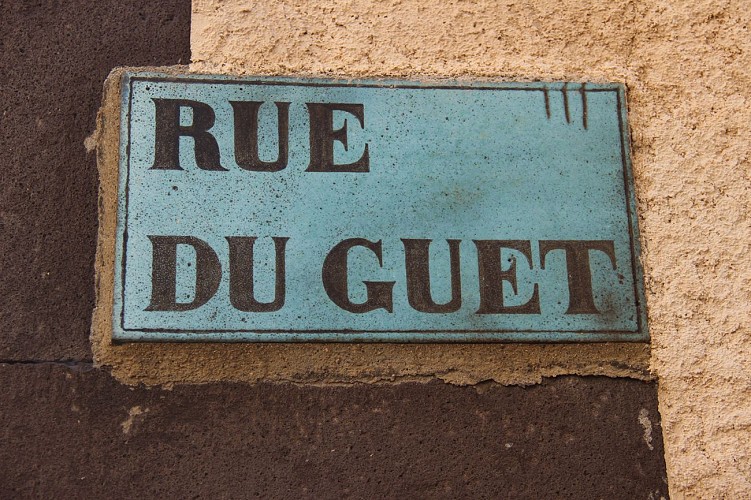
Vestiges listed as Historic Monuments and located within the perimeter of the Pays d'Art et d'Histoire de Clermont Auvergne Métropole. The ensemble benefits from a heritage promotion and mediation program. Photo 1: Belfry Photo 2: Map of Pont-du-Château by Jacques-Antoine Dulaure, 18th century Photo 3: Tour de Bise, now called Tour Cochon, rue des Remparts, early 20th century Photo 4: Tour Cochon, rue des Remparts, 2025 Photo 5: Toponymy evoking the layout of the old ramparts Photo 6: Toponymy evoking the layout of the old ramparts Photo 7: Belfry
Data author
