Alert
Alerts
Château de Bougy
Description
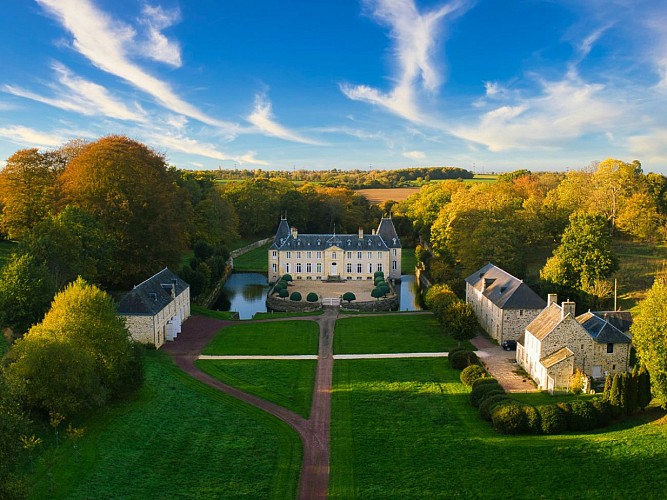
(17th-18th century) Private property. At the start of Louis XIV's reign in the 17th century, the noble protestant Le Révérend family were promoted from feudal lords to a marquisate. Not much is known about the construction of the Château de Bougy. While some elements date back to the time of the Le Révérend family, the château was rebuilt in the following century by the Hue de Carpiquet family (coats of arms on the main facade of the château 's pediment) on the foundations of the original 17th-century château. Various additions were added over the next century, including the square pavilion to the north east and the narrow pavilion to the south west. The château park dates back to the 18th century and has an array of different sections || a large central access alley was preceded by an avenue originally 2 km long, now shortened to 700 m. Various estate management buildings line this access alley.
The ornamental garden has a central flowerbed that was once divided by a central driveway. Retaining walls were installed at its north and south ends, given the site's slope. An overhanging avenue at the northern end provides another superb view. The flowerbed leads to a rectangular stone man-made pool which reflects the château's walls. There is a pond to the north west, after the pool. A small channel allows water to flow into the Odon via an octagonal contraption. The furthest part of the park is the most romantic and contrasts with the more classic layout of the flowerbed and ornamental garden. The western side is wooded for a more countryside feel. The Bougy estate's park is one of its main highlights. Historically, it showcases the expertise of 18th-century landscapers who could adapt terrain and include hydraulics as complex as those at Canon.
Technical Information
Altimetric profile
Additional information
Author
Orne Odon Tourisme
IGN cards







Data author
