Alert
Alerts
Plaque Gardes-Côtes
Description
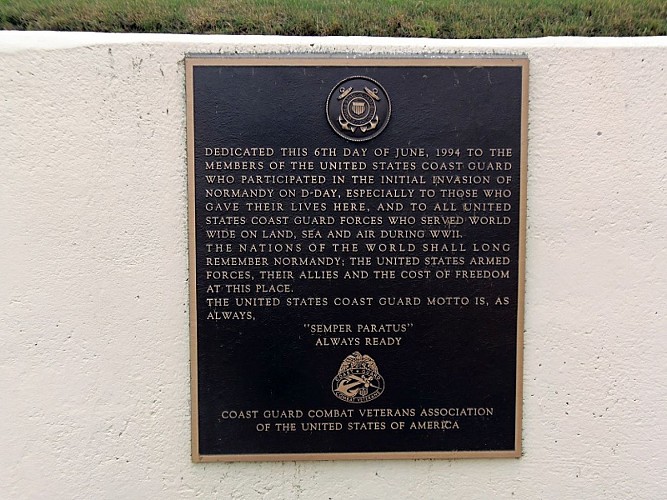
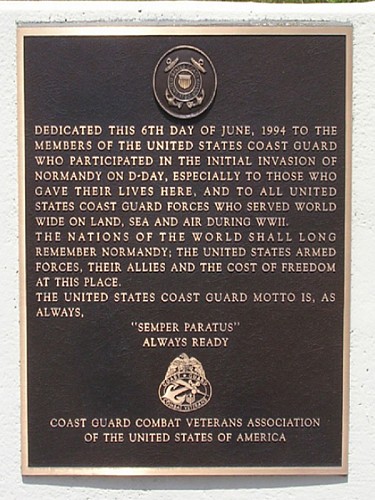
The commemorative plaque pays tribute to the members of the United States Coast Guard (USCG), who served alongside the Allied forces during the Normandy landings and throughout the Second World War.
Established in 1790, the US Coast Guard is one of America?s oldest armed forces. In wartime, it can be placed under the authority of the US Navy, as was the case in 1941, in anticipation of a massive worldwide engagement.
During the Second World War, the Coast Guard played a fundamental role in naval logistics and amphibious operations. Their versatility made them indispensable for carrying out landing missions, piloting transport ships, managing maritime safety and rescue operations at sea.
During Operation Overlord on June 6, 1944, the US Coast Guard was mobilized in a major way. Its men took command of :
10 Landing Ship Tank (LST): ships capable of transporting heavy vehicles, tanks and troops directly to the beaches.
24 Landing Craft Infantry (LCI): boats specially designed for landing infantry.
Several dozen Attack Transport Ships, essential for transporting soldiers from England to the Normandy coast.
But their most emblematic mission was that of Rescue Flotilla One, a rescue flotilla set up to recover soldiers who had fallen overboard. Placed under the command of Coast Guard Reserve Commander Alexander Stewart, this unit was made up of 60 speedboats assigned to the surveillance of landing zones. Equally divided between the American and Anglo-Canadian sectors, the flotilla rescued around 400 soldiers on D-Day.
The plaque was installed in Sainte-Marie-du-Mont on June 6, 1994, to mark the fiftieth anniversary of the D-Day landings. It bears the motto of the US Coast Guard:
"Semper Paratus? Always ready,
as well as their official emblem, recalling the founding of the USCG in 1790.
GPS coordinates: Latitude: 49.416375 | Longitude: -1.175551
Technical Information
Altimetric profile
Additional information
Data producer
This information is provided by OT Baie du Cotentin
Contact
Email : tourisme@ccbdc.fr
Data author
