Alert
Alerts
An underwater channel?
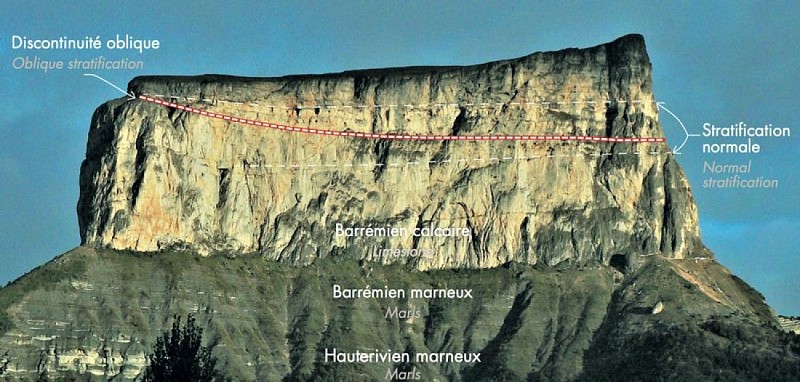
Description
Limestone is formed on the seabed through an accumulation of skeletons and shells of sea creatures. The limestone of Mont Aiguille was fashioned in a shallow sea in a tropical climate and close to the continent. This limestone is “stratified” like a millefeuille cake or a pile of plates, each sheet representing a period of sedimentation.You can see this stratified limestone on the south-east face of Mont Aiguille in front of you. However, on the its upper section you can very clearly make out one level that cuts through the stratification at an angle. This is almost certainly an old underwater channel that created ravines in the sediment that was already there.Once established, sedimentation was able to restart and plugged this channel.
