Alert
Alerts
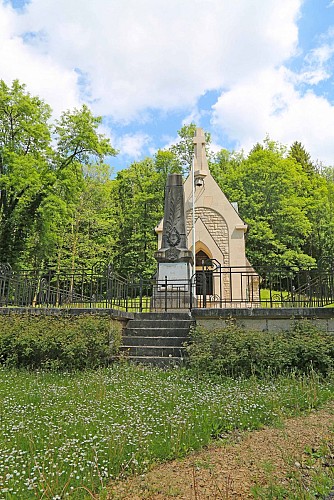
Destroyed village of Beaumont-en-Verdunois
Description
Indeed, this ancient village, of Gallo-Roman origin and founded in the Middle Ages around 324, has already undergone several evacuations throughout its history, notably during the Germanic invasions.
The longest evacuation occurred during the Thirty Years' War when the inhabitants took refuge for nearly two years, in 1635 and 1636, in the fortress of Ornes, a few years before it was captured by the Catholic troops of the Duke of Lorraine.
Later, in 1815, the village faced evacuation when the Prussians conducted their first invasion of Verdun after Napoleon's defeat.
During the Franco-Prussian War in 1870, a regiment of German white cuirassiers entered the village on August 24, 1870.
However, it was in September 1914 that the non-mobilized inhabitants were evacuated to the south of France because the village was too close to the front line. Until mid-October 1914, the village found itself between the French and German lines in a no man's land stretching up to 6 or 7 km wide. A strong offensive push by the French army allowed it to be within friendly territory until February 1916.
On February 21, 1916, with the onset of the great German offensive on Verdun, the violent battle of Bois des Caures took place, where Colonel Driant died shortly after ordering the survivors of the 56th and 59th Battalions of Chasseurs à Pied, which he commanded, to retreat to Beaumont. However, the power of the German attack, strongly supported by superior artillery, allowed their infantry to capture the village by February 24.
The resistance of the French soldiers, who had taken refuge in the cellars, proved effective thanks to their machine guns, which, through the ventilators, mowed down many German soldiers, forcing them to retreat. This retreat, however, was soon followed by continuous shelling for long hours, gradually reducing all resistance and transforming the village into a vast field of ruins.
From August 20 to 26, 1917, the French managed to partially reconquer the village. But the German infantry, firmly entrenched in defensive positions, clung on and could not be dislodged despite continuous French shelling, which only further devastated this unfortunate village.
It remained in German hands until October 8, 1918, when American troops arrived and occupied it until the end of the war.
The joy of the inhabitants, dreaming of returning to their land and rebuilding their homes, was short-lived, as the village was declared to be in a "red zone," prohibiting any hope of reconstruction and the resumption of farming due to the risks of explosion and contamination of the groundwater.
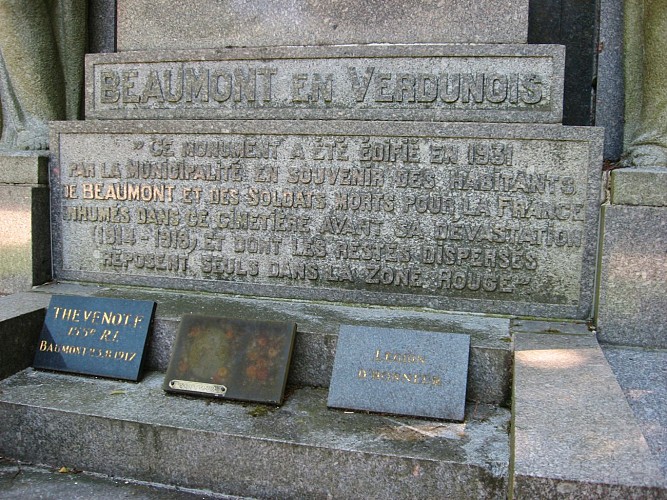
In 1919, the village benefited from government measures that allowed it to have a municipal commission and a president with mayoral powers. This enabled it to have an official structure to conduct memorial activities on its land between the wars, such as the erection of a war memorial in 1925, where the citation awarded on March 15, 1921, in recognition of its supreme sacrifice, is inscribed, and the Saint Maurice shelter-chapel on the very site of the old church.
Even today, and more than ever, this work of remembrance brings new life to this destroyed village, now recognized as a true place of memory for present and future generations.
To see:
The Saint Maurice shelter-chapel (mural of the village before the war by the painter Lucien Lantier)
The old cemetery
The war memorial
The restored fountain
The marker indicating the first French line in the summer of 1918
Traces of the 1916 battles
Technical Information
Altimetric profile
Date and time
- From 01/01/2025 to 31/12/2025 Ouvert le lundi, mardi, mercredi, jeudi, vendredi, samedi, dimanche
Additional information
Producteur de la donnée
Ces informations sont issues de la plateforme SITLOR - Système d’Information Touristique - Lorraine
Elles sont synchronisées dans le cadre du partenariat entre Cirkwi, l’Agence régionale du Tourisme Grand Est et les membres du comité technique de Sitlor.
IGN cards











Data author
