Alert
Alerts
Ecouen Castle Park
Description
Set within the 104-hectare Écouen Forest, a 19-hectare enclosed estate surrounds this château. Serving as a natural barrier between a highly urban environment and the Plaine de France, this park offers a constantly changing view of nature throughout the seasons.
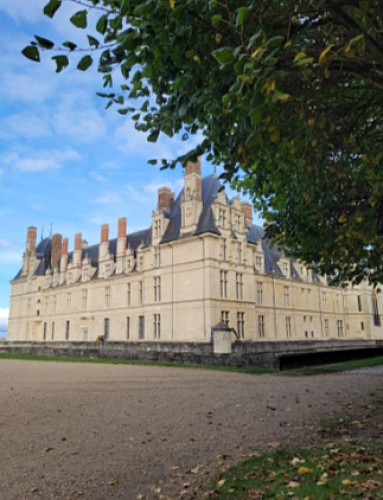
The Château d'Écouen, which today houses the collections of the National Museum of the Renaissance, is a landmark of the French Renaissance. Built for Constable Anne de Montmorency by the finest artists between 1538 and 1555, it is situated on a promontory overlooking the entire plain of France.
A forest borders it, crisscrossed by beautiful paths that were once the scene of numerous hunts. According to engravings by Androuet Du Cerceau, we know that a garden featuring sixteen enclosed squares had been planned at the castle’s entrance, but it appears that the earthwork required for its construction was never carried out, and only a niche at the base of one of the bastions still bears witness to this original design. Similarly, a grotto adorned with splendid plant and animal motifs had been commissioned around 1556 from Bernard Palissy, the most famous ceramist of the time, but the constable’s death in 1567 prevented the project from being completed, and it was for Catherine de’ Medici at the Tuileries that this grotto was eventually finished.
In 1696, the château passed into the hands of the Condé family. Jules Hardouin-Mansart then transformed the landscape by creating an esplanade at the rear of the château, on which he laid out three parterres with simple geometric designs. These flowerbeds extend into the forest via a long green avenue lined with trees and groves to the south and a “grand tapis” to the north, in the style of the one at Versailles. The forest itself was enhanced with new paths and roundabouts from which other paths radiated outward.
In 1805, Napoleon decided to establish the first boarding school for young women of the Legion of Honor in the château. A perimeter wall then enclosed the estate. In 1810, the Prince of Beauharnais presented his sister, Queen Hortense—patron of the institution—with a fountain at the far end of the park, on the presumed site of an old fountain known as the Fontaine Madame.
When the museum was established here in 1977, it was decided to restore the estate to its original appearance. Although the “carpet” has been irrevocably truncated due to urbanization, the rest of the flowerbeds and paths have been restored. A gate was added to the perimeter wall in 1995 to restore the view intended by Mansart. Only the Hortense Fountain has not yet been restored, which, we hope, will happen soon!
Technical Information
Altimetric profile
Additional information
Price(s)
Free of charge.
Updated by
Office de Tourisme Grand Roissy - 17/11/2026
www.grand-roissy-tourisme.com/
Report a problem
Open period
From 01/01 to 31/12 from Monday to Saturday between 8 am and 6 pm.
Closed exceptionally on January 1st and December 25th.
Contact
Phone : 01 34 38 38 50
Email : accueil.musee-renaissance@culture.gouv.fr
Website : http://musee-renaissance.fr
Facebook : https://www.facebook.com/musee.renaissance.officiel
Data author
