Alert
Alerts
Alpe d'Huez Museum of History and Archaeology
Description
Listed among the “Musées de France” since 2003 and affiliated with the municipal archaeological site of Brandes-en-Oisans, the Alpe d’Huez Museum of History and Archaeology traces the long history of the village of Huez and its mountain pasture, from the Middle Ages to the present day.
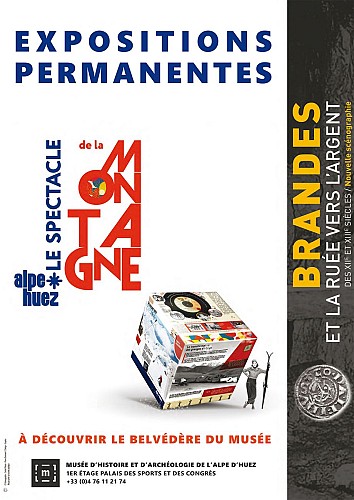
Having been awarded the "Musée de France" designation in 2003 by the Ministry of Culture, the Musée de l’Alpe d’Huez has featured two new exhibits since December 2022: the permanent exhibitions “The Spectacle of the Mountains” and “Brandes and the Gold Rush of the 12th and 13th Centuries.”
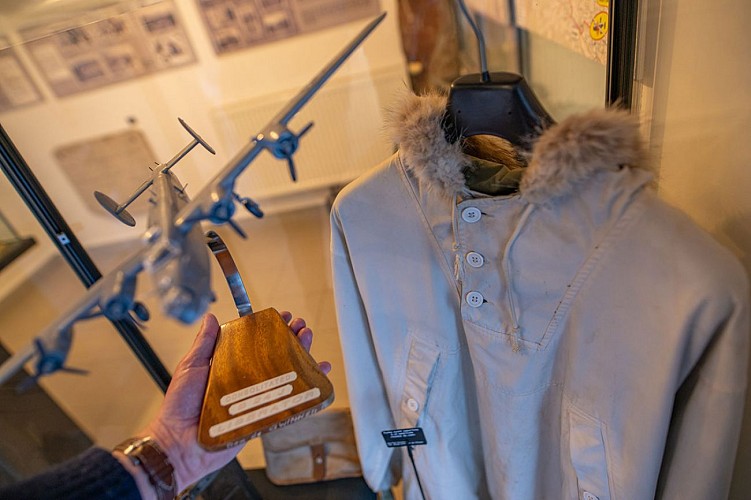
You can also explore the section dedicated to World War II through the exhibition “Summer 1944: The Maquis of Oisans.”
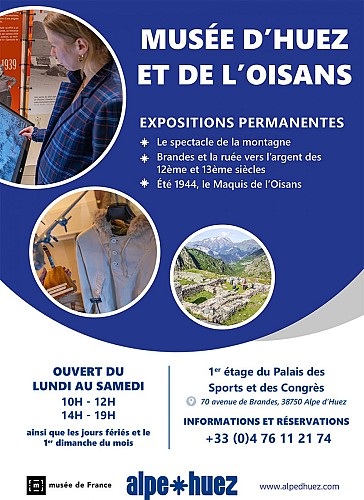
3 PERMANENT EXHIBITIONS: “THE SPECTACLE OF THE MOUNTAINS,” “BRANDES AND THE GOLD RUSH OF THE 12TH AND 13TH CENTURIES,” “SUMMER 1944: THE MAQUIS OF OISANS”
THE SPECTACLE OF THE MOUNTAINS
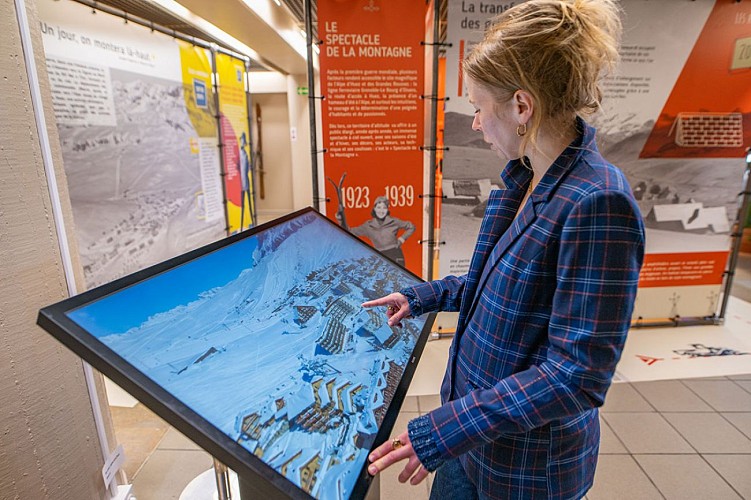
This long-term exhibition traces the transformation of alpine chalets (now the Vieil Alpe neighborhood) into family-friendly hotels that, beginning in the 1970s and 1980s, formed an internationally renowned tourist resort perched at an altitude of 1,850 meters. Featuring four “kiosks” (immersive cubes) richly illustrated with photographs chronicling the periods 1923–1939, 1945–1973, 1974–1989, 1990–2022, this chronology reveals to visitors the spectacular evolution of Alpe d’Huez through its pioneers (the Moulin, Chaix, Chalvin, and Collomb families, as well as figures such as Maurice Rajon, Jean Pomagalski, Joseph Paganon, etc.), the heyday of traditional hospitality between the 1930s and 1960s, sporting events such as the Tour de France (which first reached Alpe d’Huez in 1952 with Fausto Coppi’s victory; with Dutch, Spanish, French, and British victories in the following decades), new snow and winter sports such as snowboarding in the 1980s, summer skiing on the Sarenne slope and glacier starting in the 1960s, as well as numerous events like the Tomorrowland Winter electronic music festival (since 2019). In addition, urban development—characterized by diverse and multifaceted architecture—is highlighted through an interactive touchscreen (featuring historical and 3D models of the resort’s neighborhoods) and an interactive kiosk that spotlights several key figures associated with this growth. The built heritage (hotels, ski lifts, public buildings, the Rif Nel and Neiges d’Or apartment complexes, Notre-Dame des Neiges Church (1969), International Style buildings such as the Daria I Nor Hotel (2019), Neo-Savoyard chalets, etc.) in Alpe d’Huez is showcased here, as are upcoming real estate projects. Finally, film screenings from the National Audiovisual Institute (leisure activities in the 1950s, the role of real estate developers in the 1970s, the inauguration of the Olympic bobsled track (Grenoble Winter Olympics in February 1968), the conquest and inauguration of the Pic Blanc (3,330 m above sea level) in 1963) will capture the attention of young and old alike.
BRANDES AND THE RUSH FOR MONEY IN THE 12TH AND 13TH CENTURIES
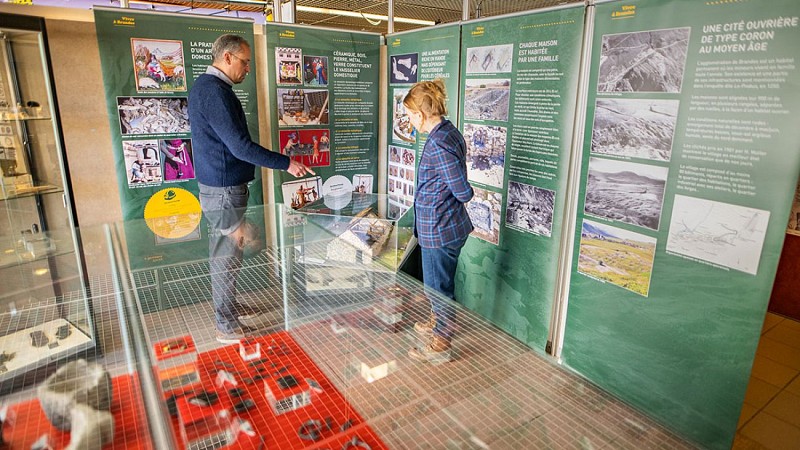
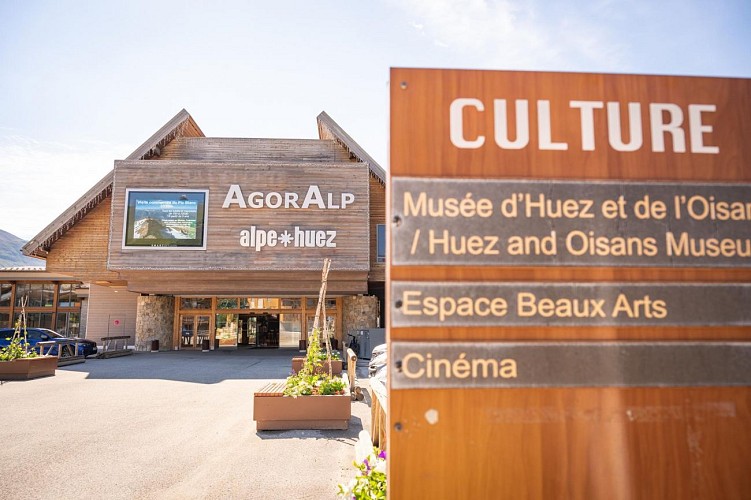
As you explore the resort and the Alpe d’Huez plateau, who would believe that in the Middle Ages, a community consisting of male mining specialists, women, and children (who crushed the ore), settled on the plateau in Brandes, at the foot of the Saint-Nicolas rock, extracting silver ore from the ground at an altitude of 1,800 meters, as well as around Lac Blanc (2,700 meters)? Yet, from the 12th to the 14th centuries, the inhabitants of Brandes (a site that constituted the medieval mining settlement and the highest human settlement in Europe for that period) lived there year-round (between 200 and 250 people), despite harsh weather conditions from October through April. This history of mining techniques (specifically, the development of the pre-industrial era in Western and continental Europe) and human settlement was revealed by systematic archaeological excavations conducted beginning in 1977 by archaeologist Marie-Christine Bailly-Maître (former curator of the Huizat Museum) and her teams, which included speleologists, scientists, archaeology students, and volunteers. The discoveries made during the excavations—including mining techniques, the production of silver powder, Brandes’s finished product used to mint the coins of the Dauphin (lord of the Dauphiné), religious practices and daily life, and the construction of a watchtower with unique architecture, a “shell-keep”) led to the creation of the “Maison du Patrimoine” in 1982, centered around its archaeological collection, which became the “Musée d’Huez et de l’Oisans” and then the “Alpe d’Huez Museum of History and Archaeology” in 2023. Formerly housed in the “Hôtel des Lacs,” this museum, heritage, and cultural institution has occupied the first floor of the AgorAlp (formerly the “Alpe d’Huez Sports and Convention Center”) since 2012. A new exhibition design showcasing the archaeological collection remains on display and contextualizes the artifacts found both above and below ground through several models and a wealth of illustrations.
The archaeological site is open from April through October (toward the clay pigeon shooting range or near the Sarenne Pass road); explore its illustrated educational panels and audio-guided commentary via the PILGRIMZ web app (free download and account).
SUMMER 1944. THE OISANS MAQUIS
Let us also not forget the history of the Oisans Maquis during World War II. While the mountains may seem like a place untouched by the fighting between draft dodgers from the Compulsory Labor Service (STO) and German soldiers, events—sometimes tragic, often heroic—took place in the Grandes Rousses massif and throughout the Oisans region more broadly. Alpe d’Huez hosted a military hospital for the French Forces of the Interior (the FFI, opponents of the German occupation), notably in Huez and later at the Chalet du Signal, an annex of the “Grand Hôtel” in Alpe d’Huez. Faced with the advance of the enemy army and its determination to control the Oisans region and destroy its resistance movement (following the Nazis’ victorious capture of the Vercors in July 1944), Dr. Tissot, a surgeon, ordered the evacuation of the wounded being treated in this small building in mid-August 1944. Thus began a slow and arduous climb for the patients (some in critical condition) and the medical staff up to the heights of Alpette and the slopes of the Grandes Rousses, for those who were able-bodied. This group received welcome and life-saving assistance from the crew of a B-24 Liberator bomber—“11 Americans who fell from the sky” (an expression coined by Pierre Montaz, a member of the Resistance at Alpe d’Huez): The crash of their plane—following a bombing campaign on Munich (Germany)—near Gap, in Prunières, prompted them to cross the Oisans region in late July 1944. Having learned in Le Bourg-d’Oisans of the existence of the military hospital at Alpe d’Huez, they provided invaluable assistance to the retreating FFI. Protecting the evacuation of the wounded (some of whom were taken to the Fare refuge at an altitude of 2,600 meters), the armed Oisans resistance fighters fought a fierce battle on the heights of the Alpette against a division of German Alpine hunters; They emerged victorious on August 14, 1944, suffering no casualties. Relive this significant historical event in the French Resistance in the mountains through richly illustrated educational panels and artifacts from the collection of the Musée de l’Alpe d’Huez, also on loan from the Association of Friends and Descendants of the Oisans Maquis.
LEARN MORE ABOUT THESE 3 EXHIBITS
Quick Museum Tour: Discover the museum’s artifacts in a new way! Three artifacts will be examined and placed in their historical and geographical contexts.
Every Wednesday during French school breaks, from 4:30 p.m. to 4:45 p.m. — FREE — from December 2026 to April 2027; register at the museum or by calling 04 76 11 21 74
CULTURAL PROGRAM
Museum Late-Night Events (FREE, registration recommended at the Museum; held from 8:00 PM to 10:00 PM) are offered during the winter season; discover the heritage of the town of Huez-Alpe d’Huez, as well as screenings on environmental, historical, and artistic topics, among others.
For more information, call 04 76 11 21 74 or email accueil.musee@mairie-alpedhuez.fr
CULTURAL AND GUIDED TOURS IN THE RESORT
=> Guided tour of Pic Blanc, with its exceptional panoramic views at an altitude of 3,330 meters, and a visit to the Ice Cave (10:00 a.m.–12:30 p.m.)
Upon arrival at the cable car station, the cultural services guide will cover several topics: the Michelin Green Guide 3-star panorama, the history of the resort and skiing, information on geology, the landscape, fauna, flora, glaciers, and the history of the Alpe d’Huez resort…
No walking required; maximum of 20 people per tour (access via the Pic Blanc cable car). Tuesdays and Thursdays mornings, from 10:00 a.m. to 12:30 p.m.
How to get there: Meet in front of the indoor ticket counters for the Pic Blanc gondola (formerly DMC, at the top of the resort, at an altitude of 1,850 m, on the right 150 m past the Pistes roundabout (at the end of Avenue du Rif Nel); Pay by credit card at the SATA ticket office and meet Frédérik Tane, cultural guide and facilitator, in the same room at 9:45 a.m.)
Tour prices: Contact the SATA Museum (04 76 11 21 74) (04 76 80 30 30)
Registration is required at the Alpe d’Huez Museum: 04 76 11 21 74 or accueil.musee@mairie-alpedhuez.fr; limited availability
=> During the winter season, another guided tour is offered by the Huez-Alpe d'Huez Cultural Department; register at the Museum (by email or phone at accueil.musee@mairie-alpedhuez.fr or 04 76 11 21 74; €5 or €3; 04 76 11 21 74): a tour of the Notre-Dame des Neiges Church, a remarkable religious and cultural landmark known for its wooden architecture, the multicolored Arcabas stained-glass windows depicting the Gospel according to Saint Mark, and the Raphaël organ; its history is closely tied to the development of the ski resort and the Tour de France cycling race. The church is one of the buildings designated as “20th-Century Heritage” by the Isère department. Organ concerts are held during the season on Thursday evenings (information available at the Museum).
THE MUSEUM’S ART AND TEMPORARY EXHIBITIONS
In the Anne Auvergne Hall (1st floor of AgorAlp, across from the Museum), take advantage of the spacious room and its beautiful lighting to explore exhibitions of watercolors, paintings, sculptures, prints, digital art, photographs, and more throughout the winter. Opening receptions followed by a reception are held in the company of the artists during the winter season.
FREE ADMISSION; exhibitions from December 2026 to April 2027
CREATIVE WORKSHOPS WITH THE ARTISTS for children and adults, introducing the techniques featured in the exhibitions; €5 or €3 per person; for more information, contact the museum (in person or by phone at 04 76 11 21 74)
Technical Information
Altimetric profile
Date and time
- From 28/09/2026 to 18/10/2026
- From 19/10/2026 to 23/10/2026
- From 24/10/2026 to 25/10/2026 from 14:00 to 19:00
- From 26/10/2026 to 30/10/2026
- The 31/10/2026 from 14:00 to 19:00
- From 01/11/2026 to 04/12/2026
- From 05/12/2026 to 25/04/2027
Additional information
Distinctions
Famille Plus
Museum of France
Price(s)
Free of charge. Free admission to the Musée d'histoire et d'archéologie de l'Alpe d'Huez and the Anne Auvergne exhibition hall.
For cultural events, register on site or on 04 76 11 21 74 or at accueil.musee@mairie-alpedhuez.fr
5€ full price or 3€ Premium price and/or family of 3 minimum for guided tours; for the Pic Blanc guided tour, see skipass.alpedhuez.com + SATA; 5 or 3€/person for adult and children's fine art workshops organized by the Museum.
Updated by
Alpe d'Huez Tourisme - 03/09/2026
www.alpedhuez.com
Report a problem
Contact
Phone : 04 76 11 21 74
Email : accueil.musee@mairie-alpedhuez.fr
Website :
https://www.alpedhuez-mairie.fr/
https://www.alpedhuez.com
Location complements
Cultural space on the second floor of AgorAlp: Museum and fine arts exhibition space in the Anne Auvergne room (winter and summer exhibitions).
Animals
No
