Alert
Alerts
Village of Bellentre
Description
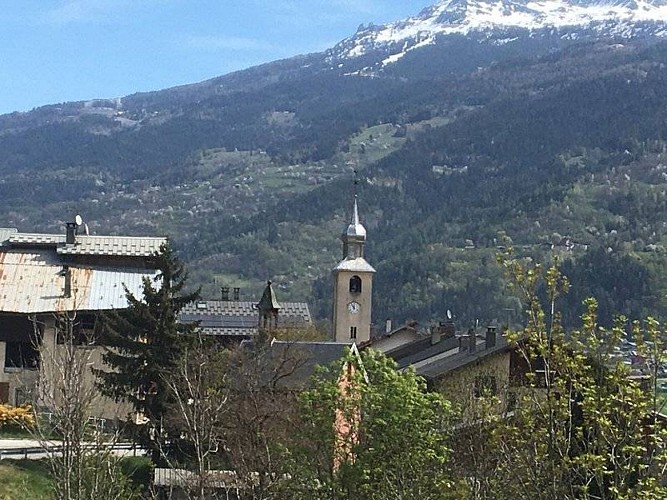
This village is located on either side of the Isère, with some of its houses on the Versant du Soleil and the rest on the left bank of the Isère, also known as the “Revers”. A priory was built near the Church of Saint Andrew in the 11th century. The parish was one of the richest and most populated in the region and its religious and Baroque heritage is still very much on view in the municipality. The Church of Saint Andrew on Les Chemins du Baroque (www.savoie-mont-blanc.com/decouvrir/explorer/culture-et-patrimoine/les-chemins-du-baroque) bears witness to the many changes it has undergone over the centuries, although its exterior makes its Romanesque origins clear enough .The interior is characterised by a mixture of neoclassical architectural features, while the so-called “onion bulb” steeple shows Northern Piedmont influence. The steeple was knocked down in 1797 during the French Revolution and rebuilt in 1816 after Savoie became part of the Sardinian States. The cross in front of the church dates back to 1756. It is made of marble from Villette (near Aime), which is famous for its quality.Above the pediment, you can see a statue of a cockerel, the municipality of Bellentre’s emblem.Not far away, Notre Dame de la Compassion Chapel dates back to 1634, but little is known of its history. The stele nearby commemorates the sacrifices made by the village’s “poilus” (infantrymen) in the First World War.
Church of Saint Andrew open on Mondays from 2:30 p.m. to 4:30 p.m., from 1 July to 30 August. A QR Code provides a link to the Patrimoine de La Plagne Tarentaise website
Technical Information
Altimetric profile
Data author
