Alert
Alerts
Le murus gallicus


Description
A little history
The Romans occupied this place and gave it the name Viriliacum. After the decline of the Roman Empire, the town reverted to its Celtic name Vidua, meaning tree, wood or forest. This could refer to a wooded area on the outskirts of the town, which was used for the construction of the oppidum. It is therefore a very old fortified town.
The Gauls of the Iron Age settled on one of the islands that emerged, at the level of the present-day village, in an area that enabled them to move easily between the Loire and Lac de Grandlieu. Artefacts from the Neolithic period (flint scrapers and arrows, polished stone axes) and an iron sword found in the Tenu (Iron Age) testify to the continuity of occupation.
The Romans, who occupied the region, reinforced the fortification of the town by building a murus gallicus, a type of rampart typical of Gaul. Although partially destroyed over the centuries, notably during the Wars of Religion, remains of this rampart can still be seen today.
It is thought to have been built between 150-50 BC, at a time when the city of Nantes and Rezé did not yet hesitate.
Vue occupied a strategic position at the time: an island on the Loire River. It was located at a forty-metre high point, highly visible to navigators arriving by sea.
What's more, the mouth of the River Tenu, which gave direct access to the interior of the Pays de Retz, was right on the outskirts.
For researchers, this explains the location of such an inhabited site.
What we know about this rampart
A Gallic construction reinforced by the Romans: the foundations of the rampart are of Gallic origin, but the Romans reinforced it and adapted it to their construction techniques. The oppidum consisted of two protective zones:
- an inner enclosure of around 12 hectares, consisting of a wall 1,250 metres long,
- an outer wall covering 25 hectares and 2km in length.
A strategic role: the rampart served to protect the town and its inhabitants from invasion and attack.
Remains still visible: although partially destroyed, the rampart has left indelible traces on the Vue landscape. Archaeological excavations have shed light on its construction and role.
In 1876, Maître Jaguelin, notary and mayor of Vue, was landscaping the grounds of his property at the entrance to the village, in a place called La Poterne, when he discovered the foundations of a thick wall. Its characteristics were similar to those of a murus gallicus (Gallic rampart) protecting an oppidum (fortified settlement) estimated to date from the period 120-30 BC. "Mr Jaguelin built all the walls of his property with the material he removed from his excavations", explains Nantes archivist Léon Maître, and sold the rest of the stones.
After a promising archaeological survey (preventive excavations in 2012), it was in 2014, when work was being carried out on the development of the Fontaine-aux-Bains housing estate, that archaeologists discovered traces of the ancient Gallic fortified town during the definitive archaeological excavations.
The results of the dig, carried out between May and July 2014 by a team of eight archaeologists on behalf of INRAP (Institut national de recherches archéologiques préventives), revealed an exceptional site covering a total area of 25 hectares.
During the excavations, several footprints were found:
the load-bearing framework of the wooden houses of the Gallic settlement
and the grain storage area, which must have included no fewer than twenty-two granaries on stilts in a row.
Why is this rampart important?
Evidence of ancient occupation: it reminds us that Vue was an important place in ancient times.
A key part of the local heritage: the rampart is an essential part of the historical heritage of Vue and the Loire-Atlantique region. The remains of the Gallic stronghold are no longer visible. Today, a tarmac road covers the old ramparts.
Sources: Association Vue sur le Marais website; article "Une petite Carcassonne à Vue" by Jean-Luc Ricordeau in SHPR Bulletin no. 33 (2020).
Technical Information
Altimetric profile
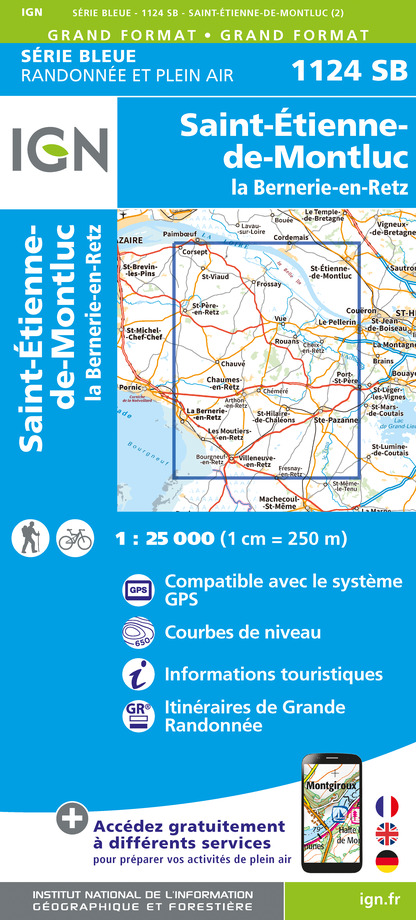
IGN cards





Data author
