Tours
Activities
Places of interest
Where to eat
Where to sleep

Explore Dieppe's local charms with HOTEL FIRST ECO

Are you the owner?
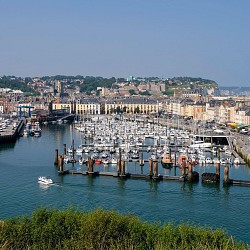
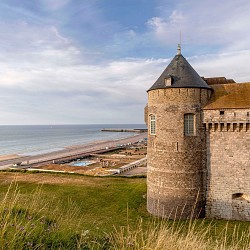
Nestled in the region of Haute-Normandie, Dieppe offers an idyllic setting for a holiday rich in discoveries. From HOTEL FIRST ECO, explore a wealth of activities and local attractions. Start your day with a visit to the Château de Dieppe, a museum housing an exceptional collection of carved ivories and offering a breathtaking sea view. Next, dive into the colorful hustle and bustle of the seafron...See more

Walking around HOTEL FIRST ECO

See more suggestions
Discover the walking paths of HOTEL FIRST ECO.
See more suggestions
What to do in HOTEL FIRST ECO

See more suggestions
Choose from a variety of activities in HOTEL FIRST ECO and book your favorites.
See more suggestions
Royaumont - abbey & fondation
126 km

Royaumont - abbey & fondation

In 1228, Saint Louis and his mother Blanche de Castille established the Abbey of Royaumont, today still the largest Cistercian abbey of Ile-de-France. Listed as a historical monument, the abbey has one of the most beautiful examples of Gothic refectory in France. The 7 hectares park, crossed by canals, is labelled "Remarkable garden" by the French Minister of Culture. It has conserved some of its medieval features and today has three gardens: an experimental vegetable garden, opened in 2014, a medieval inspiration garden, and the garden of the monastery transformed into a ravishing French garden in 1912. The abbey is open every day, from 10 am to 6 pm (5:30 pm between November and March). Royaumont Abbey also offers guided visits, heritage and garden activities for children and families every Sunday throughout the year, and holds a music and dance Festival every year in September and October. In 1228, Saint Louis and his mother Blanche de Castille established the Abbey of Royaumont, today still the largest Cistercian abbey of Ile-de-France. Listed as a historical monument, the abbey has one of the most beautiful examples of Gothic refectory in France. The 7 hectares park, crossed by canals, is labelled "Remarkable garden" by the French Minister of Culture. It has conserved some of its medieval features and today has three gardens: an experimental vegetable garden, opened in 2014, a medieval inspiration garden, and the garden of the monastery transformed into a ravishing French garden in 1912. The abbey is open every day, from 10 am to 6 pm (5:30 pm between November and March). Royaumont Abbey also offers guided visits, heritage and garden activities for children and families every Sunday throughout the year, and holds a music and dance Festival every year in September and October.

3 Jard de l’abbaye de Royaumont 95270 Asnières-sur-Oise
Book from 0 EURBook
Show
Eglise Saint-Acceul
136 km

Eglise Saint-Acceul

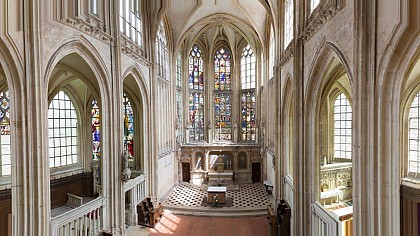
An architectural and artistic gem of the Renaissance, the Church of Saint-Acceul is listed as a historic monument. This church is the only one in France to bear this name, and it is the only church in the Val-d’Oise to still have its original stained-glass windows. Listed as a historic monument, this church is the only one in France to bear this name, which remains a mystery, even though it is often associated with Saint-Andéol, the evangelizer of Languedoc, who was martyred in the 3rd century. Saint-Acceul is depicted on the church’s façade holding a saw (Saint-Andéol’s skull was sawed off by the Romans). An architectural and artistic gem of the Renaissance, the Church of Saint-Acceul in Ecouen is a major tourist attraction for the town. Construction of the Saint-Acceul Church began in 1536 under the direction of Constable Anne de Montmorency (builder of the Château d’Ecouen), who wished to make this imposing monument a symbol of the Montmorency family’s status and power. The choir was completed in 1545. The building underwent numerous modifications thereafter: the nave was constructed in the early 18th century and the façade in the mid-19th century. The combination of these various periods, each with its own artistic and architectural style, gives the church its unique character; it is also known for its stained-glass windows. Inside, visitors can see the altar and its imposing painting—a copy of Raphael’s “Transfiguration”—as well as an organ. The bell tower contains three bells, the largest of which—weighing over 1,400 kg—bears the coat of arms of Anne de Montmorency. The other two bells weigh 850 kg and 600 kg, respectively. The architect, Jean Bullant, is said to have been buried in the church. The main feature of the church in Ecouen lies in its stained-glass windows, which have survived intact since the Renaissance. Indeed, in many churches from that era, the stained-glass windows were shattered during wars, broken by accident, or even stolen. The stained-glass windows in those churches are therefore later reproductions, sometimes with dull colors. In contrast, the rich stained-glass windows of Ecouen, dating from the 16th century (the period when the castle was built), hold many surprises for visitors... The ten stained-glass windows, funded by the Montmorency family, are believed to have been created between 1544 and 1587. They depict not only the powerful family but also the Passion of Christ, incorporating more contemporary themes (as the period marked the outbreak of the Wars of Religion).

2 Rue Jean Bullant 95440 Écouen
Book from 0 EURBook
Show
La Maison Fournaise Renoir the immersive experience
137 km

La Maison Fournaise Renoir the immersive experience

The Fournaise museum proposes a meeting with the artist during a show, punctuated by digital animations and videos, in the middle of the atmosphere recreated by the sets of theaters. of the museum. One hundred years after his death, Renoir is back in Chatou hologram! Familiarly, he tells us about his vision of painting, the harsh criticisms of his contemporaries, his workshop secrets, his loves, his relatives ... and the fertile inspiration drawn from the banks of the Seine. At the time of the first scandals, Durand-Ruel and some amateurs give him a decisive support by buying him paintings. Alphonse Fournaise is one of the first! He ordered his portrait and that of his daughter for 200 francs. For more than ten years, Renoir made frequent stays at home and around Chatou where he painted about thirty paintings. Aged nearly forty, he began the ambitious Breakfast of the Boaters. This painting, painted on the balcony of the Maison Fournaise, is the result of long research. The painter feels then that he has arrived "at the end of impressionism". This great admirer of the masters of the Italian Renaissance dreams of making this work a bridge between Veronese, Raphael and the modern life of his century. Retained at the Fournaise by his painting in 1880, he wrote to Monsieur de Bellio: "You will not regret your trip. It is the most beautiful place around Paris. " To complete your experience in the footsteps of Renoir, go back in time on the Fournaise hamlet thanks to the virtual reality helmets, wander among the characters of the Breakfast of the boaters with the tactile tablets or create your own work according to the master in painting Virtual. In this unprecedented show, technology offers an innovative, fun and surprising approach to an immersive journey in the heart of the painter's Impressionist years in Chatou. - Departures of visits every 30 minutes. Come 15 to 20 minutes in advance. - Duration of the show: about 60 minutes

3 rue du bac Île des Impressionnistes 78400 Chatou
Book from 9 EURBook
Show

What to visit in HOTEL FIRST ECO

See more suggestions
Relax in the parks of HOTEL FIRST ECO.
See more suggestions
Le Prieuré de Rouxmesnil-Bouteilles
1.3 km

Le Prieuré de Rouxmesnil-Bouteilles

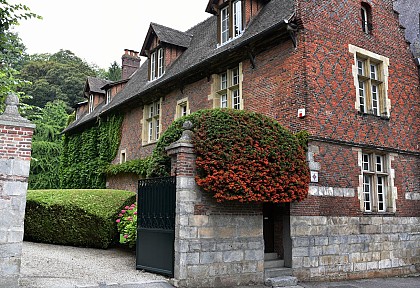
Curious to get off the beaten track of historical heritage, I went to meet monuments that we meet every day along our departmental or national roads. Located near Dieppe on the Alabaster coast, the priory of Rouxmesnil-Bouteilles is a remarkable monument by its architecture. The Department of Seine-Maritime, wishing to highlight its rural heritage has awarded its "Label Patrimoine Rural" to the priory of Rouxmesnil-Bouteilles for its architectural and historical qualities. This former priory has now become the town hall of Rouxmesnil-Bouteilles, a commune born from the merger of two villages in 1822. On the main road, crossing the village, I see the priory on my left. When I get close to the entrance gate I approach the wooden sign indicating the labeling of the place with a history. I am very pleased to have information on this priory that I see before me, nestled in a green setting. The contrast of the dwelling covered with red tiles and light shades for the sandstone/flint assembly, is of the most beautiful effect. The external facings are remarkable! The design of the facade is regular and completes a harmonious volumetry of the whole building. I can't wait to get closer to this magnificent building to appreciate all the details. I enter the courtyard through the large gate with its wrought iron doors and walk along an arched path. I am in front of a building that is classified as religious, perhaps because of its name priory, but on closer inspection it is a building that is more reminiscent of a manor. So I can confirm that this place is more than interesting for its past Construction began in the Renaissance when the Hacquenouville family built a main residence, and an illustrious member, Roger d'Hacquenouville, was chamberlain to the King of France Charles VI at the beginning of the 15th century. A religious community settled there in 1692, and immediately afterwards the priory passed into the hands of the Jesuits who remained there until 1762. During the French Revolution the priory was sold as national property. The story does not end there, in the 19th century the grandfather of the composer Claude Delvincourt bought the property. The illustrious musician remained there until 1954, when he died. In 1980, the priory will house the town hall After this historical interlude, I return to my wandering around this magnificent building, modified over time by its successive hosts. I note that the various restorations have preserved its massive silhouette, its marquetry of flint and sandstone, characteristic of the rural heritage of the Dieppe region. Stepping back a little, I discover the plan of the dwelling which is rectangular as was the fashion during the Renaissance. It is set on a vaulted cellar, whose entrance is to the right of the steps of the door in a semi-circular arch, with a decorated sandstone frieze. The architecture of this priory is definitely a pleasure for the eyes. Looking up, I also admire the mullioned windows and the oculi harmoniously pierced on the facade, but also the Anglo-Norman style dormer windows. My curiosity pushes me to go and see what is hidden at the back of the building and there I discover a square tower which reminds me of the typical campaniles of Italy. Still to the north-west, a large octagonal tower was added in 2001 and serves as a reception area for the Town Hall. I note that even on this recent part, all the walls repeat the same sandstone/flint patterns of the dwelling, thus creating a beautiful homogeneity of the built complex. Finally, just next to the access to the town hall, are the old stables. My visit is coming to an end. Let's go, I allow myself a little more time in the park with its elegant trees and head for the exit, leaving behind me a splendid rural heritage, steeped in history and music.

Mairie - Rue du Champ de Courses 76370 ROUXMESNIL-BOUTEILLES
Show

Where to eat in HOTEL FIRST ECO

See more suggestions
Savor culinary specialties in HOTEL FIRST ECO.
See more suggestions
Where to sleep in HOTEL FIRST ECO

See more suggestions
Book your stay at one of HOTEL FIRST ECO's accommodations.
See more suggestions
Dominique 76
2.3 km

Dominique 76

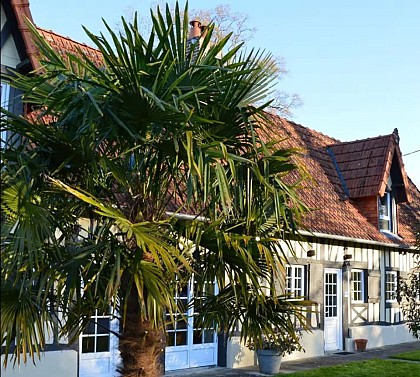
Martin-Eglise, 3 km away from Dieppe, new and pleasant three-star holiday cottage, detached and all at ground level in a private property in a quiet setting. Two rooms (40 sq m) for two to four people (maximum), living room with open equipped kitchen, bedroom with bathroom (shower, toilet and wash basin). In the living room: TV, convertible sofa bed and dining area. You will be able to make the most of the garden and the terrace, with barbecue (private outdoor surface area 120 sq m) while being close to the town, the port and the beach of Dieppe and Puys. Bed linen and towels provided. Small dogs accepted with owners' prior agreement (extra charge: 5€ short trip, 10€ for a week). In Dieppe: beach, traditional market, heated seawater pool with slides, amusement park, Spa and thalassotherapy centre, golf course, miniature golf course, casino, tennis court, go-kart track, WWII sites of remembrance, sea fishing, ESTRAN Cité de la Mer Museum (exhibitions and aquariums dedicated to the Norman coastline), Castle, etc. There’s no risk of getting bored in Dieppe! The local cuisine will delight your taste buds with raw milk Neufchâtel cheese, fresh fish all year round (depending on the season and availability) such as sole "à la dieppoise" (Dover sole served with a white wine sauce and shrimp, mushrooms and mussels), scallops from October to May, the Dieppe caramel and apple spread, etc. Housecleaning service and linen (bedsheets and towels) included.

400 Chemin des Meuniers 76370 MARTIN-EGLISE
Show
Caution!
We have no information on the difficulty of this circuit. You may encounter some surprises along the way. Before you go, please feel free to inquire more and take all necessary precautions. Have a good trip! 🌳🥾