Tours
Activities
Places of interest
Where to eat
Where to sleep

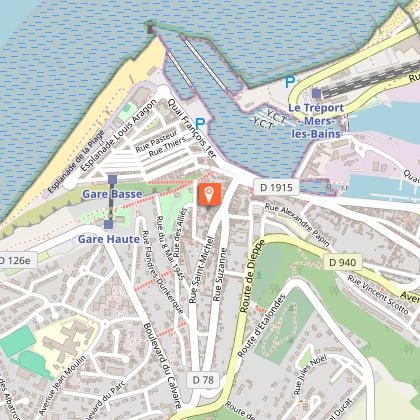
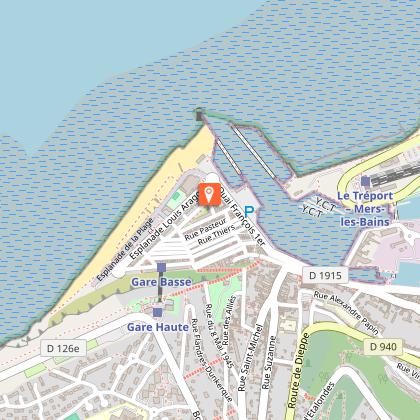
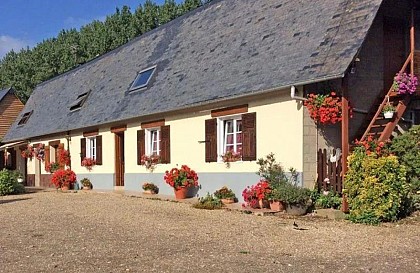
Explore CAMPING LE CLOS SAVOYE in Biville-sur-mer

Are you the owner?
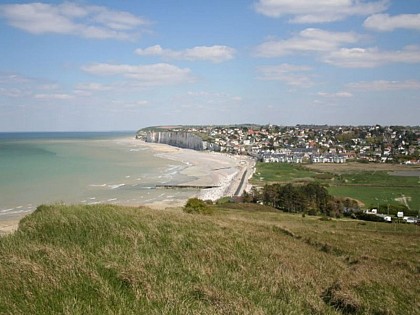
Welcome to CAMPING LE CLOS SAVOYE, your perfect starting point to explore Biville-sur-mer and the treasures of the Seine-Maritime in Haute-Normandie. Nestled on the coast, this region offers a unique experience blending nature, history, and culture. Discover the majestic cliffs of Les Andelys, ideal for hiking enthusiasts and breathtaking scenery. Don't miss Dieppe, renowned for its castle and bus...See more

What to do in CAMPING LE CLOS SAVOYE

See more suggestions
Choose from a variety of activities in CAMPING LE CLOS SAVOYE and book your favorites.
See more suggestions
Royaumont - abbey & fondation
123 km

Royaumont - abbey & fondation

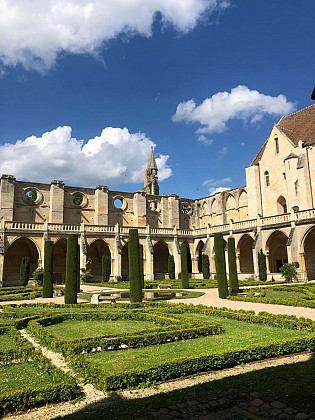
In 1228, Saint Louis and his mother Blanche de Castille established the Abbey of Royaumont, today still the largest Cistercian abbey of Ile-de-France. Listed as a historical monument, the abbey has one of the most beautiful examples of Gothic refectory in France. The 7 hectares park, crossed by canals, is labelled "Remarkable garden" by the French Minister of Culture. It has conserved some of its medieval features and today has three gardens: an experimental vegetable garden, opened in 2014, a medieval inspiration garden, and the garden of the monastery transformed into a ravishing French garden in 1912. The abbey is open every day, from 10 am to 6 pm (5:30 pm between November and March). Royaumont Abbey also offers guided visits, heritage and garden activities for children and families every Sunday throughout the year, and holds a music and dance Festival every year in September and October. In 1228, Saint Louis and his mother Blanche de Castille established the Abbey of Royaumont, today still the largest Cistercian abbey of Ile-de-France. Listed as a historical monument, the abbey has one of the most beautiful examples of Gothic refectory in France. The 7 hectares park, crossed by canals, is labelled "Remarkable garden" by the French Minister of Culture. It has conserved some of its medieval features and today has three gardens: an experimental vegetable garden, opened in 2014, a medieval inspiration garden, and the garden of the monastery transformed into a ravishing French garden in 1912. The abbey is open every day, from 10 am to 6 pm (5:30 pm between November and March). Royaumont Abbey also offers guided visits, heritage and garden activities for children and families every Sunday throughout the year, and holds a music and dance Festival every year in September and October.

3 Jard de l’abbaye de Royaumont 95270 Asnières-sur-Oise
Book from 0 €Book
Show
La Maison Fournaise Renoir the immersive experience
138 km

La Maison Fournaise Renoir the immersive experience

The Fournaise museum proposes a meeting with the artist during a show, punctuated by digital animations and videos, in the middle of the atmosphere recreated by the sets of theaters. of the museum. One hundred years after his death, Renoir is back in Chatou hologram! Familiarly, he tells us about his vision of painting, the harsh criticisms of his contemporaries, his workshop secrets, his loves, his relatives ... and the fertile inspiration drawn from the banks of the Seine. At the time of the first scandals, Durand-Ruel and some amateurs give him a decisive support by buying him paintings. Alphonse Fournaise is one of the first! He ordered his portrait and that of his daughter for 200 francs. For more than ten years, Renoir made frequent stays at home and around Chatou where he painted about thirty paintings. Aged nearly forty, he began the ambitious Breakfast of the Boaters. This painting, painted on the balcony of the Maison Fournaise, is the result of long research. The painter feels then that he has arrived "at the end of impressionism". This great admirer of the masters of the Italian Renaissance dreams of making this work a bridge between Veronese, Raphael and the modern life of his century. Retained at the Fournaise by his painting in 1880, he wrote to Monsieur de Bellio: "You will not regret your trip. It is the most beautiful place around Paris. " To complete your experience in the footsteps of Renoir, go back in time on the Fournaise hamlet thanks to the virtual reality helmets, wander among the characters of the Breakfast of the boaters with the tactile tablets or create your own work according to the master in painting Virtual. In this unprecedented show, technology offers an innovative, fun and surprising approach to an immersive journey in the heart of the painter's Impressionist years in Chatou. - Departures of visits every 30 minutes. Come 15 to 20 minutes in advance. - Duration of the show: about 60 minutes

3 rue du bac Île des Impressionnistes 78400 Chatou
Book from 0 €Book
Show

What to visit in CAMPING LE CLOS SAVOYE

See more suggestions
Savor the local cuisine of CAMPING LE CLOS SAVOYE.
See more suggestions
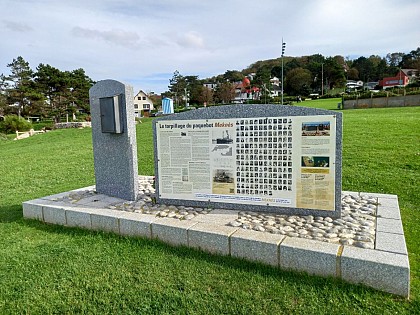
Stèle des Oubliés du Meknès
4.5 km

Stèle des Oubliés du Meknès

The "Les Oubliés du Meknès" association has been working since 2009 in memory of the sailors who survived and disappeared on the Meknès liner torpedoed in 1940. On Wednesday July 24, 1940, 1179 officers and sailors (including 2 officer?s wives and a child) and 103 crewmen boarded the Meknès for France, expecting to be reunited with their loved ones and demobilized. It was 11 p.m. off Portland, and the Meknès was sailing under clear lights, the tricolored flags painted on each side of her hull illuminated by large lamps, testifying to her neutrality. She was machine-gunned by a German patrol boat and torpedoed. She sank in eight minutes. It was a tragic night for all concerned. At dawn the next day, the survivors were picked up by British destroyers. 420 sailors were unaccounted for. This was the beginning of the "Forgotten of the Meknes". The four destroyers docked in Weymouth harbor at noon on July 25, carrying 899 survivors, 4 dead and 57 wounded, who were taken to St. Martin?s Hospital in Bath. To their misfortune, from August 23rd to the end of October 1940, the sea washed up on the beaches of Normandy and Picardy 243 bodies, 116 of which were terribly mutilated and never identified. 177 bodies were never recovered. A stele on the cliffs of St-Martin-en-Campagne/Berneval-le-Grand in the commune of Petit-Caux (76) serves as a reminder. Every July 24, a commemorative ceremony is held at the stele to honor the memory of the missing sailors and survivors of the Meknès, as well as the 3 British airmen, so that they are not forgotten. The association continues to work to raise awareness of the history of the Meknès and its sailors, both those who survived and those who disappeared.

Place Duparchy 76370 PETIT-CAUX
Show
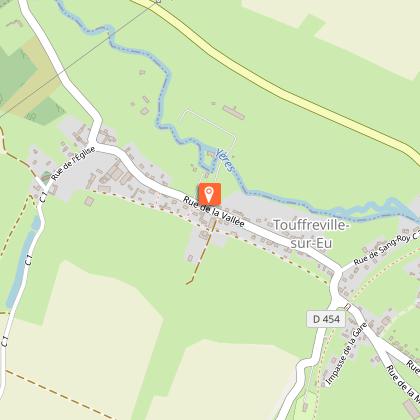
Viaduc de Touffreville-Sur-Eu
5.7 km

Viaduc de Touffreville-Sur-Eu

The Seine-Maritime region boasts a rich industrial heritage dating back to the 19th century. Such is the case of the Touffreville-sur-Eu railway viaduct, which has just been designated a Seine-Maritime rural heritage site. After the black fumes of coal-fired locomotive chimneys, it's time to turn to nature. The Chemin Vert du Petit Caux, a hiking trail, now includes the Viaduct, allowing visitors to discover a magnificent landscape on foot, on horseback or by bike. It all began in 1872 with the opening of the 40 km Dieppe-Eu railroad line, where the Touffreville-Sur-Eu Viaduct was built to cross the Yères valley. Inaugurated in 1885, the brick viaduct features 9 arches, and the line is operated by Compagnie de l'Ouest, notably to transport pebbles for industrial export. A link of the coastal railroad from Le Tréport to Le Havre was then operated to serve the beaches, whose seaside activity was booming with casinos, villas and sumptuous hotels with architecture typical of the Normandy coast. Before 1914, it took 1h45 to travel from Dieppe to Le Tréport, with five omnibuses making the journey each day. From 1938, the line was closed to passengers and devoted to freight transport. The Second World War led to the disappearance of most of the buildings on the coast, and the seaside activity came to a halt. Freight traffic resumed until 1972, when it came to a halt with the oil crisis. The SNCF then bought up the 17 km of track between Saint-Quentin-au-Bosc and Eu, and in 1986 turned it into a hiking trail - the birth of the Chemin Vert du Petit Caux! To better appreciate the richness of the Petit Caux agricultural plateau, put on your hiking gear and set off to discover the history of this railroad past and savor the joy of being in the middle of nature. Along the way, you'll come across numerous animals, discover the flora and take picnic breaks. It takes four hours to complete this long hike, but you can do it in sections and admire the gatekeeper's house, the level crossings and the Touffreville-sur-Eu goods hall. For your convenience, there are numerous information panels along the way.

76630 PETIT-CAUX
Show

Where to eat in CAMPING LE CLOS SAVOYE

See more suggestions
Explore the culinary traditions of CAMPING LE CLOS SAVOYE.
See more suggestions
Where to sleep in CAMPING LE CLOS SAVOYE

See more suggestions
Enjoy your stay with accommodations in CAMPING LE CLOS SAVOYE.
See more suggestions
Caution!
We have no information on the difficulty of this circuit. You may encounter some surprises along the way. Before you go, please feel free to inquire more and take all necessary precautions. Have a good trip! 🌳🥾