Alert
Alerts
PTM 1 - LUCHON : FLÂNER, VISITER, DÉCOUVRIR… LE PATRIMOINE

Description
Fancy a walk that combines history, culture and nature? Follow us through the streets of Luchon, the "Queen of the Pyrenees", for around fifty surprising discoveries. You will be captivated by the elegance of the built heritage: villas steeped in history, Belle Époque palaces that have hosted illustrious personalities, and buildings emblematic of tourist life (Thermal Baths, Casino, etc.). You will come across magnificent statues, guardians of memory. And nature will not be outdone: let yourself be charmed by the majesty of century-old trees, the tranquillity of parks and gardens, and the beauty of lakes and fountains that punctuate this unforgettable walk.
Technical Information
Altimetric profile
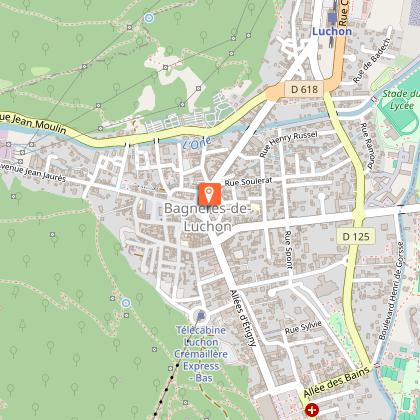
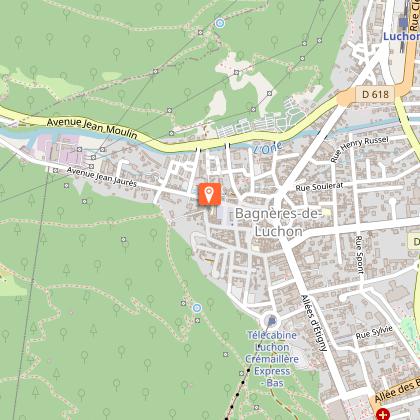
Starting point
Points of interest
Additional information
Detailed stages
1 - Château Lassus Nestier - Built in 1772 in the Louis XIV style, this is the oldest building on the Allées d'Etigny. It currently houses the Tourist Office.
2 - The Charles Tron House - Set back from Square Lauret, it was built by Edmond Chambert in 1854.
3 - The "Crémaillère Express" cable car - It connects Luchon (627m) to Superbagnères (1800m) in less than 10 minutes.
The first cable car operated from 1993 to 2023.
The current cable car was inaugurated during the winter of 2023-2024.
4 - Representative buildings - Nos. 41 to 45, Nos. 47 and 53 are representative of the 19th-century neoclassical style.
5 - The Spont Chalets - Built in 1854, upon the return of Mr Spont and Miss Soulérat from their honeymoon in Switzerland. They reflect the style of their honeymoon destination.
6 - The Thermal Park - Developed in 150, it is home to all of Luchon's thermal activities.
7 - The Chambert Thermal Baths - Built in 1848 on the ruins of the Roman Baths.
8 - The Imperial Pavilion - Created in 1954 by Artigala, today the first floor houses the SPA (800 m²), which combines beauty treatments, relaxing rituals and a thermal area with a natural sauna, hammam, jacuzzis, sensory showers and a heated bench.
Everything you need for an unforgettable moment of relaxation.
9 - The Thermal Baths - Two therapeutic treatments are available: respiratory and rheumatology.
Built in 1969, it offers treatments for spa guests as well as the "Ressources & Vous" thermal leisure area with pools, including one outdoors, a jacuzzi, saunas, a trépidarium, a snow room, a gym and weight training room... and, above all, the Grotte Vaporarium, a natural hammam that is unique in Europe.
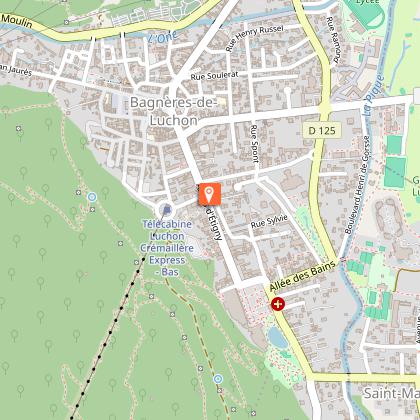
10 - The statue of Baron d'Etigny
11 - The statue of Abel and Cain
12 - The funicular railway station - Built in 1894, the funicular railway provided access to the Chaumière restaurant. It operated until 1964.
13 - The Petit Lait refreshment bar - Built in 1874. Ladies would come here to drink milk to soothe stomach upsets caused by excessive consumption of thermal waters.
14 - The bust of Marcel Spont - Two laces above the refreshment bar, the bust from 1906, created by Jean-Marie Mengue, who was a prominent Pyrenean figure depicted with the attributes of a mountain dweller.
15 - The Caraouet Fountain - Mentioned in Edmond Rostand's poetry collection Le Musardises.
The author spent many summers of his youth in Luchon.
It is marked by a plaque bearing a few verses: "It sings like a spinning wheel, the fountain of Carouet."
16 - The Column - Built in 1855 to honour the cross-border road between France and Spain.
16: The Statue of the Valley of the Lily - In the small basin in front of the Jen-Marie Mengue lake (1900).
17 - The Statue of the Valley of the Lily - In the small basin in front of the Jen-Marie Mengue lake (1900).
18 - The Bronze Bear - A statue that has been used by children for sliding down for generations. (Guyot 1950).
19 - The Bandstand - Characteristic of the late 19th century style.
20 - The Spa House - Dating from 1855, it was built on the site of the former emollient baths, which were used for beauty treatments for ladies. The building is topped by a glass roof characteristic of the Belle Epoque.
Inside, you can visit exhibitions, including a presentation of the thermal water circuit, conferences, and more.
21 - Villa Pyrène
22 - The Statue of Edmond Rostand - At the end of Allée des Bains (Mayliard - 1971)
23 - Villa Edouard - Built in a romantic style with two turrets, it was constructed by Edmond Chambert in 1864.
Sacha Gitry and Yvonne Printemps stayed there.
24 - The Russian and Persian Chalets - Symbols of European aristocratic holidays during the Belle Epoque (1860).
25 - Villa Raphaël - At No. 12, Clémenceau stayed here in the 1900s, then it was occupied by Mata Hari. It was also used as Gestapo headquarters during the Second World War. Built in 1900.
26 - The Majestic - Going up Boulevard Edmond Rostand, the hotel was built in 1800. Previously, it was a military hospital for many years.
27 - The statue of François I and his sister Marguerite
28 - Villa Julia - at 10 Boulevard Edmond Rostand. Covered in ivy, built in 1880. Edmond Rostand stayed here. The balcony inspired Cyrano de Bergerac.
29 - The Casino Park - At the entrance, two small symmetrical pavilions connected by an ornate gate are the last vestiges of the fence that once surrounded the park.
30 - 31: The Statue of the Kiss at the Spring - At the edge of the lake, near the grotto, is a work by Couteillas (1862) that was originally placed in the Elysée Gardens.
31 - The Pyrénées Palace - Built in 1913 on the same model as the Négresco in Nice, they also share the same architect, Edouard-Jean Niermans.
32 - The Norman Pavilion - Built for the Universal Exhibition in Paris (1900), it was then transported and rebuilt in Luchon.
33 - The Casino - Built in 1880 by architect Raymond Castex. It was transformed in 1923 in an Art Deco style by Henry Martin.
34 - The Statue of Fate
35 - The Statue of Isis Unveiling Herself - by André Allar (1901).
36 - The Villa Luisa - On Boulevard Charles Tron, built in 1870. It was home to Prince Albert I of Monaco.
37 - The Villa de Flaubert - At the corner of Avenue Balaran and Rue Spont. The author stayed here in 1840 and 1872.
38 - The Post Office and Golf Club - On the corner of Avenue Boulara and Allées d'Etigny, this was a former post office in the mid-19th century.
39 - The Town Hall - Building bequeathed by Madame Colomic to the town of Luchon
40 - Castel d'Alti - at no. 21, dating from 1789
41 - The Pountet Fountain - Its name, "Pountet", means "little bridge" in Occitan. The fountain is located where a small stream once flowed down from the mountains, and a small bridge allowed people to cross it. The fountain was built in the 19th century.
42 - Statue of Jean-Marie Mengue - Located on the square of the same name, this statue was created by Gaston Petit (1954). Behind it is the house of Jean-Marie Mengue.
43 - Church of Our Lady of the Assumption - Opposite Place Joffre, the church was built by Loupot between 1847 and 1857 on the site of the former Mozzarade collegiate church, of which only the north porch remains.
44 - War Memorial - Bronze and marble by Jean-Marie Mengue (1921).
It also symbolises the equal distance between the Mediterranean Sea and the Atlantic Ocean.
45 - Place Gabriel Rouy: Town Hall - The old Town Hall was built in the Middle Ages and rebuilt in 1935 after being destroyed by fire.
46 - Place Gabriel Rouy: Les Halles - Built in 1896, inspired by Baltard and the Musée d'Orsay, they were renovated in 2000 and are open every morning. On Wednesdays and Saturdays, there is an open-air market where you can find local producers.
47 - The Statue of the Lioness
48 - The Chapel of Saint Stephen in Barcugnas
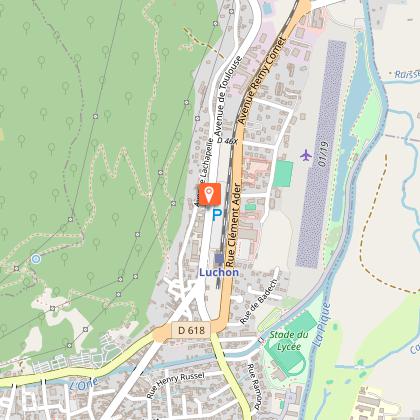
49 - Luchon railway station
Elevation gain
10
Services at the starting point
Bus stop nearby
Car parking
Public toilets
Start and end town
BAGNERES-DE-LUCHON
Data producer
Contact : HAUTE-GARONNE TOURISME / OFFICE DE TOURISME PYRENEES 31
This information comes from the Haute-Garonne Departmental Tourism Network and is synchronized as part of the partnership between Cirkwi and Haute-Garonne Tourisme.
Data author
