Alert
Alerts
26. Three Steeples Trail – Starting point: Village Square of Flancourt-Catelon or Community Hall Car Park in Illeville-sur-Montfort
Description
This route brings together three villages, three church steeples and a remarkably diverse architectural heritage.
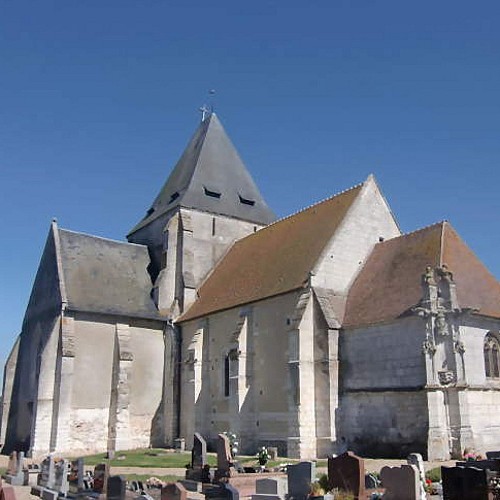
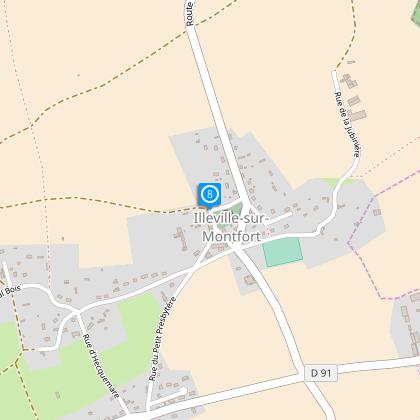
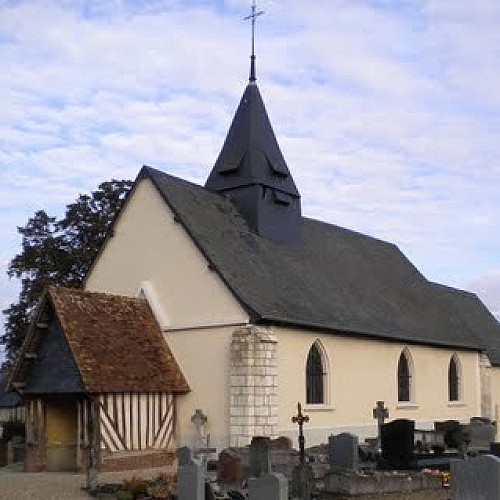
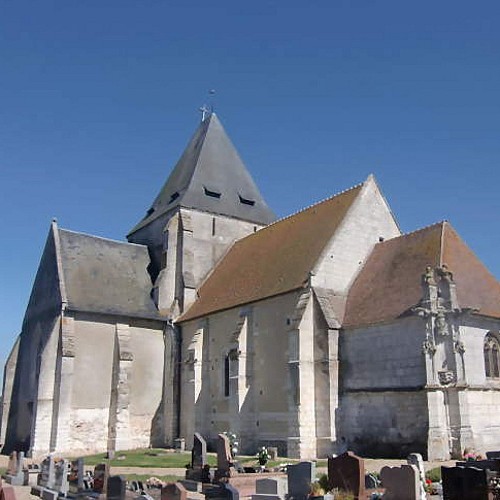
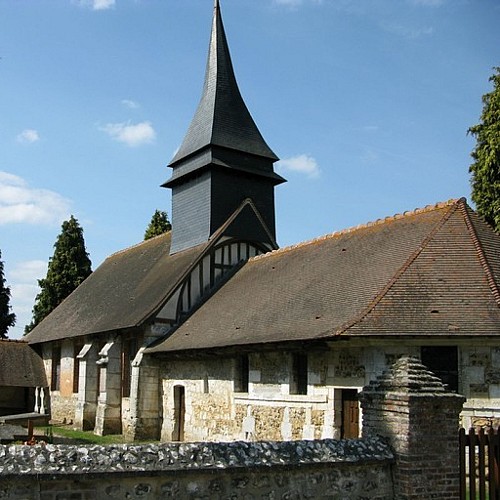
In Illeville-sur-Montfort, the Saint-Médard Church, dating largely from the 16th century, features an elegant stone porch blending Gothic and Renaissance styles, crowned with finely sculpted gargoyles. Nearby stands a discreet yet remarkable 18th-century octagonal half-timbered dovecote, a gem of rural architecture located on private property.
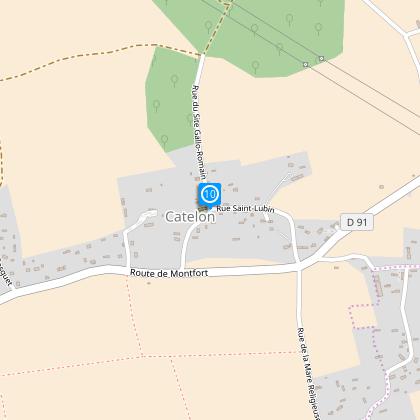
In Catelon, the Saint-Lubin Church combines Romanesque elements from the 11th century with later 18th-century alterations. Its Romanesque portal opens onto a churchyard shaded by cypress trees and a magnificent yew. The Manor of Candos and the Manor of Landry further enrich the local heritage. The former showcases traditional 18th-century half-timbering, while the latter combines brick, stone and timber framing and includes a round medieval stone tower dating from the 11th to the 16th century.
In Flancourt-Catelon, the Saint-Ouen Church surprises visitors with a dormer window near the bell tower, an unusual feature for a religious building. Its old cemetery is enclosed by a traditional earthen wall. At the entrance to the village, a statue of the Virgin and Child quietly commemorates the Liberation.
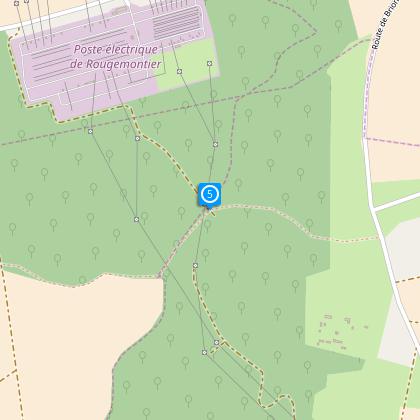
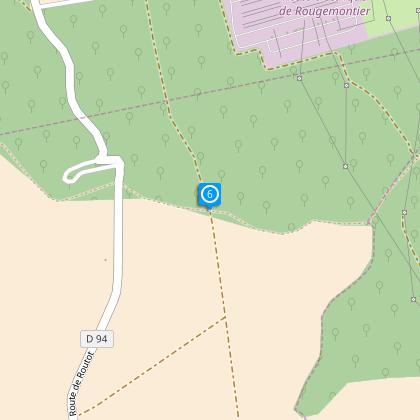
The Montfort State Forest provides a short but beautiful section of tall mature woodland, offering a striking contrast to the open countryside and bocage landscapes that dominate most of this route.
A walk through churches, manor houses and living memories, where every village tells a different chapter of Norman history.
Technical Information
Altimetric profile
Starting point
Steps
Points of interest
Data author
