Alert

Alerts

To see around
See more
Open
Close
Show
Show
Show
Show
Show
Show
Show
Show
Show
Show
Show

Oups... It would appear that Cirkwi does not have permission to use your location.

Presentation
Description
Map
Points of interest
Ratings and reviews
See around

PR 25 : Le Pont de Vernéjoux

PR 25 : Le Pont de Vernéjoux

Description

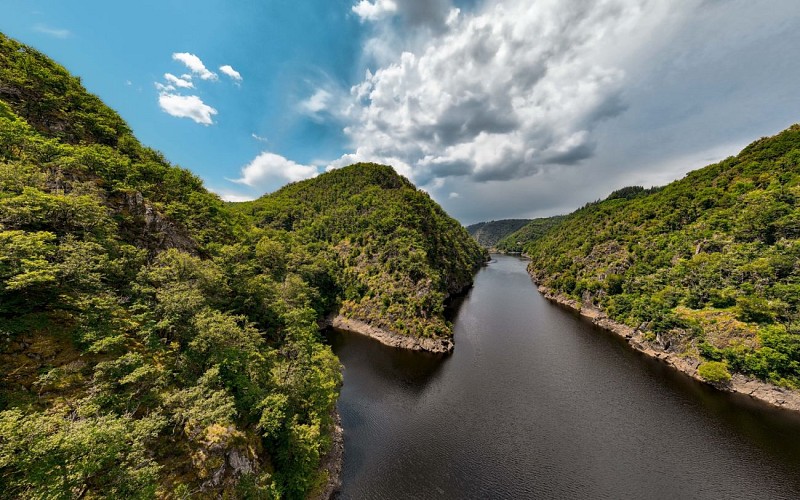
From the Champagnaguès plateau, this hike takes you to the gorges of the Dordogne, a legendary river, once tempestuous, whose steep banks still shelter a rich and wild nature.

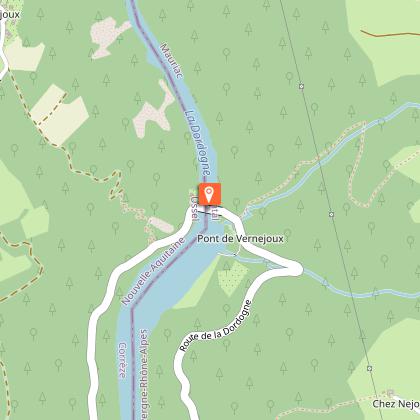
Since at least the 14th century, Vernéjoux has been a gateway to the Limousin region. At that time, a ferry regularly crossed the Dordogne. Around 1840, the ferry was replaced by the Vernéjoux suspension bridge. The latter was rebuilt in the 20th century.

Departure point: Champagnac church square.
From the church square in Champagnac, take the D12 towards Saint-Pierre.
As you leave the village, fork left onto a wide track and drive 500 m to reach the corner of a meadow. Turn right onto a forest track.

Technical Information

Walking
Difficulty
Easy
Duration
3h15mn
Dist.
11 km
Show more

Altimetric profile

Starting point

Place de l'église , 15350   Champagnac
Lat : 45.35704Lng : 2.397859

Points of interest

image du object

The Dordogne gorges

Straddling the departments of Corrèze and Cantal, the gorges of the Haute-Dordogne are undoubtedly one of the most remarkable natural areas in the Auvergne and Nouvelle-Aquitaine regions.The gorges were carved out by the Dordogne River, which rises in the Sancy massif where two rivers, the Dore and the Dogne, meet.The Upper Dordogne gorges, and more generally the entire Dordogne basin, have been granted international recognition by UNESCO as a biosphere reserve. The gorges are home to rare and protected species of flora and fauna, including breeding populations of birds of prey, some of which are migratory: the booted eagle, the red kite and the short-toed eagle are undoubtedly the most representative. Hiking in the gorges : The Association La Dordogne de Villages en Barrages invites you to discover breathtaking trails on its long-distance hiking itinerary. With L'itinérêve, combining nature and industry, you can step back in time to discover the impressive dams that line the river. This itinerary is designed for good walkers, as it covers a total distance of over 460 km, with some steep ascents and descents. If you want to discover the trails over a shorter distance, opt for the Bort-les-Orgues loop (84 km 2500 m D+) or the Vernéjoux loop (83 km 2000 m D+), for example. Hiking in the gorges : A short hiking trail (10.6 km) allows you to appreciate part of the gorges from Champagnac: PR25 Le pont de Vernéjoux. Other activities in the gorges: Roche-le-Peyroux in Corrèze has a nautical base where you can enjoy the peace and quiet of the gorges. You can get to the gorge from the Mentier site (Saint-Pierre) and the Vernéjoux bridge (Champagnac), and there are also a number of viewpoints in Corrèze: the Saint Nazaire site and the Gratte Bruyère lookout. There's also a viewpoint over the Marèges dam: follow the "remarkable site" signs from the village. The gorges can also be seen from the "big rocks" viewpoint.

- Office de Tourisme de Sumène-Artense -
Consulter
image du object

Saint Martin's Church

Romanesque church. Year of construction: 12th century. Listed as a historical monument since 2019.The Church of Notre-Dame in Champagnac testifies to the influence of Romanesque art in the region. It was remodeled several times, notably in the 15th and 19th centuries, during the major restoration and expansion campaign led by the architect Louis Bonnay. Built of local stone, it retains a characteristic Romanesque chancel and a western bell tower dating from the 15th century. The 19th-century Neo-Romanesque extension added a four-bay nave and side aisles, harmoniously integrated into the original structure. The church features an apse and tower of Romanesque origin, as well as remarkable stained-glass windows restored in 2022. One can also admire the 80 corbels sculpted by the Mauriac artist Jean Ribes, who also created the holy water font, altar, and capitals in the typical Mauriac style during the 19th century. An earlier sculptor, Geraldus Clericus, also left his mark on the building: he is responsible for several Romanesque capitals, one of which depicts Saint Michael slaying the dragon. Inside, the nave is covered with a plaster vault, while the chancel retains Romanesque elements and restored paintings. The furnishings include a baptismal font, confessionals, and beautiful grisaille stained-glass windows created by the master glassmaker Gaudin, contributing to the building's peaceful atmosphere. Visit and access: Self-guided tours are possible; keys can be obtained from the Champagnac town hall (04 71 69 61 55).

Place de l'église 15350 Champagnac
- Office de Tourisme de Sumène-Artense -
Consulter

Additional information

Environments

Riverside
Overview on river
Mountain view
Forest location
Waterside
In the country

Updated by

Office de Tourisme de Sumène Artense - 13/11/2025
www.tourisme-sumene-artense.com
Report a problem

Contact

Phone : 04 71 78 76 33

Email : info@tourisme-sumene-artense.com

Website : https://www.tourisme-sumene-artense.com

Animals

Yes. Dogs on leash.

Ratings and reviews

To see around
See more
Open
Close
Show
Show
Show
Show
Show
Show
Show
Show
Show
Show
Show
Caution!
We have no information on the difficulty of this circuit. You may encounter some surprises along the way. Before you go, please feel free to inquire more and take all necessary precautions. Have a good trip! 🌳🥾