Alert

Alerts

To see around
See more
Open
Close
Show
Show
Show
Show
Show
Show
Show
Show
Show
Show
Show

Oups... It would appear that Cirkwi does not have permission to use your location.

Presentation
Description
Map
Steps
Points of interest
Ratings and reviews
See around

Tour of the Forts of Briançon from La Vachette

Tour of the Forts of Briançon from La Vachette_Val-des-Prés
Tour of the Forts of Briançon from La Vachette

Description

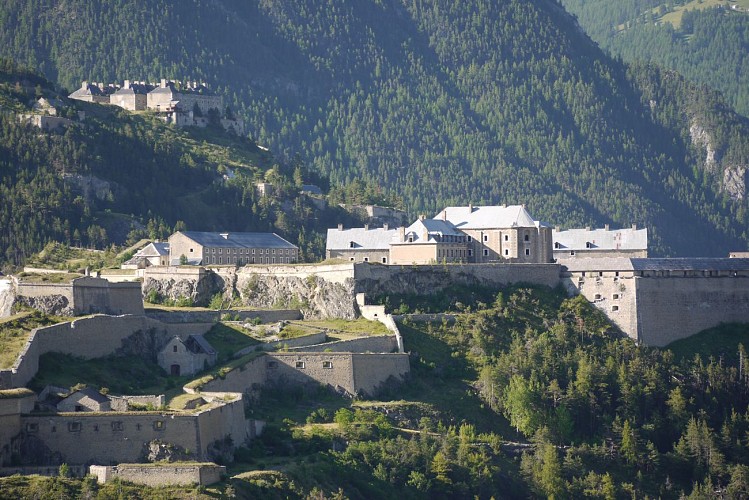
This loop will take you from the hamlet of La Vachette to discover Briançon's forts: Fort Dauphin, Fort des Trois Têtes, a UNESCO World Heritage site, and Fort des Salettes.

From the parking lot alongside the N94 opposite the hamlet of La Vachette, enter the forest directly from a small path at the start of the parking lot alongside the old buvette.
This path then runs alongside the ravin du Vallon stream for around 250 metres, leading to a wide forest track.

At this junction, take the wide forest track to the right: signposted by the GR5 towards Le Fontenil and yellow signs pointing to the Fort des Têtes, this wide track winds quietly through the heart of the Bois de l'Infernet for 3 kilometers, passing the unfinished command post of the Batterie de la Lame and taking you straight to the foothills of Briançon.

The trail leads first to Fort Dauphin and then on to the firing range and the imposing old Fort des Trois Têtes overlooking Briançon.

Once you've reached the Fort des Trois Têtes, take the track on your right, which skirts the fort (which remains on your left), opening up a vast view of Briançon: continue downhill towards the gorges to cross the Pont d'Asfeld and reach the Cité Vauban.

Stroll through the Cité Vauban up the central pedestrian street until you reach the Porte de Pignerol, then the Champ de Mars parking lot.

Once at the Champ de Mars parking lot, cross over to the asphalt road "Chemin des Salettes": this rises steeply and soon leads to a gravel track: take the right-hand track to the Fort des Salettes.

Just before the entrance to the fort, climb to the left along a steep, stony path for 150 m, then fork right onto a beautiful balcony path that leads to La Vachette.

Technical Information

Walking
Difficulty
Easy
Duration
5h
Dist.
10 km
Show more

Altimetric profile

Starting point

Parking N94 La Vachette , 05100   Val-des-Prés
Lat : 44.916326Lng : 6.676094

Points of interest

image du object

Fort Dauphin

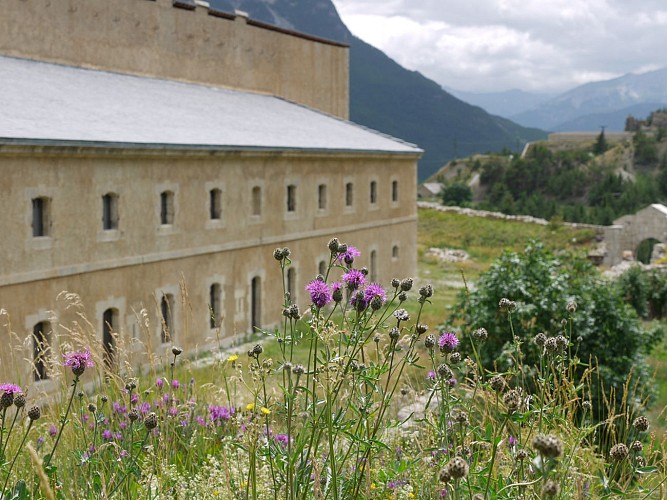
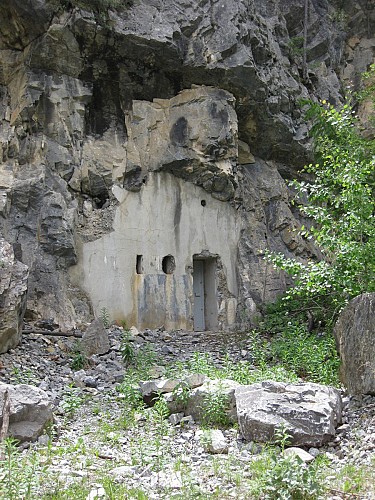
Designed as an advanced sentinel in the 18th century chain of fortifications, Fort Dauphin provided a crossfire with Fort des Salettes to prevent access to the town from the Chemin du Piémont and protected Fort des Têtes.As early as 1711, the military engineer Tardif planned a redoubt on a dangerous plateau called the Biffeul plateau (originally Bissecul), as the enemy could take up positions there, but a real fort was not built until between 1724 and 1734. Positioned as an advanced sentinel in the 18th century fortification chain, the fort was designed as a "shield" to protect the Trois Têtes fort. It ensures the crossing of fires with the Salettes redoubt in order to prohibit access to the town via the Montgenèvre road. This fort has hardly been modified, except for the addition of a cavernous powder magazine in 1874. Numerous projects aimed at giving it more scope followed one another, but only routine maintenance work and a few improvements were carried out. After the 1870 war, it became obsolete with the construction of new forts at higher altitudes. All the defensive equipment was turned towards the east and the Infernet mountain. It was necessary to carry out extensive earthworks to give it a regular shape, in accordance with the classical spirit and art of bastioned fortification. Rectangular in shape, it comprises three bastions and a truncated half-bastion due to the steepness of the terrain. It is designed in two parts separated by a large crossbeam, serving as a mask, on which the barracks rests. The latter houses a set of 16 cells designed to house 120 soldiers*. It consists of two floors plus a basement containing a 182 m3 water tank. One room is fitted out as a powder magazine. Each room, with a barrel vault, contains two firing windows opening onto the mask. These firing windows were only opened in the event of an attack so that the soldiers could conserve some heat. The original fireplaces have been replaced by stoves on the first floor, with the exception of the one in the officer's room. Fort Dauphin is one of the few works that can show 18th century architectural arrangements still intact. *according to Milet de Monville in 1747 - SHD Vincennes The fort belongs to the town of Briançon and is one of the works inscribed on the list of World Heritage Sites for the works of Vauban.

Porte de Pignerol Cité Vauban 05100 Briançon
- Apidae -
Consulter
image du object

Fort des Trois Têtes

Pivot du système défensif de Briançon, ce fort a remplacé à partir de 1721 le camp retranché sur le plateau des Trois Têtes, jugé si important par Vauban pour la défense de la ville. Sa superficie représente une fois et demie celle de la ville haute.Le fort doit son nom au plateau rocheux sur lequel il a été édifié. Destiné à empêcher les ennemis de prendre position au-dessus de la ville, un camp retranché est établi sur cette hauteur dès 1709 d'après le projet de 1700 de Vauban. Les travaux définitifs commencent après la fin de la guerre de Succession d’Espagne et le traité d’Utrecht de 1713 qui a modifié la frontière avec le duché de Savoie. Ils durent jusqu’en 1734. Ce fort est l’ouvrage le plus important de la barrière fortifiée du 18e siècle et oppose 600 m de front à l’ennemi sur une profondeur de 350 m. Après avoir aplani le plateau rocheux, les ingénieurs disposent de la place nécessaire pour édifier les bâtiments indispensables à la vie de la garnison. Un front bastionné, puissamment armé, protège le fort des assauts venus des pentes de la montagne de l’Infernet. Un bas-fort plonge vers la gorge de la Durance et permet de battre le fond de la vallée. Le fort comporte trois accès : 1 - La porte de la Durance permet d’entrer dans le fort en venant de Briançon par le pont d’Asfeld. 2 - La porte du front de secours au sud, facile d’accès en hiver et abritée des tirs ennemis, permet de ravitailler le fort en vivres et en eau et d’évacuer les blessés en cas de conflit. 3 - La porte royale est située dans la partie la plus défendue du fort. Elle est protégée par un important dispositif : un front bastionné composé de deux bastions et une demi-lune (doublés d'une lunette et de contregardes), des fossés et un chemin couvert. Le passage s’ouvre au centre de la courtine. Un décor de style classique comportant deux pilastres et un fronton triangulaire orne l'entrée. La place d'armes est protégée des tirs ennemis par une demi-caserne s'appuyant sur un épais mur faisant office de blindage. À l’intérieur du fort s'élèvent des casernes de type Vauban pouvant loger environ 1 200 hommes, une chapelle dédiée à saint Louis, un bâtiment pour le gouverneur de la place, un arsenal pouvant abriter une centaine de pièces d'artillerie au rez-de-chaussée et 20 000 fusils sur deux niveaux*. Pour le stockage des poudres, sont construits successivement : en 1727, un magasin à poudre de type Vauban (83 tonnes de poudre noire*), en 1874, une poudrière caverne (38 tonnes) et en 1878, une mi-caverne (60 tonnes). La caserne casematée protégeant le front de la Durance côté Briançon pouvait abriter jusqu'à 390 hommes. On y trouvait une boulangerie, des écuries pour 24 chevaux et les cachots. Le hangar surmontant le bâtiment servait pour le stockage du bois. Le plateau ne comportant aucune source, le fort est équipé de 2 citernes pour ravitailler la troupe en eau (3 300 m3*). Elles étaient alimentées par une source captée dans la montagne de l'Infernet. L'eau arrivait dans le fort par le front royal. *d'après Milet de Monville en 1747- SHD Vincennes Le fort appartient à l'État, ministère des Armées.

- Apidae -
Consulter

Additional information

Environments

Mountain view
Mountain location

Updated by

Office de tourisme des Hautes Vallées - La Grave - La Clarée - L'Izoard - 20/08/2025
www.hautesvallees.com/la-grave/
Report a problem

Contact

Phone : 04 92 20 02 20

Email : claree@hautesvallees.com

Website : www.hautesvallees.com/la-claree/

Facebook : www.facebook.com/clareetourisme

Animals

Yes

Data author

Ratings and reviews

To see around
See more
Open
Close
Show
Show
Show
Show
Show
Show
Show
Show
Show
Show
Show
Caution!
We have no information on the difficulty of this circuit. You may encounter some surprises along the way. Before you go, please feel free to inquire more and take all necessary precautions. Have a good trip! 🌳🥾