Alert

Alerts

To see around
See more
Open
Close
Show
Show
Show
Show
Show
Show
Show
Show
Show
Show
Show

Oups... It would appear that Cirkwi does not have permission to use your location.

Presentation
Description
Map
Points of interest
Ratings and reviews
See around

Le Châtelet-en-Brie : The Castle Path
Le Châtelet-en-Brie : The Castle Path

Le Châtelet-en-Brie: The Castle Path_Le Châtelet-en-Brie

Description

A pleasant stroll through Le Châtelet-en-Brie, a small town in the Brie region overlooking a spring which is said to have been the reason for its original settlement. Certified by FFRandonnée.

Description of the route :

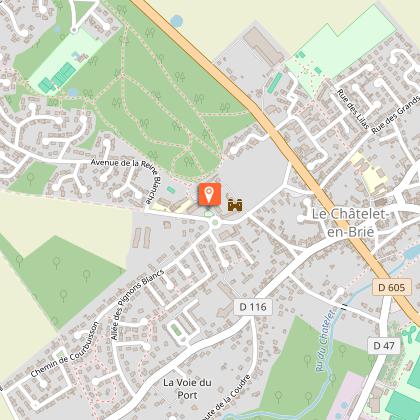
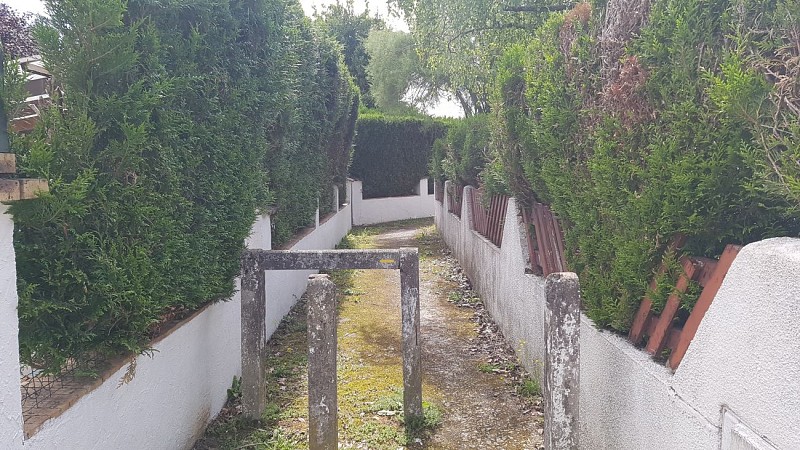
1. With the castle in front of you, leave to the left, then right at the roundabout. Pass the car park on the right and take the woodland path on the same side. Take the path on the right and cross the residential area. Cross the RD605 and follow Rue de la Loge aux Bergers. At the bend, go straight ahead into the path, then turn right into the Passage de la Peupleraie. It crosses a street and leads onto Rue des Grands Jardins.

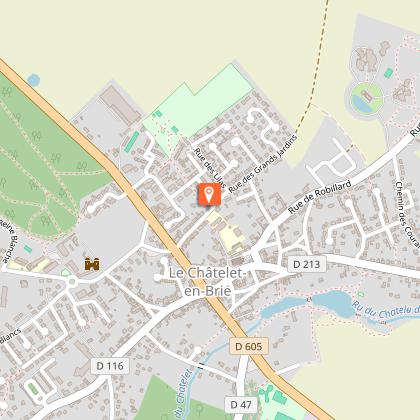
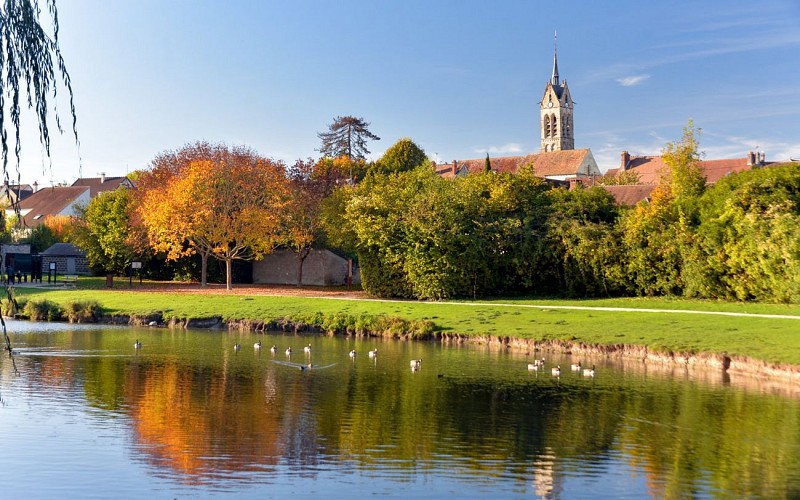
2. Make a right then a left and, by the Passage des Marjolets, pass in front of the church to reach the RD213. Turn right, then left into Rue Saint-Hubert. Turn left into Rue Baudra, which continues as Rue des Dames de Poissy. Go down on the right by the path running along the washhouse.

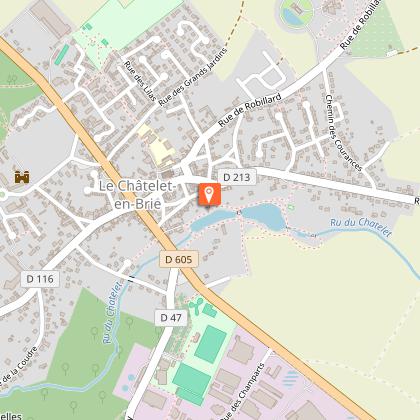
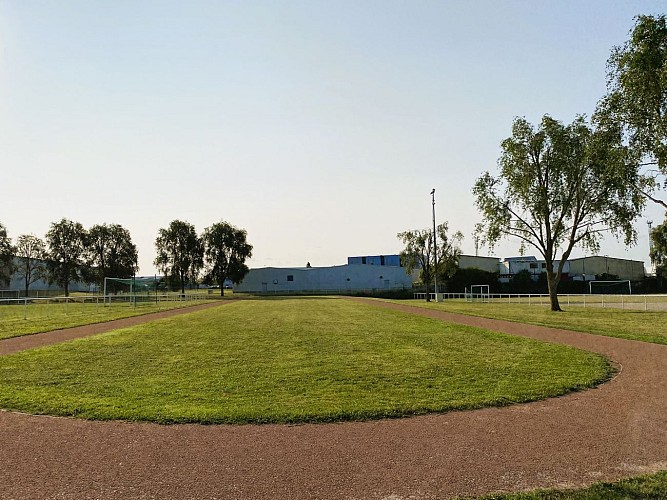
3. Go around the basin on the right, cross the bridge over the Châtelet stream and go uphill on the right. Cross the RD605 and go up Route de Féricy. Pass the cemetery and the wastewater treatment plant opposite the sports complex, then go down the woodland path on the right. When you reach the road, make a right then a left and cross the bridge over the stream again.

4. Climb the grassy path on the right up to Rue de Fontaine-le-Port. Make a right then a left and enter the grassy path, then another path on the right passing between houses. Leave the path on the left, make a wide left curve and cross a paved road. Then leave the left path and, following a right curve, reach the paved Allée des Pignons Blancs. Turn right, then left into Chemin des Guyottes. Turn left into the path, which continues as a paved road. After a right-angle turn to the left, rejoin Allée des Pignons Blancs.

5. Turn right twice, leave the road on the left, and continue along the gravel path which makes a right-left turn, continuing as a paved passage. Turn left into Rue de Rambouillet, then left into Rue Saint-Augustin, and finally left into Rue du 19 Mars 1962 to return to the starting point.

Municipality crossed : Le Châtelet-en-Brie
Distance : 5 km - Duration : 1h40 - Marked trail : Yellow - Difficulty : Easy
Access to the map : www.cirkwi.com/fr/circuit/353267-le-chatelet-en-brie-le-chemin-du-chateau

Technical Information

Walking
Difficulty
Very easy
Duration
1h40mn
Dist.
5 km
Show more

Altimetric profile

Starting point

5000 2 Rue du 19 Mars 1962 , 77820   Le Châtelet-en-Brie
Lat : 48.504664Lng : 2.788478

Points of interest

image du object

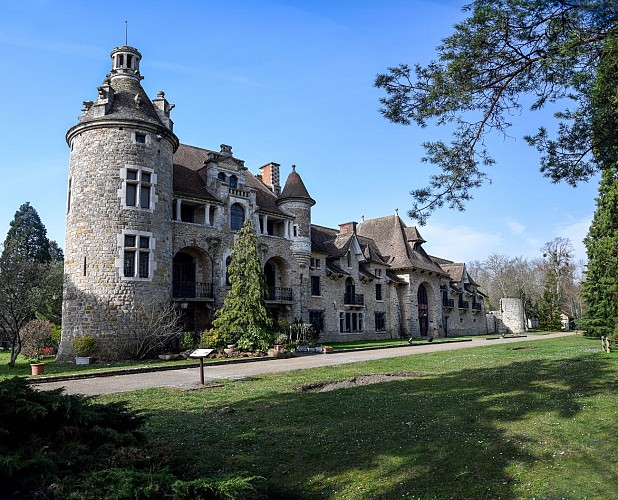
Château des Dames and its park

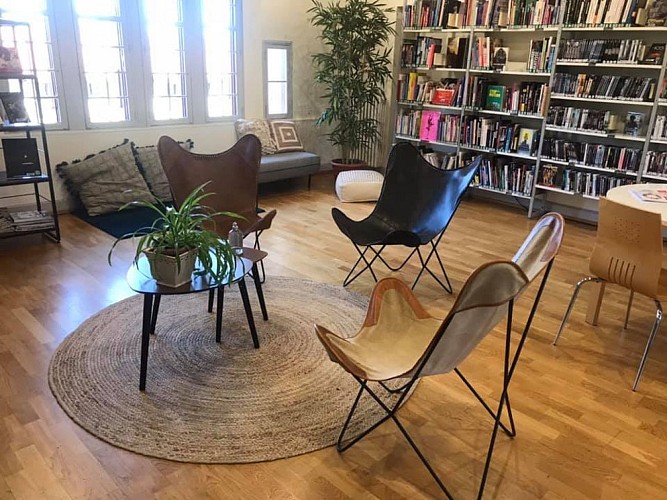
The Château des Dames at Châtelet-en-Brie takes its name from the nuns of the Royal Abbey of Saint-Louis de Poissy, holders of the lordship of the Châtelet lands from the 14th century to the Revolution.The Château des Dames was built in the 14th century following the donation of the estate to the nuns of the Royal Abbey of Saint-Louis de Poissy by King Philip the Fair. They turned it into a fortified farm, with both a defensive and an agricultural role. They kept it until the French Revolution, when the lordship was sold as national property. Several owners followed, farming the land without making any significant changes to the castle. In 1861, Polycarpe Maclou Poussié purchased the estate. He was a prosperous notary in Aubervilliers. He was a member of the Municipal Council of Châtelet-en-Brie, a member of the Melun Agricultural Society and vice-president of the Horticultural and Botanical Society. Between 1877 and 1885, he completely renovated the castle with architect Pierre-Victor Cuvillier. He built a castle and modern farm buildings inspired by medieval architecture. These constructions were carried out according to a layout quite close to the pre-existing structure. The Château des Dames then became a family residence enhanced by a park. Through the prosperity of its farm, in operation until the 1960s, it functioned in near self-sufficiency. Between 1965 and 1978, the lands, the farm and the castle were gradually sold. In 1998, the municipality of Châtelet-en-Brie became the owner of the castle, the farm and its park, to enhance the building and turn it into a cultural venue. The Château des Dames now houses : inside the castle, the Media Library, and in the courtyard, the socio-cultural hall "Le Manège". The park is a place for walking open to all.

Rue du 19 mars 1962 77820 Le Châtelet-en-Brie
- Communauté de Communes Brie des Rivières et Châteaux -
Consulter
image du object

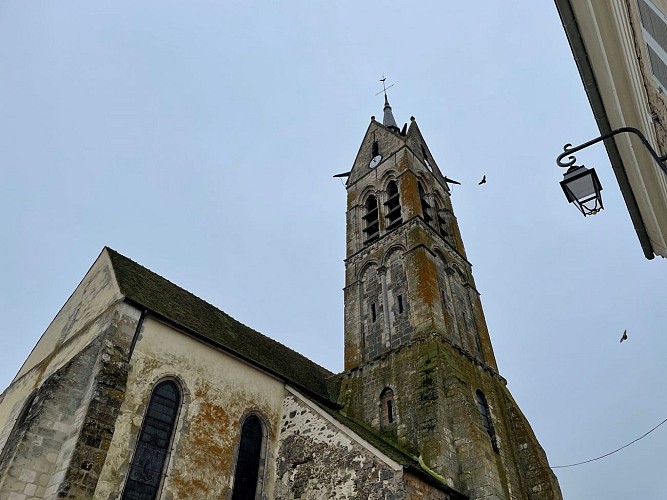
Église Sainte-Marie-Madeleine

Au cœur du village du Châtelet-en-Brie, l’église, sous le vocable de la pénitente de Magdala, Sainte-Marie-Madeleine, dresse fièrement son clocher jusqu’à 42 mètres du sol.La construction de l’édifice s’échelonne du 13e siècle pour les parties les plus anciennes (sanctuaire, chœur, transept), à la fin du Moyen-Âge. Le clocher, point de mire de nombreuses routes des environs, est carré, à trois étages, couvert par une toiture briarde en double bâtière, surmonté d’une flèche de charpente couverte d’ardoise. Le plan de l’église est relativement simple. L’ensemble paraît remonter à la première moitié du 13e siècle, malgré l’archaïsme des voûtes sexpartites du chœur. La nef, beaucoup plus sobre, à charpente apparente, témoigne d’une construction en plusieurs étapes relevant de commanditaires différents. Le chœur comprend deux travées voûtées, bordées au sud par une ancienne chapelle seigneuriale. La charpente qui couvre cette église est un bel exemple de charpente médiévale, anciennement ornée d’un lambris remplacé aujourd’hui par un enduit de plâtre. La nef est bordée, au sud, par une galerie de bois qui fait office de porche, et, au nord, par un bas-côté actuellement désaffecté. Contre le côté nord du chœur, s’élève le clocher de l’église dont les premiers étages paraissent dater du 13e siècle, alors que les niveaux supérieurs n’ont été construits qu’à la fin de l’époque médiévale ou peut-être même durant l’époque Classique. L'église abrite plusieurs objets protégés au titre des Monuments Historiques : retable de l'ancien maître-autel, tableaux, statues...

Place de l'Église 77820 Le Châtelet-en-Brie
- Communauté de Communes Brie des Rivières et Châteaux -
Consulter
image du object

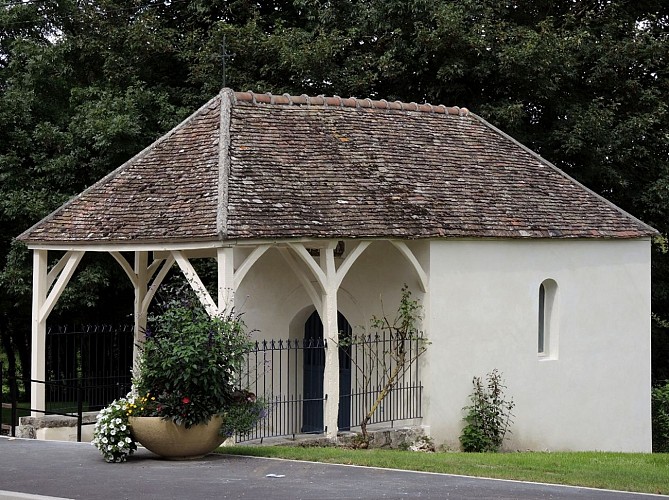
Chapelle Sainte-Reine

Au Châtelet-en-Brie, la Chapelle Sainte-Reine actuelle, fut bâtie sur le bord de la fontaine par Berthier, le sieur des Essarts et bénie le 28 avril 1737 par André, curé d’Héricy. Les pierres et les tuiles de la Maladrerie servirent à son édification.La source du Châtelet est d’abord placée par les Celtes sous l’invocation d’une divinité du paganisme. Étant en bordure de l’ancienne voie allant à Alise Sainte Reine, on peut considérer que ce nom de Sainte Reine lui fut donné à cause des pèlerins s’y rendant, ou peut-être même par eux. Ce serait le type du pèlerinage secondaire créé par le pèlerin. Ce culte est fort ancien au Châtelet, où il est très populaire. La fontaine est fréquentée pour la guérison des maladies vénériennes et par les femmes désirant avoir des enfants. A l’origine, la chapelle se trouvait au fond de la vallée, à côté de la source. La Chapelle de la Sainte Trinité, (chapelle Sainte Reine actuelle), fut bâtie sur le bord de la fontaine par Berthier, le sieur des Essarts et Dame Sylvain et bénie le 28 avril 1737 par André, curé d’Héricy. Les pierres et les tuiles de la Maladrerie servirent à son édification. Après la vente des biens nationaux, elle est rachetée en 1821 par la commune et rendue au culte. En 1841, l’abbé Rouffiac, curé doyen fit reconstruire le porche qui précède la chapelle. En 1900, l’abbé Bled curé-doyen fit procéder à la réfection du plafond et au ravalement de la façade. En 1935, l’abbé Péricart, curé-doyen, fit refaire la toiture, les murs extérieurs, les grilles et les peintures intérieures. En 1950, l’abbé Jozon fit restaurer la chapelle. En 2000, la commune, fit refaire charpente et toiture. Pèlerinage, procession à la fontaine, et messe eurent longtemps lieu le 7 septembre à la chapelle.

55 Rue du 26 Août 1944 77820 Le Châtelet-en-Brie
- Communauté de Communes Brie des Rivières et Châteaux -
Consulter

Additional information

Environments

In the country

Updated by

Communauté de Communes Brie des Rivières et Châteaux - 29/04/2026
www.briedesrivieresetchateaux.fr
Report a problem

Open period

All year round daily.

Data author

1 rue des Petits Champs 77820 Le Châtelet-en-Brie France

Ratings and reviews

To see around
See more
Open
Close
Show
Show
Show
Show
Show
Show
Show
Show
Show
Show
Show
Caution!
We have no information on the difficulty of this circuit. You may encounter some surprises along the way. Before you go, please feel free to inquire more and take all necessary precautions. Have a good trip! 🌳🥾