Alert

Alerts

To see around
See more
Open
Close
Show
Show
Show
Show
Show
Show
Show
Show
Show
Show
Show

Oups... It would appear that Cirkwi does not have permission to use your location.

Presentation
Description
Map
Points of interest
Ratings and reviews
See around

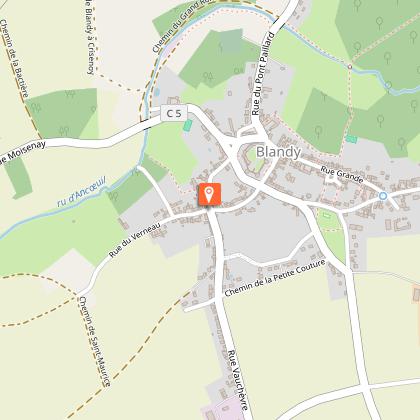
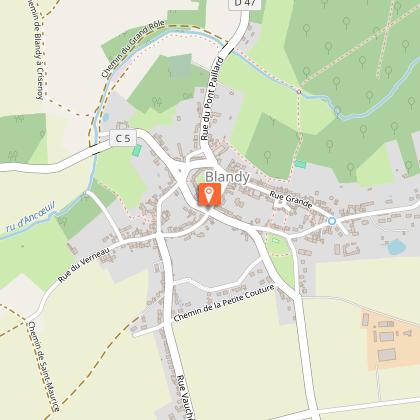
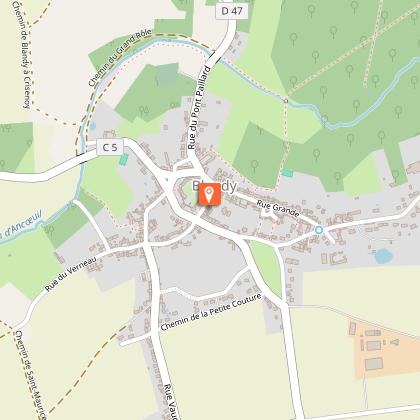
Walk in Blandy-les-Tours

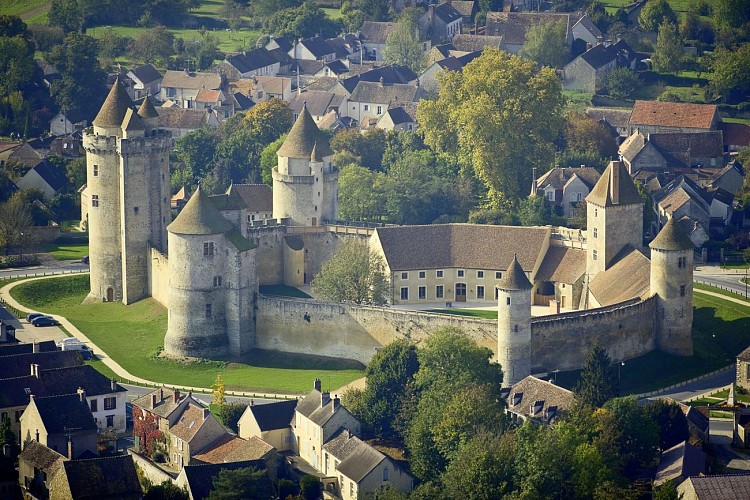
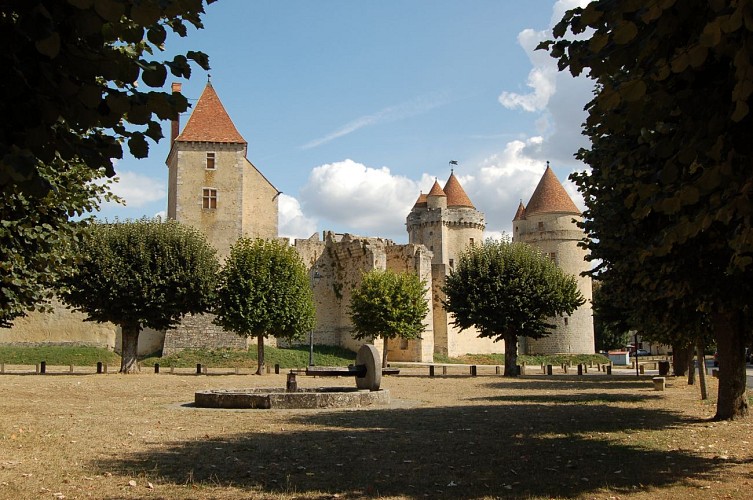
View of Blandy-les-Tours
Walk in Blandy-les-Tours
Credit : CCBRC

Description

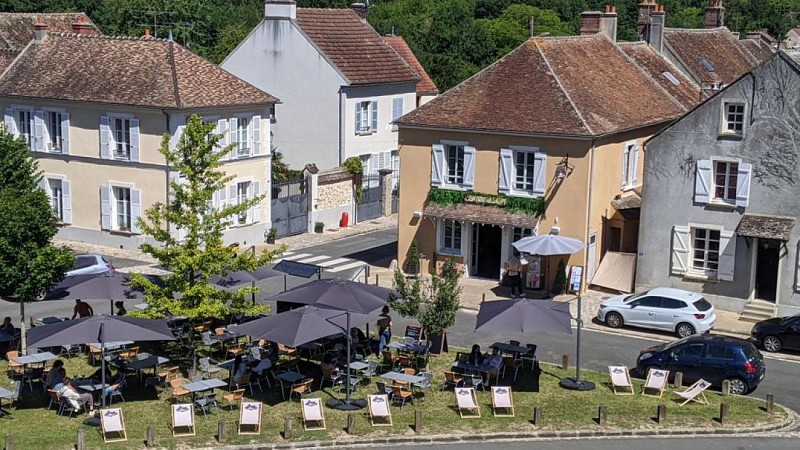
Built around a castle that looks as if it has stepped straight out of a storybook, Blandy-les-Tours is an exceptional village for lovers of old stone.

With its medieval castle at the heart of the village, Blandy-les-Tours boasts a unique heritage in the Île-de-France region. Blandy is thought to have emerged from the Gallo-Roman period. Since at least the 12th century, its history has been linked to the Viscounts of Melun, who built the first manor house, which over the centuries became a fortified castle and then a residential castle, before being transformed into a farm and falling into ruin. Now the property of the Département de Seine-et-Marne, the castle has been the subject of excavations and major restoration work, making it of particular interest. Don't hesitate to ask about the calendar of cultural events. Following a loop around the château, through the old streets and then along the river Ancœur, the village walk invites you to discover both its rich heritage and its bucolic landscapes. Restaurants, cafés and open-air cafés will ensure you spend a pleasant day in Blandy-les-Tours.

The route, step by step...

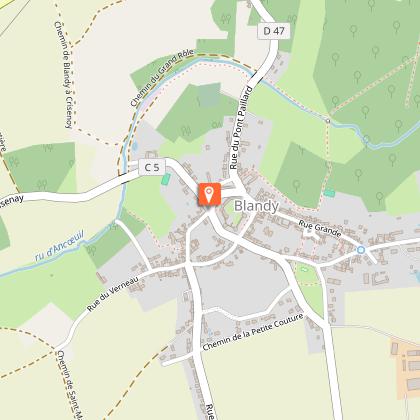
1. Go to Place des Tours, opposite the entrance to the castle. Take advantage of this position to admire the castle.
2. Head for the apple crusher in Place du Colombier.
3. A stone's throw from the apple crusher is the church of Saint Maurice.
4. Walk along the south side of the church towards the farmhouse.
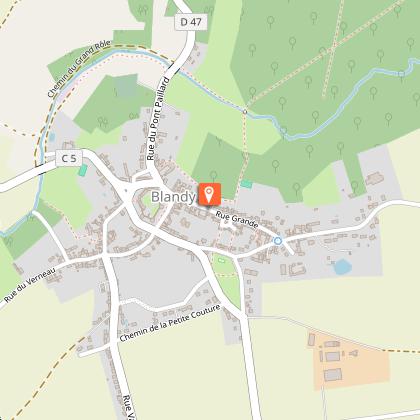
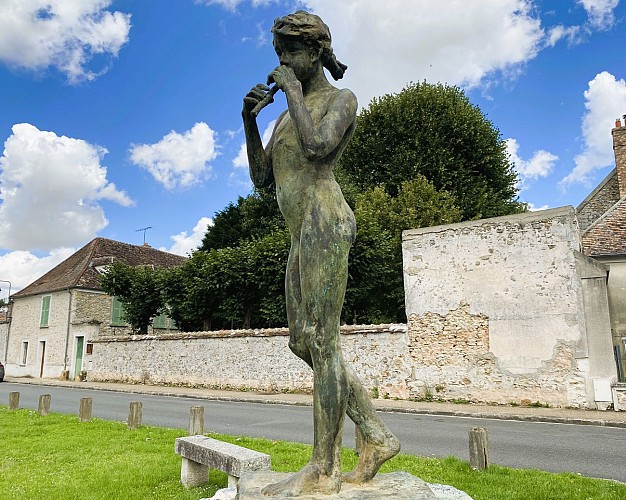
5. Take the Grande Rue, still known as the Rue Grande, one of the oldest streets in the village. You'll notice the statue of a flute player on your right in the Place du Pilori, a gift from Blandyn sculptor Michel Lévy, and an old water pump at the entrance to the street. Admire the remarkable porch at no. 9.
6. The narrow Clos lane (on your left) leads to a path behind the houses. Turn right and follow the path into the surrounding countryside to reach the ru d'Ancœur.
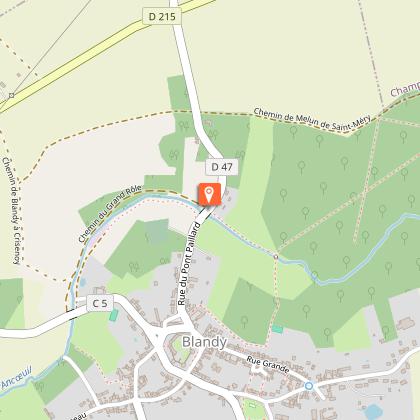
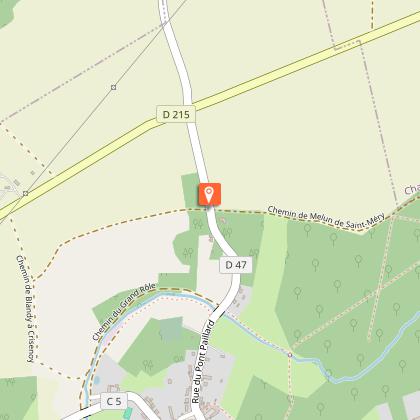
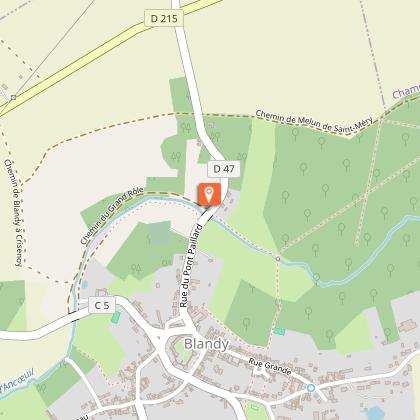
7. Turn right onto Rue du Pont Paillard (D47).
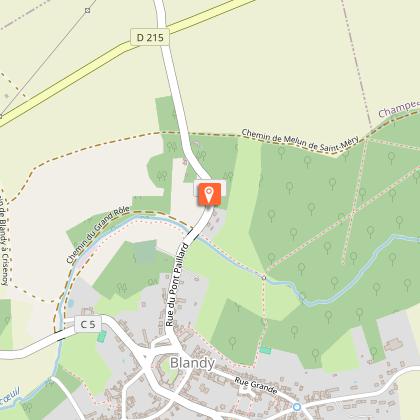
8. Just after the last house, turn right onto the country lane known as ‘la rue Creuse’. A picnic table awaits you for a rural break.
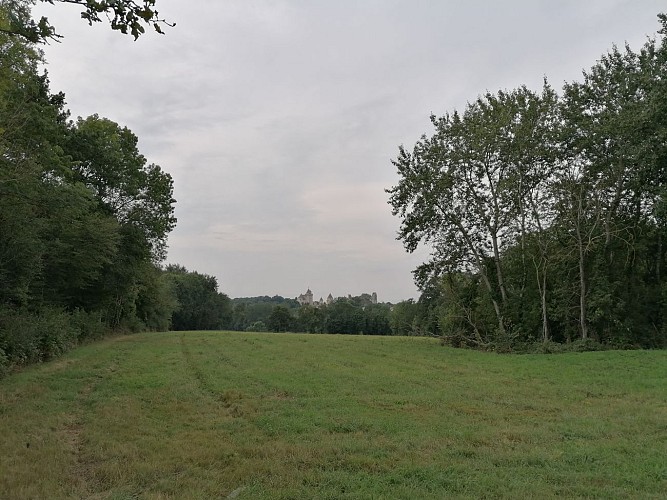
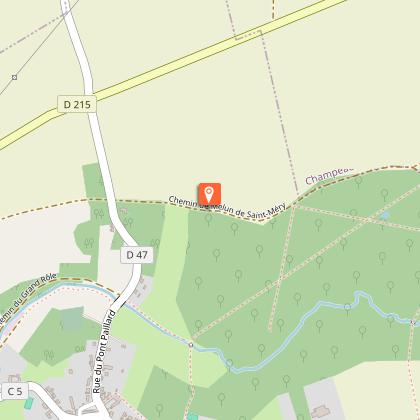
9. At the end of the lane, turn left onto the Chemin de Melun de Saint-Méry. After about 100 m, you will see a panoramic view of Blandy-les-Tours and its château on your left.
10. Resume your walk. On your left, head back down the rue du Pont Paillard (D47) towards the village. You will come across the Fontaine de Monferton.
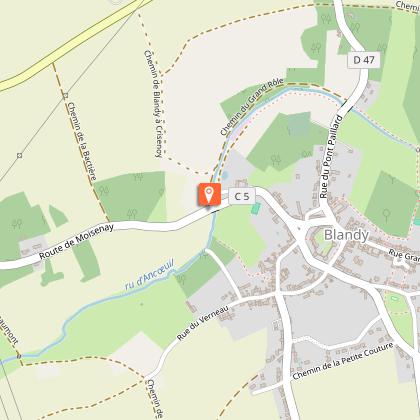
11. Turn right onto chemin du Grand Rôle. Continue to follow the Ru d'Ancœur as far as the bridge over the Rue du Moulin.
12. Turn left to cross the Moulin bridge and walk up the Rue du Moulin towards the village. In the distance, you will see the church tower and the towers of the château.
13. You are now back in the village square, opposite the castle. Turn right immediately into rue de la Fontaine. You can stop at the wash-house.
14. Continue along rue de la Fontaine then turn left into rue Raoul Kourilsky to return to the château.
15. Turn right into rue Raoul Kourilsky. You can finish the walk in style by visiting the château and admiring the exceptional panoramic view from its covered walkway.

District covered: Blandy-les-Tours
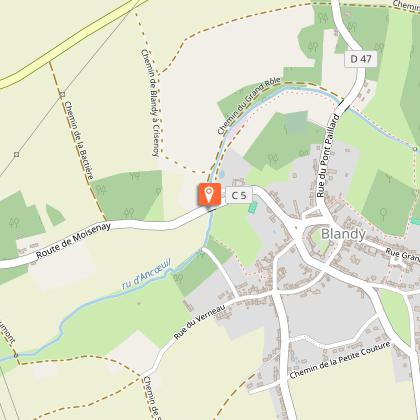
Distance: 3.7 km - Time: 1h15 - No signposting
Access to map: www.cirkwi.com/fr/circuit/339841-balade-a-blandy-les-tours

Technical Information

Walking
Difficulty
Very easy
Duration
1h15mn
Dist.
3.7 km
Show more

Altimetric profile

Starting point

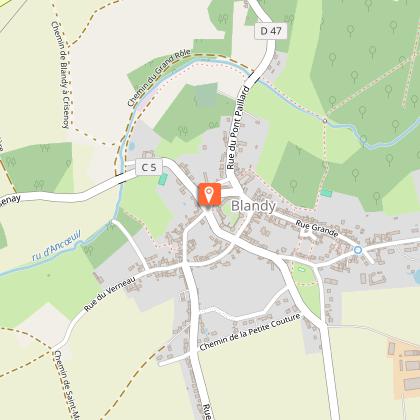
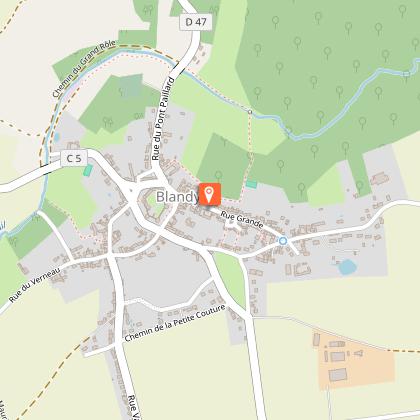
16 Place des Tours , 77115   Blandy
Lat : 48.567271Lng : 2.780504

Points of interest
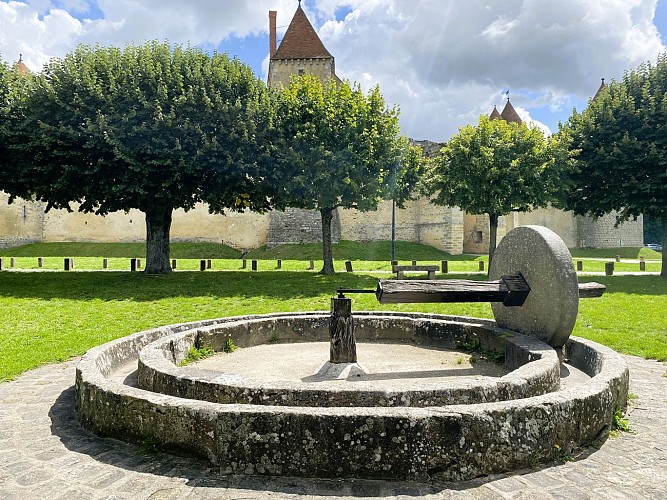
image du object

Église Saint-Maurice

L'Église Saint-Maurice à Blandy-les-Tours, datant du 14e siècle est classée aux Monuments Historiques notamment du fait de sa nécropole de 72 sépultures de jeunes enfants.L’église Saint-Maurice, classée aux Monuments historiques, dont l’origine remonte au début du Moyen-âge, se dresse tout près du rempart nord du château fort. À l’époque mérovingienne, le groupe paroissial était composé de deux bâtiments différents : l’église et une chapelle dont les vestiges subsistent, délimités au sol, dans la cour intérieure du château. Une nécropole de 72 sépultures de jeunes enfants a été retrouvée autour du chevet de cette chapelle. L’église, longue de 44 m et large de 13 m, se situe dans le secteur où de nombreux sarcophages ont été retrouvés, ce secteur était alors occupé par un cimetière mérovingien. L’édifice a été régulièrement transformé et agrandi. Le clocher à quatre pans droits, caractéristique des églises briardes, et la nef de style gothique, datent du 14e siècle. La nef, à trois travées, est flanquée d’un unique bas-côté. Son chœur comprend un imposant retable à quatre piliers ainsi qu’un maître-autel sculpté datant du 18e siècle. Les chapelles comportent un ensemble de tableaux et boiseries de la même époque. Plusieurs pierres tombales des 16e au 18e siècles subsistent : elles sont principalement situées à l’entrée de l’édifice ou fixées aux murs. On remarquera aussi la chaire datant de 1772, les fonts baptismaux finement sculptés, et le confessionnal. La statue représentant sainte Geneviève, éclatante sous la lumière des vitraux, interpelle le visiteur. Les cloches qui rythment la vie du village datent de 1790 et de 1889. La sacristie, prolongeant l’église, est plus récente.

11 place Couturon 77115 Blandy
- Communauté de Communes Brie des Rivières et Châteaux -
Consulter
image du object

Castle of Blandy

Blandy is a medieval fortress last one left as well restaured in the Ile-de-France region.The first baronial residence was built in the thirteenth century, in the form of a simple manor with an irregular surrounding wall. Later that century, considerable fortification work was done, particularly the three towers which were added to the fortified entrance tower. A large residential building was built inside these fortifications. The fourteenth century saw considerable development of the château defences, with a moat and a new tower entrance boasting a spiked drawbridge. In the second half of this century Blandy became the model for fortified castles. The keep, 39 metres high, defended by two drawbridges, was built. The keep was altered by the addition of new towers and curtain walls. Between the fifteenth and seventeenth centuries, the fortress gradually lost its military purpose and became a residential castle. More domestic buildings were built. In the early eighteenth century, Maréchal Villars, the owner of Vaux-le-Vicomte, bought the lands and fortress of Blandy, which was pulled down and turned into a farm. Little by little, the fortress disappeared. Bought by the town council in 1883, the ruins of the fortress were classified as a historic monument the following year. From 1970 onwards, volunteer associations began work on restoring the château. In 1992, the Seine et Marne general council bought the fortress and undertook a vast restoration operation. A complete programme of works has enabled this superb fortress to be resuscitated and become one of the leading tourist attractions in the department. This dashing fortress represents one of the flagship tourist site of the district.

Place des Tours 77115 Blandy
- Seine et Marne Attractivité -
Consulter
image du object

Val d'Ancoeur: listed site

The story begins like a fairy tale: "Once upon a time, there was the Val d'Ancœur..." with its castles, its legends and the 3 names of this small stream, which has become a myth, from Ancœur to Ancoeuil and ends in Almont... before flowing into the Seine.(extract from the Archives Départementales website) The ru d'Ancoeur is a watercourse which rises in the commune of Grandpuits-Bailly-Carrois at an altitude of 125 m. It then takes the name of "Ancoeuil" in the commune of Moisenay and, after a journey of 25 km from its source, flows into the Bassin de la Poële at the Château de Vaux-le-Vicomte. At the end of this basin, it flows into the Almont 5 km downstream into the Seine at Melun. Together with its tributaries, it forms a catchment area of approximately 306 km². The ru d'Ancoeur flows through the municipalities of Grandpuits-Bailly-Carrois, La Chapelle-Gauthier, Bréau, Bombon, Saint-Méry, Blandy-les-Tours, Moisenay, Maincy and Melun. Classified as an "Exceptional Site" since 14 October 1985 by the Direction Régionale et Interdépartementale de l'Environnement et de l'Energie d'Île-de-France, the ru d'Ancœur offers enchanting landscapes. The listed site covers 1861 hectares. Along its watercourses - the Almont, the Ancoeuil (or Ancueil) and then the Ancoeur - the Val d'Ancœur offers panoramic views: villages, forests, châteaux (Vaux-le-Vicomte, Blandy-Les-Tours, etc.) and, at the confluence with the Seine, urbanised areas. "The Ancoeur is a river with very little water, very irregular and in danger of running dry on a regular basis. The water level in its catchment area is 96 millimetres a year, which is one of the lowest in France, more than three times lower than the average for the country as a whole, and above all well below the average for the whole of the Seine basin (around 240 millimetres). For centuries, however, the constant flow of the river Ancoeur has enabled numerous mills to operate. The large number of hydraulic structures, such as canals, basins and ponds, small reservoirs and mills, give the landscape a distinctive identity based on water and its control. This is linked to the wet nature of the land. A place where people live, produce and create, the Val d'Ancoeur is home to a number of major heritage sites throughout the area: churches and works of art dating back to the 12th century, castles, farms, mills, rural housing, small-scale rural heritage, and so on. It has also become a subject of reflection and aesthetic admiration thanks to the artists who have seized upon its beauty to interpret it in their own way. - L'Ancueil ("Anqueil" in its 17th-century spelling), for example, gave its name to a majestic statue in the grounds of Vaux-le-Vicomte located to the left of the grotto complex (1659-1662), facing the Tiber installed to the right in 1659. - In 1879, the painter Paul Cézanne immortalised the Pont de Maincy (preserved at the Musée d'Orsay). - And sculptor Auguste Rodin devoted some superb drawings to the Collegiate Church of Champeaux (1890-1917), testifying to his admiration. For several years now, the Communauté de Communes Brie des Rivières et Châteaux and the Communauté d'Agglomération Melun Val de Seine have been working together to draw up a Landscape Plan to highlight the assets of the Val d'Ancoeur. An opportunity to protect and enhance the landscape heritage. The perimeter of the listed site covers 11 communes in an area of around 56 km². As the crow flies, it is almost 17 km long.

- Communauté de Communes Brie des Rivières et Châteaux -
Consulter
image du object

Broyeur à pommes

Sur la place du Colombier de Blandy-les-Tours trône un broyeur de pommes qui servait autrefois à broyer les fruits qui étaient ensuite portés au pressoir.Le nom de cette place rappelle, qu’autrefois, s’y élevait une tour circulaire : le colombier du château, lié au privilège seigneurial d’élever des pigeons. Cet édifice ayant disparu pendant la période révolutionnaire, on installa sur la place, dans les années 90', le broyeur de pommes situé au préalable au N°9 de la rue Grande. On y accédait en passant sous le magnifique cintre de pierre conservé en bon état à ce jour. Cet équipement rural servait à broyer les pommes avant de les porter au pressoir banal attenant, détruit depuis lors. Le pressoir, ainsi que le moulin et le four, entretenus par le seigneur et dénommés "banalités" étaient mis à la disposition des habitants de la seigneurie, en contrepartie de quoi, ils avaient l’obligation de n’utiliser que ces équipements moyennant le paiement d’un impôt. Le principe de fonctionnement du broyeur de pommes était le suivant : la meule de grès, fixée sur un axe de bois et entraînée par un cheval, écrase les pommes additionnées d’eau dans la gouttière périphérique dont la circonférence est d’environ 6m et sa profondeur est de 50cm. Les pommes étaient ensuite pressées afin d’en extraire le jus qui servait à faire du cidre. D’autres fruits étaient également broyés et pressés, notamment les poires pour le poiré, ou cidre de poires.

15 Place des Tours 77115 Blandy
- Communauté de Communes Brie des Rivières et Châteaux -
Consulter

Additional information

Environments

In the country

Updated by

Communauté de Communes Brie des Rivières et Châteaux - 02/11/2025
www.briedesrivieresetchateaux.fr
Report a problem

Open period

All year round daily.

Contact

Phone : 01 60 66 90 23

Email : mairie@blandylestours.fr

Website : http://www.blandy-les-tours.fr

Reception complements

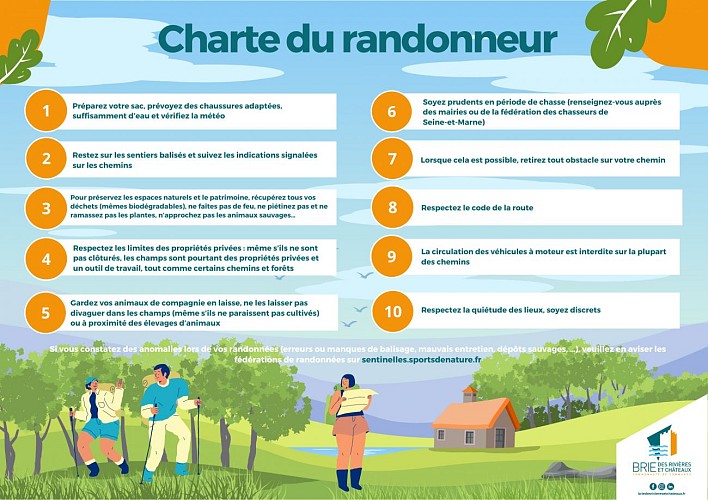
The Hiker's Charter: for responsible hiking in complete tranquillity :
1. Pack your bag, bring suitable footwear, enough water and check the weather forecast.
2. Don't stray off the beaten track, stay on the marked paths.
3. Protect natural areas and our heritage: collect all your rubbish (even biodegradable), don't make fires, don't trample or pick plants, don't approach wild animals, etc.
4. Respect the boundaries of private property: even if they are not fenced, fields are still private property and a working tool, just like certain paths and forests.
5. Keep your pets on a lead, and don't let them roam in fields (even if they don't appear to be cultivated) or near livestock farms.
6. Be careful during the hunting season (check with your local council or the Seine-et-Marne hunters' federation).
7. Where possible, remove any obstacles in your path.
8. Respect the highway code.
9. Motor vehicles are not permitted on most paths.
10. Respect the peace and quiet of the area and be discreet.
If you notice any anomalies during your walks (errors or lack of signposting, poor maintenance, illegal dumping, etc.), please notify the walking federations at sentinelles.sportsdenature.fr/.

Ratings and reviews

To see around
See more
Open
Close
Show
Show
Show
Show
Show
Show
Show
Show
Show
Show
Show
Caution!
We have no information on the difficulty of this circuit. You may encounter some surprises along the way. Before you go, please feel free to inquire more and take all necessary precautions. Have a good trip! 🌳🥾