Alert
Alerts
Hiking: the high peaks from Lélex

Description
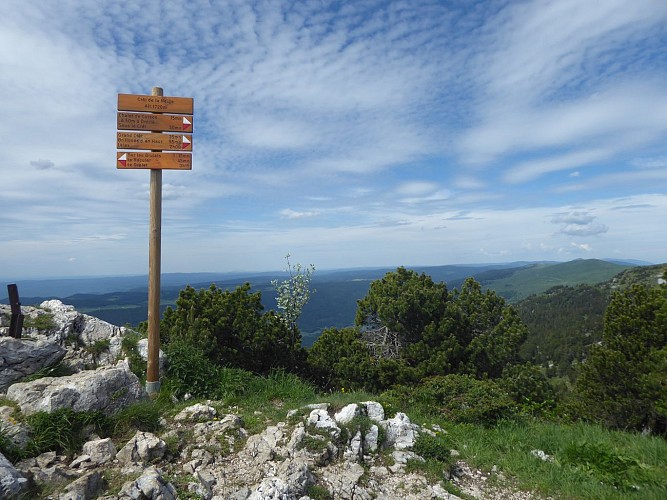
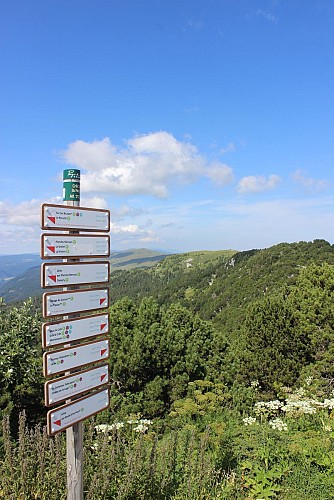
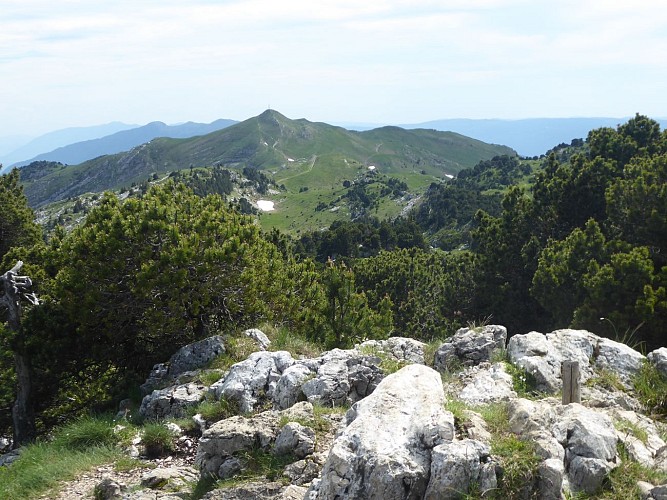
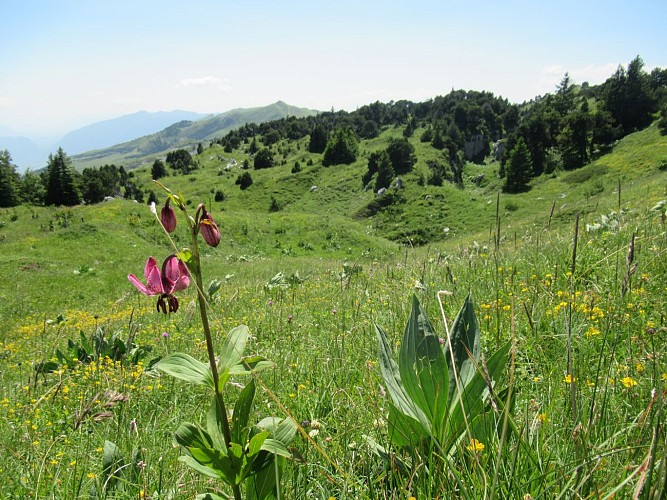
This tour offers a varied and demanding route from the banks of the Valserine to the highest peaks of the Jura. A sublime panorama of the Alps, Lake Geneva and the Jura mountains awaits hikers in an unspoilt setting.
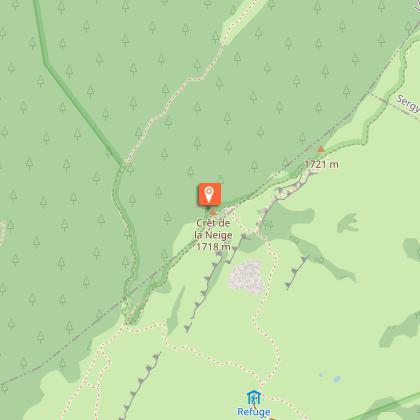
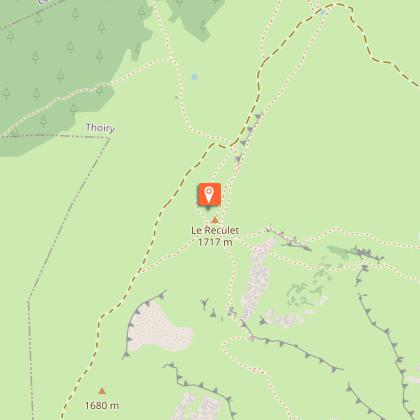
Valserine river at the bottom of the valley and passes through its peat bog. Remarkable flora grows here in fine weather. The entrance to the nature reserve is reached before beginning the ascent of the Jura Mountains and Reculet (1,719 m). A 1,600 kg cross was hoisted there in 1892 by four inhabitants of Thoiry. The trail continues to Crêt de la Neige, the highest point of the massif at 1,720 m. Before descending to the village of Lélex, note the remains of ancient buildings along the trail, which bear witness to human activity in the Jura Mountains and its alpine farming tradition.
The route takes you through the heart of the Haut-Jura Regional Nature Park, and part of the Haute Chaîne du Jura National Nature Reserve: a protected, unspoilt area to be explored with respect.
Good to know - Protected area
Part of the route passes through the Haute Chaîne du Jura National Nature Reserve, which is subject to special regulations:
Dogs are not allowed, even on a lead.
Please respect these rules to preserve the richness of this exceptional environment.
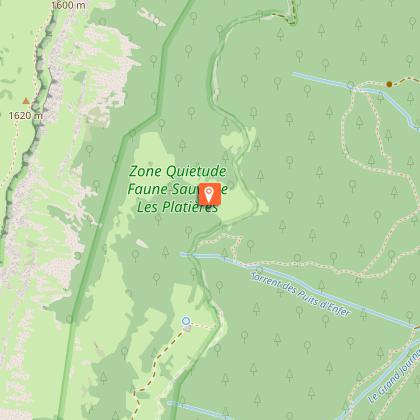
You are passing through a wildlife quiet zone in the Crêt de la Neige area; use of the GR trail is tolerated during the closure period, provided you stay strictly on the marked path.
Technical Information
Altimetric profile
Starting point
Points of interest
Date and time
- From 01/04/2026 to 30/11/2036
- From 01/04/2027 to 30/11/2037
Additional information
Open period
From 01/04 to 30/11 daily.
Subject to there being no snow.
Updated by
Office de Tourisme du Pays de Gex - 09/07/2026
www.paysdegex-montsjura.com
Report a problem
Environments
In a nature reserve
Close to GR footpath
Mountain view
Panoramic view
Presence of livestock and guard dogs
Lake view
Contact
Phone : 04 50 28 09 16
Email : contact@paysdegex-tourisme.com
Website : https://www.paysdegex-montsjura.com
Type of land
Ground
Topo guides and map references
Topo guides references :
Hiking in Pays de Gex and the Haute Chaine du Jura: on sale at Pays de Gex tourist agencies: €9.
Map references :
3328OT - CRÊT DE LA NEIGE
Reception complements
▶ This route crosses the Haute Chaîne du Jura National Nature Reserve. Please respect the regulations.
The rules include the following:
Dogs are strictly forbidden, even on a lead.
Plant picking and mineral collecting are also prohibited.
The trail crosses a Quiet Zone, closed from December 15 to June 30.
Tolerance is granted for use of the GR, provided you stay strictly on the marked path. It is forbidden to leave the path.
▶ Before setting off :
Check the general and local weather forecast, and make sure there's no precipitation.
Find out about the approach route, the height of the itinerary, the time it will take to complete the climb, and any possible escapes (IGN map, GPS, topo-guide, etc.).
Evaluate possible risks by asking mountain professionals, mountain huts and gîtes.
Inform someone close to you of your objective, and contact them again in the event of any changes: departure and return times, number of participants with telephone numbers for each, vehicle(s), parking, etc.
Avoid setting off alone, and use equipment that is suitable for the activity, adjusted and in good condition: headlamp, complete first-aid kit, survival blanket, etc.
In the event of a problem, call 112 (European emergency number).
▶ The Patou or guard dog: what attitude should you adopt?
When out hiking, it's not uncommon to come across flocks of sheep or goats guarded by guard dogs known as patous. These dogs, formidable against predators such as wolves, bears and lynxes, can frighten hikers with their barking.
The patou protects flocks in total autonomy. Its main role is to deter intruders and alert the shepherd. Raised among the ewes from an early age, he learns to protect them at all times, often in groups.
▶ To avoid problems with a patou:
Identify grazing areas before setting off.
Keep your distance and go around flocks if possible.
In the event of an encounter, stay calm, turn back slowly or stop to let the dog sniff you out.
Don't try to pet or feed the animals, avoid sudden movements, don't run, and avoid taking photos.
▶ For runners:
Do not run when approaching a herd.
Take off your headphones to hear the dog's barking.
By adopting these behaviors, you'll be able to cohabit serenely with guard dogs on your hikes.
Tricky passages
The 32 contours path, which climbs from Le Plat des Menues to Le Reculet, is demanding. Better to take it on the way up rather than on the way down.
After the Crêt de la Neige, the GR path that follows the ridges is winding: be careful where you step.
Guidebook with maps/step-by-step
(1) From the tourist office, follow the yellow signs, then turn left towards La Vieille Chapelle. The two one-way roads converge at this intersection, whether you come from the upper or lower road. After passing several shops, continue until the road becomes two-way again, then take the second road on the right.
(2) From here, follow the GR® (red and white markings) down the Route du Frênet. Pass to the left of the Chapelon farm, the Chalet Louis Marchand, then the tennis courts, before reaching the Pont de la Fruitière.
(3) Just after crossing the Valserine, turn left towards Le Niaizet. The first part of the route is on a road which then becomes a white path after passing under a fir stand. Walk past a house and a peat bog, then continue to the end of the combe, where you'll see an intersection with a bench.
(4) Turn left off the GR® and continue on the yellow PR to cross the Pont du Niaizet.
(5) Just after the bridge, take the path on the right. It briefly skirts the stream before gradually climbing up to reach the main road.
(6) Cross the road to the median opposite. This is where the Chemin des 32 Contours begins. A monolith stands on the left beside an information panel. Follow the signs for Le Reculet. From this point on, the climb becomes more demanding: the path narrows to become a winding path through the trees. In less than 3 km and 700 m of ascent, we reach a new junction after emerging from the forest into the high alpine pastures. A superb view of the Valserine and Crêt de Chalam is revealed.
(7) At Thoiry-Derrière, continue climbing towards the Croix du Reculet, clearly visible from this point. The last few metres of ascent are made to the sound of clarines. The path skirts around the back of a stone hut, quickly rejoins the ridge and rejoins the GR®. Turn right towards Le Reculet (1,719 m), the second-highest summit in the Jura massif.
(8) Enjoy the breathtaking panoramic view. Follow the same path for about 200 m, then continue along the ridge towards Crêt de la Neige. The path begins as a wide track, which soon becomes a narrower path. The ruins of an old alpine village appear on the left. The path then turns right and begins the ascent to the highest point of the Jura massif, skirting hooked pines.
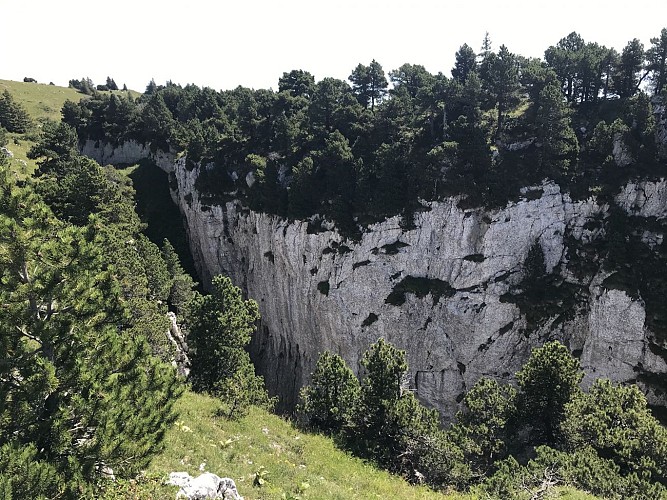
(9) The Crêt de la Neige (1,720 m) dominates the Lake Geneva basin and the Valserine valley. Enjoy the landscape marked by cavities, faults and canyons, evidence of an eventful geology. Continue along the ridge, following an undulating profile. The path becomes steeper, but its natural continuity leads to the next junction.
(10) At the Sous le Crêt junction, the descent to Lélex begins. Still on the GR®, the first few hundred metres are steep. Then the path skirts a cirque, crosses a pretty combe, and begins another steady descent through undergrowth. It opens out into the Combe des Voyettes, then passes to the left of a ruin before arriving on a white track at Les Brillones d'en Haut.
(11) Leave the GR® and turn left towards Brulats-Frésy on a yellow path. The first few hundred metres are easy, but a path descending to the right soon enters a quiet area. It winds through the trees and descends rapidly to the next crossing point.
(12) At the Chalet du Ratou intersection, rejoin the GR® and continue downhill to the left. This is where the slope becomes steepest. The route alternates between white paths and footpaths, crosses the green Fieret downhill ski run twice, and arrives at the first Lélex pastures.
(13) Continue towards the village, reaching the first houses. To return to the tourist office, turn right.
Animals
No. Dogs banned in the Haute Chaîne du Jura National Nature Reserve
Data author
