Alert

Alerts

To see around
See more
Open
Close
Show
Show
Show
Show
Show
Show
Show
Show
Show
Show
Show

Oups... It would appear that Cirkwi does not have permission to use your location.

Presentation
Description
Map
Steps
Points of interest
Ratings and reviews
See around

Historic houses of Saint-Germain-en-Laye
Historic houses of Saint-Germain-en-Laye

Description

Saint-Germain-en-Laye is one of the most interesting historic towns of the Paris region. It has retained its urban fabric from the Middle Ages, as well as its pre-17th-century winding streets and cul-de-sacs.

Starting point - Courtyard of the house where Claude Debussy was born
No. 38 Rue au Pain
In the courtyard, observe the beautiful stairway and wooden banisters, the only one remaining in Saint-Germain-en-Laye.
It dates from the late 17th century. Take the steps up to the first floor. This is the Claude Debussy museum. The composer was born here on 22 August 1862. His parents lived in a modest ground-floor flat and ran an earthenware and porcelain shop. The upper floors were occupied by other families.

Stage 1 - Rue de la Salle
Thus named since 1640 in honour of the captains who governed the town, but also because it housed a hall (“salle”) where the residents would meet.
- at no. 16: This is the oldest house in the town. Half-timbered, it is typical of the late Middle Ages. The façade has been restored.
- at no. 18: Hôtel des Maréchaux de Villeroy. Owned by Nicolas de Neuville, governor under Louis XIV, and later by his son François, who was also a governor but under Louis XV.

Stage 2 - Rue du Vieil Abreuvoir
At the street entrance there was a large watering pond but it was demolished in the 18th century to make way for the “coche”, the public vehicle that was the ancestor of the “diligence” stagecoach.
- at no. 24: Hôtel “de la Feuillade”.
This mansion belonged to the Duc de la Feuillade. He was a great admirer of King Louis XIV, and erected a statue in his honour at Place des Victoires in Paris.
- at no. 23: Hôtel de la Marquise de Maintenon.
Mistress and, later, the second wife of Louis XIV, she purchased this mansion in 1680.
The impressive wrought iron balcony dates back to 1880.
- at no. 22: Hôtel de Montausier.
Mansion owned by the Duc de Montausier, governor to Louis XIV’s eldest son.
The future Maréchal Lyautey also lived here, from 1887 to 1891. He was just a Captain at the time.

Stage 3 - Rue des Coches
So named since 1700 because it was the departure point of the public “coche” stagecoaches travelling to neighbouring towns, including Paris and Versailles.
- at no. 17:
Hôtel de Guise: this private mansion was owned by Henri II de Lorraine, Duc de Guise and grandson of the “Balafré” (“slashed face”). Albert Alain, the famous organist from Saint-Germain-en-Laye, was also born here.

Stage 4 - Rue des Vieilles Boucheries
The street was named after the meat market that was here in the Middle Ages.
The street was closed by a gate at night to dissuade thieves.

Stage 5 - Cour Larcher
Access to the courtyard is from Rue de Paris between nos. 40 and 42.
It is named after Regnault Larcher, who was an archer for King Philippe Auguste who founded a “Maison Dieu” here. This little hospital sheltered the poor of Saint-Germain-en-Laye, as well as pilgrims and travellers.

Stage 6 - Allée des Récollets
A narrow passageway on the site of the ancient Recollects convent. The Recollects were part of the Franciscan order and were initially protected by Henri II and Catherine de Medicis

Stage 7 - Rue Voltaire
Named in honour of the philosopher of light who spent two months at Saint-Germain-en-Laye in 1729.
- at nos. 2 to 6: Hôtel de Fieubet. Gaspard de Fieubet, advisor to King Louis XIV, acquired and embellished this mansion. It was reworked in the 19th century, unlike the one next to it (at no. 8) which has remained in its 18th century state.

Stage 8 - Rue / Place Saint-Pierre
- at no. 19: Hôtel de Folard, an 18th-century knight, soldier and military strategist. To the right of the door, a height marker decorated with the crown and royal cradle, indicates our altitude: 65.838 metres above the River Seine.
At Place Saint-Pierre, the Colbert fountain originally faced the Château. It was restored, moved here and inaugurated in 1989.

Stage 9 - Rue du Gast
It has borne this name since 1700 in reference to a family of public figures, one of whom was a notary under Henri IV, another was a “garde manteau”, or forestry officer, under Louis XIV.
- at no. 6, the façade features a little niche which shelters a statue of Saint Christopher. Opposite, through the wrought iron railings you can see the gardens of the Hôtel de Créquy, to which the entrance is located on Rue de Paris between nos. 10 and 12.

Stage 10 - Rue du Vieux Marché
The markets took place in this street from the moment they were initiated by François Premier in 1526. At the end of the 18th century, it was decided to move them to what is now Place du Marché Neuf, between Rue de Pologne and Rue de Poissy.

Stage 11 - Rue des Louviers
There are several theories as to where the term “louviers” comes from. It may be a deformation of the word “louvetier” meaning the officer serving as the Royal Wolfcatcher. Or, it may be a reference to the sheet merchants who came from the town of Louviers in Normandy.
- at no. 15: The Institut Saint-Thomas-de-Villeneuve, the town’s oldest school, is still in use.
- In the recess at no. 34, a niche shelters a statue of Saint Peter.

Stage 12 - Rue des Ecuyers
So-named since 1618, probably in reference to the numerous knights who lived in Saint-Germain-en-Laye along with their horsemen (“écuyers”). Opposite the school, you can see the coat of arms of Saint-Germain-en-Laye: a crib on a blue and gold background, with a fleur-de-lys. The inscription “5 septembre 1638” recalls the birth date of Louis XIV, who was born in our town.

Stage 13 - Rue de la République
- at no. 11: The chapel of the Institut Saint-Thomas-de-Villeneuve mentioned above (cf. Stage 12) features a peristyle built in 1788, with 4 Ionic columns.
- nos. 24 and 26: Hôtel particulier of Henri d’Orléans, Duke of Longueville, whose second wife, Anne-Geneviève de Bourbon, sister of the Great Condé and the Prince of Conti, was renowned for her great beauty in the 17th century.
The mansion was entirely reworked in the 19th century.
- at no. 27: An 18th-century building that has remained intact since its construction. The small balconies are Louis XV.

Stage 14 - Rue de Pontoise
- at no. 16: Hôtel de Ville de Saint-Germain-en-Laye, established here in 1842 in the former Hôtel de la Rochefoucauld which dates from the 18th century.

Stage 15 - Rue d’Alsace
- at no. 11: Hôtel de Noailles. The sumptuous mansion of the three Dukes of Noailles, who were town governors until the French Revolution, was built by Jules Hardouin-Mansart. Mozart stayed here in 1778.

Stage 16 - Rue Roger de Nézot
Named after Roger de Nézot, who was a town councillor of Saint-Germain-en-Laye in the days of the Prussian occupation (1870-71).
- at no. 9: Hôtel de Bontemps, who was Louis XIV’s first valet de chambre and confidant.

Stage 17 - Place Charles de Gaulle
You are standing opposite:
• The Château-Vieux, which now houses the National Archaeology Museum.
• The gardens of the National Domain.
• Saint-Germain Church and its peristyle with 6 Ionic columns.

Definitely worth a visit!

Technical Information

Walking
Difficulty
Very easy
Duration
1h30mn
Dist.
2.9 km
Show more

Altimetric profile

Starting point

38 au Pain Maison natale Claude-Debussy , 78100   Saint-Germain-en-Laye
Lat : 48.896747Lng : 2.092699

Steps

image du object
1

Musée d'Archéologie nationale

Les collections de la Gaule romaine, du premier Moyen Âge et d'Archéologie comparée sont fermées. Le musée s'est engagé par nécessité dans un vaste chantier de mise en sécurité et en accessibilité des salles qui touchera sur la décennie à venir l'ensemble des espaces. Afin de préparer ces travaux et de déployer à terme la collection dans un parcours revu et prenant compte des évolutions de la discipline, un chantier des collections a été initié dès 2018 et se poursuivra jusqu'en 2024. Les travaux structurels seront réalisés à l'issue de ce chantier. / Visitez ces espaces autrement en téléchargeant gratuitement l’application mobile ArcheoMAN et en suivant le parcours de visite "Découvrir les collections" (français et anglais) ». / Après la visite du château et de ses collections, direction les toits en terrasse pour une visite, si le temps le permet, exceptionnelle. L'ensemble du domaine et la vallée de la Seine sont alors à vos pieds ! / /Application ArcheoMAN/ / Le musée propose ainsi une application mobile d’aide à la visite gratuite qui vous permet de mieux découvrir la richesse et la variété des collections. / « Découvrir les collections » est le premier parcours proposé dans l’application / « ArcheoMAN ». Véritable voyage dans le temps, le parcours débute par le crâne du Mégacéros de la galerie Paléolithique et se termine par les armes Vikings du premier Moyen Âge. Les 70 objets présentés sur l’application vous font traverser les âges et accompagnent votre visite des salles du musée. / Découvrez l'archéologie en famille, explorez le musée sous un angle original et ludique !

- Office de Tourisme -
Consulter
image du object
2

Hôtel Pavillon Henri IV****

Cet hôtel ouvert au début du XIXème siècle a l’âme d’une demeure d’antan et abrite 42 chambres, un restaurant, ainsi que des salons de réception et de séminaire. / Le Pavillon Henri IV propose plusieurs salons panoramiques avec vue grandiose sur la vallée de la Seine et une grande salle avec terrasse, une décoration raffinée alliant classicisme et confort moderne. Dans les suites et chambres la royauté du lieu et le panorama sur la Seine sont à couper de souffle. / /CHAMBRES/ / Cet hôtel ouvert au début du XIXème siècle a l’âme d’une demeure d’antan et abrite 42 chambres, un restaurant, ainsi que des salons de réception et de séminaire. / /GASTRONOMIE/ / A la table de son restaurant panoramique, le chef vous propose une carte variée, inventive, raffinée qui s'adapte au fil des saisons. Les différents salons de réception du pavillon sont des lieux de choix pour tous types d’événements, aussi bien votre mariage que votre séminaire d'entreprise. L'hôtel dispose également d'un bar dans la grande galerie. / /BIEN-ÊTRE/ / Laissez-vous séduire par un univers de bien-être et de douceur… / L'espace « Le Ciel » est comme posé sur la corniche de Saint-Germain, situé au 3ème étage panoramique de l'hôtel. Attendez-vous à une vision époustouflante à perte de vue, plongeant sur les méandres de la Seine et Paris… en solo ou en duo tête à tête ! (by Cinq Mondes Paris ®) / Horaires d'ouverture de votre Espace Bien-Etre : « Le Ciel » / Vendredi, Samedi, Dimanche et jours fériés, de 9 h 00 à 19 h 30 sur rendez-vous. En semaine (sauf le mardi) exclusivement sur réservation et rendez-vous auprès de Valérie spa-manager@pavillonhenri4.fr / /PRESTATIONS/ / - Grand parking privé gratuit / - Ascenseur / - Veilleur de nuit / - Wifi dans tout l’établissement (gratuit) / - Service pressing/blanchisserie / - Coiffeur et soins esthétiques (sur rendez-vous)

- Office de Tourisme -
Consulter

Points of interest

image du object

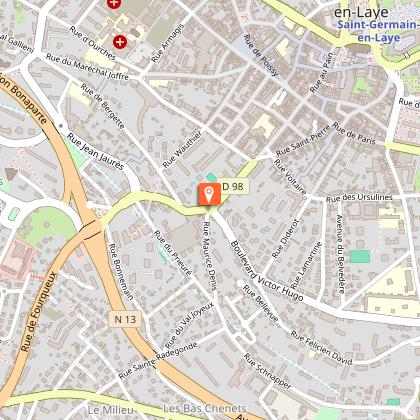
The old 'Prieuré' de Maurice Denis

The Maurice Denis departmental museum conceals a dense history in the maze of its vaulted corridors and gives pride of place to symbolist and Nabis painters whose works are revealed during your journey.Discover a garden dotted with sculptures and planted with tall trees, below a terrace and a former 17th century hospital. Now listed as a historic monument, this imposing building built at the end of the 17th century at the request of Madame de Montespan was then a royal general hospital which welcomed the needy. In 1914 Maurice Denis acquired this building in the garden of which he already had a workshop. He restored it, named it "The Priory" and lived there with his family until the end of his life. The initial fund of the museum was constituted by an exceptional donation made in 1976 by the family of Maurice Denis. Since then, numerous donations and acquisitions of works by Symbolist and Nabis artists, this innovative artistic movement at the crossroads of the 19th and 20th centuries, have enriched it. Thus, alongside the works of Maurice Denis illustrating religious and family themes, intimate scenes, or landscapes of Italy and Brittany, are exhibited paintings by Sérusier, Bonnard, Ranson, Vuilliard,... among the friends of the artist. . Do not miss to enter the chapel of the old hospital, one of the treasures of the place. The unique decor is the most complete and characteristic religious pictorial ensemble of the artist. Tiered on the hillside, the garden in which the museum is nestled invites you to stroll by offering varied landscapes and a rich botanical trail. Around the museum, a first level decorated with sculptures by Antoine Bourdelle, a close friend of the owner of the premises, is made up of a shaded courtyard and a long terrace lined with lime trees and hundred-year-old yews. From there, you reach the alley of the rose garden and a vast green theater lined with tall trees. Below stretch the old orchard and the vegetable garden, embellished with a fountain and a pond. Strolling through this harmonious garden provides a better understanding of the importance of nature in the painter's work and life. The garden space is now the privileged setting for plastic arts workshops and open-air concerts... A museum and a collection to discover without delay in the heart of Saint-Germain-en-Laye! Attention people with reduced mobility will not be able to access the floors, the elevator was out of order for an indefinite period.

2 bis, rue Maurice Denis 78100 Saint-Germain-en-Laye
- Office de Tourisme -
Consulter
image du object

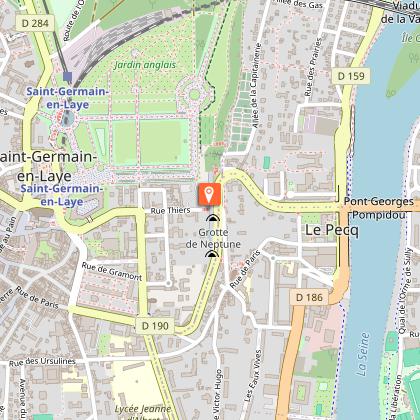
The Rampe des Grottes

The Rampe des Grottes, the Mur des Lions and the Pavillons Henri IV (where Louis XIV was baptised) and Sully (situated at Pecq) are the last remaining vestiges of the Château-Neuf and the magnificent composition of terraced gardens leading down to the Seine.The Rampe des Grottes was once fitted out in grand style: the hydraulic diversions gave much pleasure to Henri IV and his guests. It led from the bottom of the terraced gardens to the Château-neuf. Distinguished artists, including the Francini brothers, collaborated to create seven artificial grottoes beneath the terraces, each one housing amazing automatons. A SITE REWARDED IN 2017 Today, the Rampe des Grottes is classed as a Monument Historique, and in 2017, it was presented with the 'Rubans du patrimoine' regional award. THE RAMPE REKINDLED FOR 2017 HERITAGE DAYS In 2017, for the European Heritage Days, the Carabosse company decided to illuminate the Rampe by lighting it up with 1000 flames. Wrought-iron installations brought to life mechanically, eclectic music concerts and flaming torches placed from top to bottom of the Rampe revitalised this prestigious place. In addition to the Rampe des Grottes, other vestiges of Saint-Germain-en-Laye's second château remain: the Mur des Lions and the Pavillons Henri IV (where Louis XIV was baptised) and Sully (situated at Pecq). All have been restored, or have today found a new purpose, like the Hôtel-Restaurant Pavillon Henri IV. Listen to the podcast of an interview with Victoria Bernard (tourist advisor at the Office de Tourisme) by France Bleu during a guided tour of Saint-Germain-en-Laye: www.francebleu.fr/emissions/le-tour-de-l-ile-de-france-en-40-jours-09h45/107-1/etape-2-visiste-guidee-de-saint-germain-en-laye

Rampe des Grottes Rue Thiers 78100 Saint-Germain-en-Laye
- Office de Tourisme -
Consulter
image du object

Hidden bunkers: testimonies of the past

A testimony of the heavy German presence at Saint-Germain during the Occupation, more than a dozen bunkers still exist here, hidden around the town.They are an integral part of the urban landscape even though few of them are visible. Between 1940 and 1944, nearly 20,000 Germain soldiers and officers occupied the town, which was the general staff headquarters of German forces in the occupied zone. Built in large numbers, these bunkers were mainly civil defence structures. The best known is undoubtedly the one on Rue Félicien David. Partially buried underground, it could house several hundred soldiers and provide them with safe shelter in case of bombings. One of its rooms received all telephone lines from the Atlantic front for the Commander in Chief, Field Marshal Gerd von Rundstedt. The Saint-Germain-en-Laye bunkers are located at: - Parc du Château de Saint-Germain-en-Laye - Cité Médicis, rue Thiers - Pavillon Henri IV, below the Hôtel - Quartier Gramont, rue Saint-Louis - 25 bis rue Alexandre Dumas - Villa David, rue Alexandre Dumas - Collège Marcel-Roby, two structures hidden in the park - Rue Félicien-David, the shelter for von Rundstedt's command centre - 4 rue Félicien-David, shooting post extending onto the street - 13 rue des Monts-Grevets, gun-turret placed in a garden - 6 bis boulevard Victor-Hugo, now a garage - 10 ter boulevard Victor-Hugo, shelter covered with vegetation For safety reasons, access to the bunkers is now prohibited.

25bis rue Alexandre Dumas 78100 Saint-Germain-en-Laye
- Office de Tourisme -
Consulter
image du object

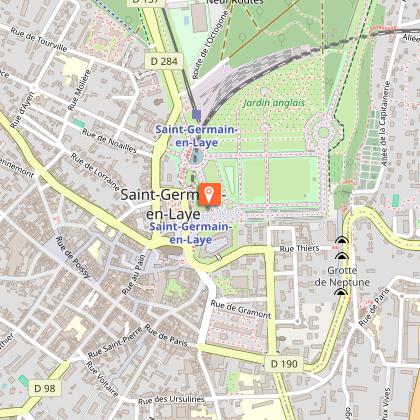
Domaine National

Many 16th-century kings and their landscape architects strove to make the Domaine National a rare gem featuring some of the most beautiful gardens of Ile-de-France.One of the main features of the Domaine de Saint-Germain is its famous Terrasse, which was designed by Louis XIV's head gardener, André Le Nôtre, and offers a superb view across western Paris. But the Domaine National also incorporates 70 hectares of protected spaces designed during the 16th, 17th and 19th centuries. Henri IV was the main person responsible for enhancing this park by building here, in the 16th century, a succession of six terraces leading down to the Seine, as well as arched galleries and some sumptuous grottoes. Later, during the reign of Louis XIII, the gardens lost their splendour, and it was Louis XIV who commissioned Le Nôtre to create new ones, from 1662 to 1674, giving rise to the famous "parterre de broderie" gardens. As a result, walkers and joggers benefit from the French gardens with suggestive names, such as the Boulingrin, the Grand Parterre and the Jardin de la Dauphine. As for the English garden, this was created in 1845 by the Crown Estate engineer, Loaisel de Tréogate. It was built on a parcel of forestland and features some remarkable trees. Nowadays, the Domaine attracts families, having adapted to become a recreational space with play areas and restaurants which open in the summer season for lunches and snacks.

Place Charles de Gaulle Domaine national du château de Saint-Germain-en-Laye 78100 Saint-Germain-en-Laye
- Office de Tourisme -
Consulter
image du object

Château-Vieux, an historical and architectural gem

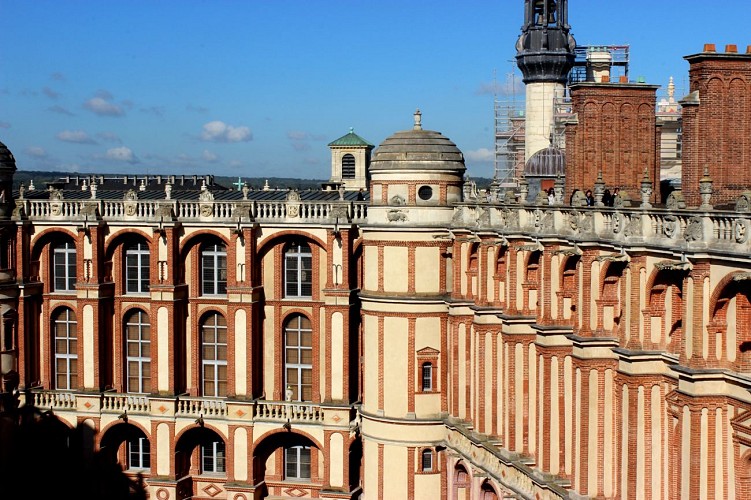
The Château-Vieux de Saint-Germain has welcomed many kings over the centuries, up to the time of Napoleon III, who turned it into the Musée d'Archéologie nationale that we know today. Come and learn about its history./ A ROYAL RESIDENCE / The imposing Château de Saint-Germain with its elegant Renaissance-style profile is in fact the third of a series that was begun by Louis VI in the 12th century. The first fortress, which became a ruin after the Hundred Years' War, gave way to a second building with a pentagonal shape commissioned by Charles V. It was François I who finally instigated the building of the Renaissance château, which was designed by Pierre Chambiges. François I and the kings that succeeded him stayed here often. Henri II continued the work initiated by his father and began construction of the Château-Neuf, where Louis XIV was born on 5 September 1638. It was Henri IV who finished this building. Overlooking the Seine, it was a real pleasure palace for the king and the court. The king added terraced gardens, which stretched down to the river. The Château-Neuf de Saint-Germain was at that time one of the finest in Europe. Under the reign of Louis XIV, Saint-Germain became the seat of the kingdom's government and the Château-Vieux was the king's main residence from 1666 to 1682, when the court left for Versailles; the layout of the city centre dates from this time. Some important events took place in the château, including the christening of Louis, Grand Dauphin, and the marriage of Mlle de Lois and the Prince de Conti; it was the scene of grand festivities, too: concerts, balls and theatrical performances. The King particularly favoured the worked of Molière and Lully. Towards the end of the 18th century, the Château-Neuf, which was already in a state of disrepair due to a lack of maintenance, was abandoned. Today, only a few remains, including the Rampe des Grottes and the Mur des Lions, recall its former existence. / TODAY'S MUSÉE D'ARCHÉOLOGIE NATIONALE / Napoleon III had the Château-Vieux restored by Eugène Millet, who notably destroyed the corner pavilions that Louis XIV had added. In 1867, the Emperor set up the 'Musée d’antiquités celtiques et gallo-romaines' here. Today, it houses the Musée d'Archéologie nationale. The old rooms of this Renaissance building display some of the finest archeological collections in the world. / THE CHÂTEAU'S COURTYARD AND CHAPEL / It was Louis IX, known as Saint Louis, who, in 1230–38, added a chapel whose style prefigured that of the Sainte-Chapelle de Paris. Many royal christenings and marriages took place here. Later, François I, adding bricks to stone, built the Renaissance château that you can discover today. And it was in the palace chapel that he married Claude of France on 18 May 1514. In the courtyard, a hidden trompe-l'œil presents itself to keen-eyed visitors. See if you can find it! As you enter the Rayonnant Gothic-style chapel, the oldest of the preserved buildings, look up and admire the corners of the rib vaults and their seven ronde-bosse heads, and have some fun seeing if you can spot that of Saint Louis! Free admission except during certain temporary exhibitions.

Place Charles de Gaulle 78100 Saint-Germain-en-Laye
- Office de Tourisme -
Consulter

Additional information

Updated by

Office de Tourisme Intercommunal de Saint Germain Boucles de Seine - 04/04/2025
www.reservation.seine-saintgermain.fr/
Report a problem

Contact

Phone : 01.30.09.39.89

Website : www.reservation.seine-saintgermain.fr/

Type of land

Ground
Grit

Data author

Image Office de Tourisme
proposed by Office de Tourisme
Jardin des Arts, 3 rue Henri IV 78100 Saint-Germain-en-Laye France

Ratings and reviews

To see around
See more
Open
Close
Show
Show
Show
Show
Show
Show
Show
Show
Show
Show
Show
Caution!
We have no information on the difficulty of this circuit. You may encounter some surprises along the way. Before you go, please feel free to inquire more and take all necessary precautions. Have a good trip! 🌳🥾