Alert
Alerts
Rocher Canon et Mare aux Évées trail
Description
This walk enables you to discover two very different sites: the boulder chaos* of the Rocher Canon, and a pond with its ditches created by Man.
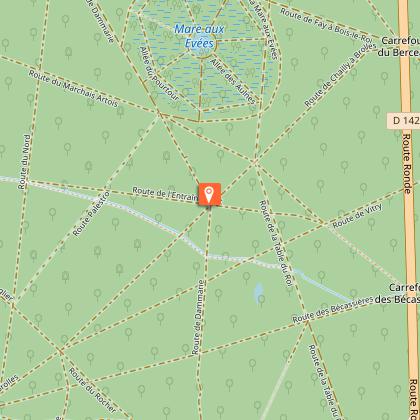
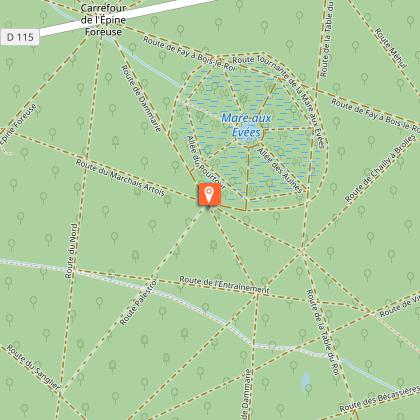
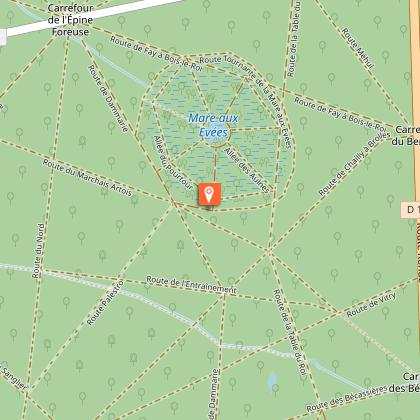
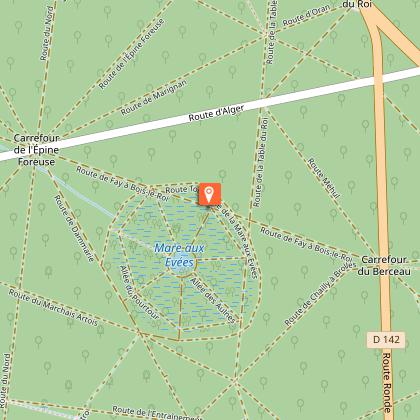
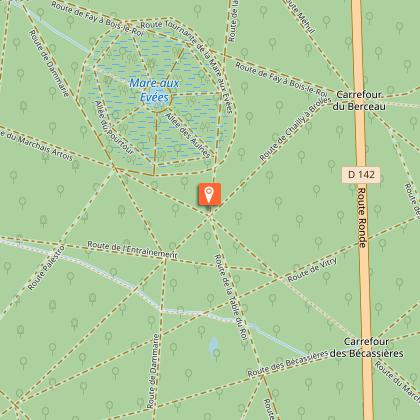
La mare aux Evées: the word « Evées » comes from old French and applies to a swampy area. The purpose of its ditches, dug under King Louis Philippe as part of public works aimed at fighting unemployment, is to drain this swampy area. A few noteworthy trees, as well as the names of alleys, bear witness to an ancient arboretum. More than 20 km of ditches were dug in a star pattern, as well as the central basin of 12. 000 m3.
Noteworthy trees: at the Rocher Canon, the oak called “Bonsai” is an outstanding curiosity of the Fontainebleau massif, a twisted tree literally “sitting” on a sandstone rock. Around the Mare aux Evées (and the Mare à Bauge nearby), bald cypresses also known as Louisiana cypresses were planted around 1830; an aerial excrescence of their roots, called cypress knees or pneumatophores can be observed.
Forest alleys: they began to be cut through the forest under the reign of King Henri IV (1556-1610), in order to ease access to the forest for stag hunting. The court was then able to follow the hunt in carriages thanks to theses alleys and star crossroads.
Technical Information
Altimetric profile
Starting point
Steps
Additional information
Updated by
Office de tourisme du Pays de Fontainebleau - 22/01/2026
www.fontainebleau-tourisme.com/
Report a problem
Environments
Forest location
Open period
All year round.
Contact
Phone : 01 60 74 99 99
Email : info@fontainebleau-tourisme.com
Website : http://www.fontainebleau-tourisme.com/
Topo guides and map references
Map references :
IGN Top25 no. 2417OT
Reception complements
Best practices in the forest:
• No waste in the forest
• Do not light fires in the forest
• Do not disturb wild fauna
• Bivouac only in authorized areas
• Share space together
• Do not climb on piles of wood
• Moderate picking
• Stay on trails
• Leave dead wood on the ground
• Dogs on leash in spring
• Hunting ground, do not enter
• Watch out for ticks
Data author
