Alert

Alerts

To see around
See more
Open
Close
Show
Show
Show
Show
Show
Show
Show
Show
Show
Show
Show

Oups... It would appear that Cirkwi does not have permission to use your location.

Presentation
Description
Map
Points of interest
Ratings and reviews
See around

Perspective de Maintenon trail

Perspective de Maintenon trail

Description

Along this walk you will get acquainted with the royal history of the forest and its relationship with the palace. Gaining elevation in the heart of the forest, it offers a beautiful view of Fontainebleau from the top of the Petit Mont Chauvet hill.

L’avenue de Maintenon: this forest road goes from the Maintenon gate to the hill called Petit Mont Chauvet. Once named Causeway Alley, Mail Henri IV or Alley of Elms, it was the setting of solemn entries, such as that of Charles the Fifth of Spain in 1539, and was a place for walks and games as well. The Maintenon gate was for a long time the main access to the palace. It was the departure point of royal stag hunting.

Le petit Mont Chauvet: formerly bare or « chauvet », this small limestone “mount”
was the location of the artillery batteries of the Applied School of Artillery after 1870. It is nowadays classified as a Managed Biological Reserve, as it is home to vegetation groups and numerous scarce and protected plants such as an endemic tree: the “French Hales” also known as

Technical Information

Walking
Difficulty
Easy
Duration
1h15mn
Dist.
3.7 km
Show more

Altimetric profile

Starting point

Parking de la Maison forestière de Maintenon ou Parking de l'allée de Maintenon , 77300   Fontainebleau
Lat : 48.39607Lng : 2.702136

Points of interest

image du object

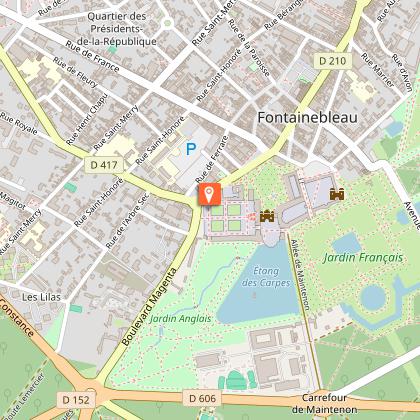
Fontainebleau palace gardens

In the 130 hectacres of garden , you can see the evolution of the art of the garden illustrated by the Great Flowerbed ("Grand Parterre") , French-style garden designed by Le Notre, the Carp Pond, the English garden, created under the first Empire, the Garden of Diana ("La jardin de Diane"), the Park , the 1200m canal ... Remarkable trees, Diana's Fountain, the Park, exotic essences, the English river ...These royal and imperial gardens are witnesses to the evolution of taste since the 16th until the 19th century in terms of landscaping. The Renaissance gardens created for Francis Ist and Henry IVth were mainly based upon a system of draining canals which started from the different wells and the carp pond and lead to the great canal. The Grand Parterre (Huge flowerbed) was created later in a very humid part situated between the carp pond and the canal. Under the reign of Louis XIVth, this "parterre" (the biggest one in Europe) will adopt a very classical appearance du to André Le Nôtre who conceived a real perspective leading from the pond to the canal with the fountain of "Tibre" in the centre of the parterre. This royal parterre reaches from the Maintenon alley to the cascades, from the ballroom and the quarter Henry IVth to the side perspective of "Saut du Loup" (the wolf hop). The Diana Garden is the former garden of the Queen. Its name comes from the fountain (17th century) which occupies its centre. This garden is limited by the "Galerie des Cerfs" built under Henry IVth (Deer Gallery), the small apartments (Louis XVIth), the Trinity Chapel, the Real Tennis court and separated from the town by a wall with some openings. The English garden was created in its present shape under the reign of Napoleon Ist. It is organised around an artificial romantic creek. Its valley like landscape integrates some sculptures and rare species of trees and plants. The carp pond, which dates back to the Middle Ages, is bordering this garden. In the centre of the pond the architect Louis Le Vau constructed a romantic pavilion under Louis XIVth (1662).

Place du Général de Gaulle 77300 Fontainebleau
- Fontainebleau Tourisme -
Consulter
image du object

Palace of Fontainebleau

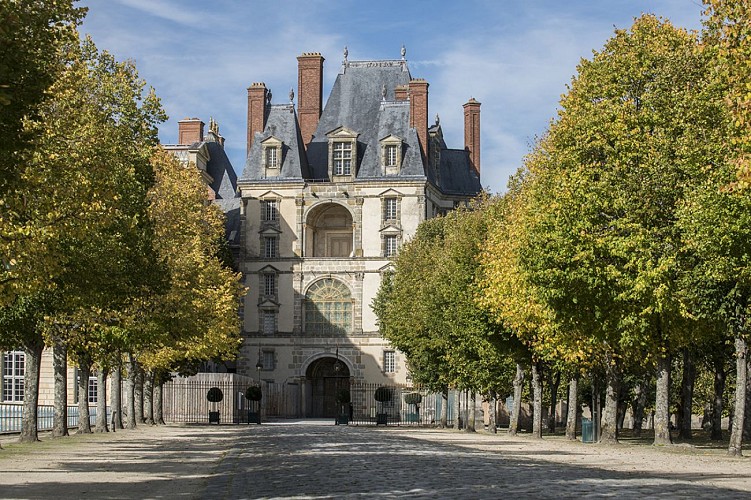
The Château de Fontainebleau is a big part of French history! This vast building, in both classical and Renaissance style, is not only famous for witnessing Napoleon's imperial adventure.From the royal charter of 1137 to the fall of the Second Empire in 1870, the Palace of Fontainebleau saw the lives of the greatest French sovereigns from day to day. The original medieval fortress was replaced by a Renaissance palace under the guiding hand of Francois I. At that time, two Italian artists, Primaticcio and Il Rosso vied in talent and founded the first School of Fontainebleau. The Galerie François I, which leads from the royal apartments to the chapel of the Convent of the Holy Trinity, is most original with its décor of frescoes, stucco and carved wood in praise of François I. The Ballroom was completed at the time of the last Valois kings, under Primaticcio’s direction. With Henri IV, the new Bourbon dynasty took over the palace, and built new rooms with interior decoration placed in the hands of the artists of the second School of Fontainebleau. Louis XIII completed the work started by his father. Under the Sun King Fontainebleau continued to be the royal family home, and the Grand Dauphin was born there in 1661. The king’s nieces were married from Fontainebleau, and the Edict of Nantes was revoked there in 1685. Louis XV and Louis XVI would spend the autumn there and initiated new, large scale building works and interior doing-ups. After the French Revolution, Napoleon I found the palace completely emptied of its furniture but intact. He undertook to refurnish the apartments and brought the palace back to its former glory as the home of the sovereign. Napoleon Bonaparte spent his last days there before his abdication in 1814 and departure for the Elba. Louis-Philippe was the first sovereign to order a complete restoration of Fontainebleau. The restoration of the Empire in 1852 gave renewed importance to the palace, and Napoleon III became strongly attached to this home, staying there regularly with his court. Housed in the Louis XV wing, the Napoleon I museum is dedicated to the Emperor and his family, with a large collection of objects from his everyday life, weapons used in military campaigns and gifts he received. The Chinese museum, created by Empress Eugenie, displays works of art from the Far East. The Jeu de Paume court, thought to be the oldest of the three surviving in France, is open to the public with demonstrations and introductory games. Le Nôtre's French gardens, the Queen’s English garden with its Fountain of Diana, the hedge maze and the Cour des Adieux are open to the public all year round. Boat excursions on the Etang aux Carpes or horse-drawn carriage rides are available. The Domain of the Fontainebleau Palace is inscribed at the UNESCO Humanity World Heritage. There is a little train going around the gardens during the touristic season.

Place du Général de Gaulle 77300 Fontainebleau
- Seine et Marne Attractivité -
Consulter

Additional information

Open period

All year round.

Updated by

Office de tourisme du Pays de Fontainebleau - 29/09/2025
www.fontainebleau-tourisme.com/
Report a problem

Environments

Forest location

Contact

Phone : 01 60 74 99 99

Email : info@fontainebleau-tourisme.com

Website : www.fontainebleau-tourisme.com/

Type of land

Stone
Ground

Topo guides and map references

Map references :
IGN map Forêt de Fontainebleau 1/16 000 or guide des balades en forêt de Fontainebleau

Reception complements

Best practices in the forest:
• No waste in the forest
• Do not light fires in the forest
• Do not disturb wild fauna
• Bivouac only in authorized areas
• Share space together
• Do not climb on piles of wood
• Moderate picking
• Stay on trails
• Leave dead wood on the ground
• Dogs on leash in spring
• Hunting ground, do not enter
• Watch out for ticks

Tricky passages

Hill to climb.

Data author

4 bis Place de la République 77300 FONTAINEBLEAU France

Ratings and reviews

To see around
See more
Open
Close
Show
Show
Show
Show
Show
Show
Show
Show
Show
Show
Show
Caution!
We have no information on the difficulty of this circuit. You may encounter some surprises along the way. Before you go, please feel free to inquire more and take all necessary precautions. Have a good trip! 🌳🥾