Alert

Alerts

To see around
See more
Open
Close
Show
Show
Show
Show
Show
Show
Show
Show
Show
Show
Show

Oups... It would appear that Cirkwi does not have permission to use your location.

Presentation
Description
Map
Points of interest
Ratings and reviews
See around

4-At the gateway of Vanoise, between mountain pastures and chapels

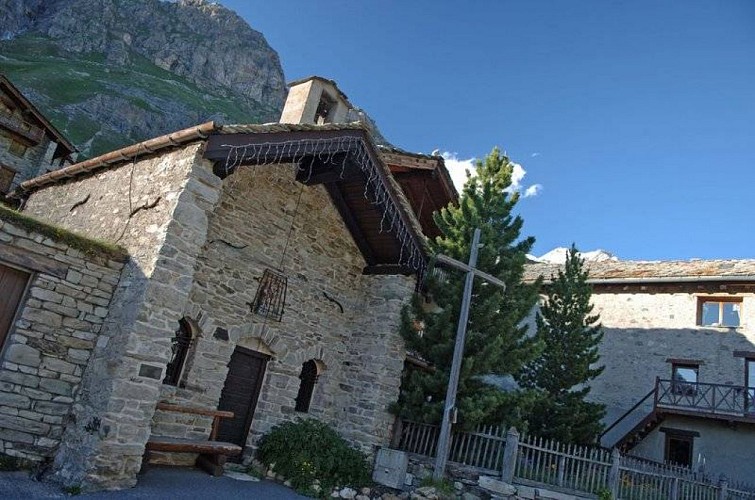
La chapelle Sainte-Lucie aux Branges
La chapelle Sainte-Marie-Madeleine du Fornet
La chapelle Saint-Roch
Le village de Val d'Isère
Credit : Val d'Isère Tourisme

Description

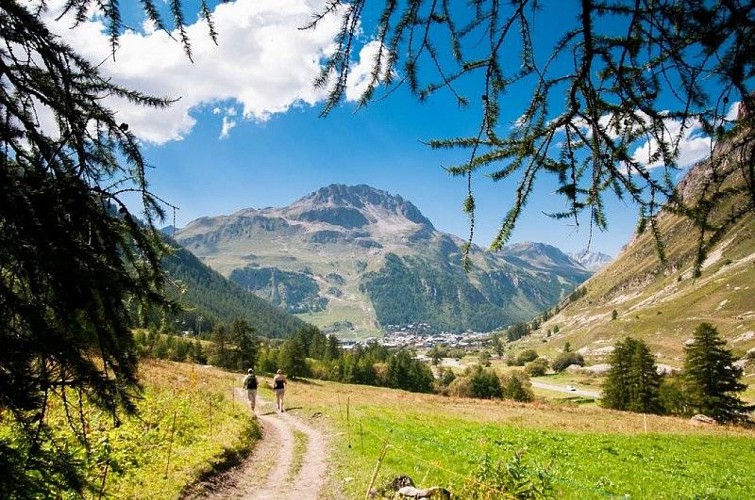
Set off in search of the seven chapels that line this route and give you an insight into the rich religious past of Val d'Isère and its hamlets. A scenic circular trail through the high mountain pastures, with Vanoise National Park just beyond.

Setting off from the Tourist Office, this trail gives you an insight into the rich religious past of Val d'Isère and its hamlets, through the seven chapels that you'll pass along the way. After reaching the hamlet of La Daille along the road, you'll make your way towards the Manchet valley via a mix of footpaths, quiet roads and tracks running through the mountain pastures. Once at the hamlet of Le Manchet, your route will take you back towards Val d'Isère and end at the gorgeous hamlet of Le Fornet. Do note that, between Val d'Isère and Le Fornet, the track is sometimes more technical and there may be lots of walkers out on the same route.Follow the green waymarks: les 7 Chapelles.E-bike rental shops and e-bike charging stations:Val E-BikeVal d'Isère TourismePlace Jacques Mouflier73155 Val d'IsèreVal E-BikeParc des Sports du Manchet73155 Val d'Isère+33 (0)4 79 06 06 60

Technical Information

Mountainbiking
Difficulty
Very easy
Duration
2h
Dist.
16 km
Show more

Altimetric profile

Starting point

Lat : 45.4486016Lng : 6.9809391

Points of interest

image du object

Notre-Dame-des-Neiges du Joseray Chapel

This chapel in Le Joseray, named "our Lady of the Snows", overlooks Le Manchet Valley. Mentioned as far back as 1633, firstly under the name St Michel and then, in 1790, under the name Our Lady of Compassion, it is now referred to as Our Lady of the Snows. In our mountains, whenever the Virgin or Our Lady is described as being "of the Snows", she is called upon to protect from the snow or ward off avalanches. On 5 August, during the Saint’s feast day, Mass used to be held in the chapel after a procession had taken place. In May, Le Joseray’s procession marked the end of the Rogation Days, which were a period when prayers were offered for God’s attention on the fields and harvests, to protect them from bad weather and insects. The fifth Sunday after Easter was Rogation Sunday, after which the “Grand Tour” would begin: Monday in Le Fornet, Tuesday in La Daille. On Wednesday, the third and final day of the Rogation ceremonies, the procession would leave the church while the cleric rang the bells until the parishioners arrived in Le Joseray. At each cross or crossroads, the procession would stop for the vicar to bless the fields. Chapels and churches dedicated to St Michael all feature the same characteristics: they stand out from afar as they are always built on a rocky spur or hillock, overlooking the landscape and reminding us mere mortals that, when the time of death comes, our deeds will be judged! In many places, the livestock would be brought back down from the high mountain pastures on St Michael’s Day: this was known as the démontagnée date. From the early Middle Ages, St Michael’s Day was also an important legal date: payments were due and contracts were renewed. This chapel is the largest of all the rural chapels in Val d’Isère and has a long nave with a barrel vault, culminating in a plain rectangular apse.

- Parc national de la Vanoise -
Consulter
image du object

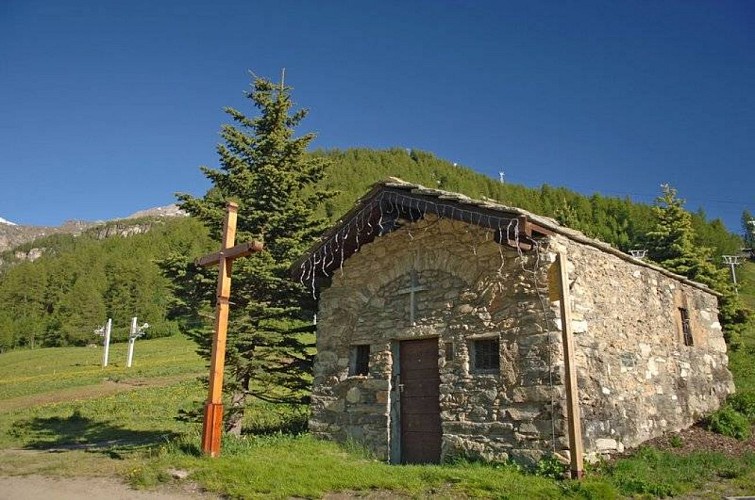
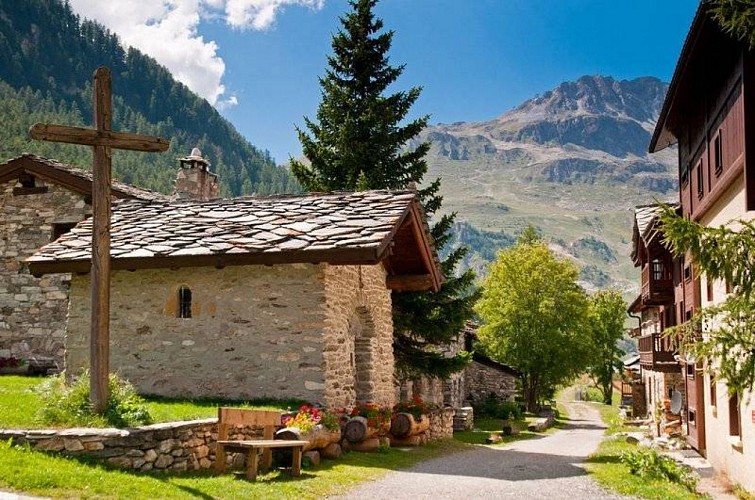
Saint-Jean-des-Prés Chapel

You’ll be able to recognise St Jean’s Chapel by the larch mission cross, erected in 1847. In the olden days, there was once a built-up spur behind the chapel (structure to protect against avalanches that could come down from Solaise via the Combe Martin). On striking the spur, they would split, lose speed and thus slow their destructive force. Built some 300m south of the church, the purpose of this chapel was to protect the village and its residents from avalanches. In 1790, four Masses, costing 12 sols (shillings) each, were celebrated a year. They were financed by an émigré who had moved to Val d’Isère, a merchant from Parma: Amédée Thovex. A procession would set off from the church with the reliquary in honour of St Innocent (21 July), the second patron saint of the Val church. With the reliquary perched on the shoulders of the male church members, banners, female church members covered in a white veil, vicars and clerics followed by believers would form this long procession that would head out along the road to Le Laisinant. On leaving the village, they would turn towards Le Rogoney to make their way back to St Jean’s Chapel where a blessing would take place before returning to the village: this was a day of celebration!Who was St John? A prominent figure of the New Testament, who can be found in a great many scenes, John, beloved disciple of Christ, has always been depicted in the iconography of the Western Church with young, and even effeminate features at times.

- Parc national de la Vanoise -
Consulter
image du object

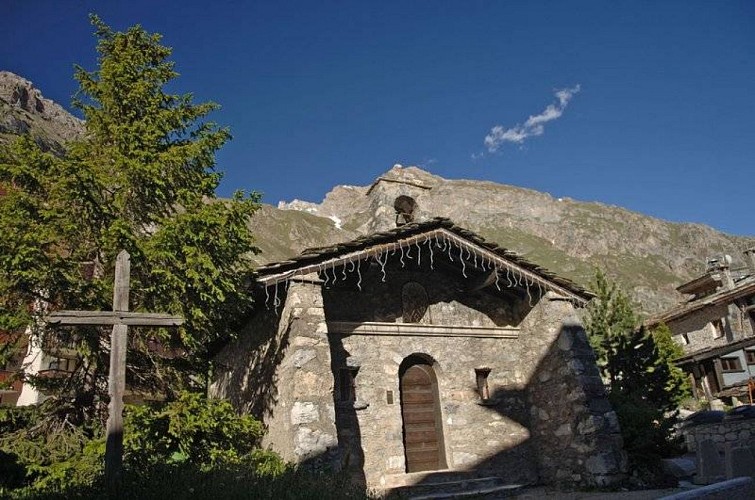
Sainte-Marie-Madeleine du Fornet Chapel

The chapels in Le Fornet have seen a fair bit of change over the centuries… that’s because of the avalanches. There have been four in all, dedicated to St Mary Magdalene each time. The first chapel was built between 1600 and 1630 near the larch forest to protect the village from avalanches. The present-day chapel was built in 1890, thanks to funds from Joachim Bonnevie. Above the entrance doorway, you can see the statuette of the Patron Saint in the recess. This was sculpted very recently as the original was stolen in the 1980s, along with many other religious artefacts. Up until the 1990s, on St Mary Magdalene’s Day, the vicar would come and bless the houses, then hold Mass in the chapel for the local congregation. Who was Mary Magdalene?According to the New Testament, Jesus cast out seven demons from Mary Magdalene. She went on to become one of his disciples - perhaps the most important. She was the first to witness Jesus’ Resurrection, which makes her very important. She is also the woman who features most prominently in the New Testament. Mary Magdalene weeps, as she does not understand what the angels are saying, it’s so unimaginable. That’s when Christ appears and speaks to her. He tells her that he is going to ascend to be with God and that she must tell the other disciples. 22 July is her feast day.Why does Mary Magdalene have a special place in Le Fornet?At this exact spot, water flows at the bottom of the gorge. It would have been difficult to access the River Isère if there was a fire. So the locals relied on Mary Magdalene’s tears to put out any fire.

- Parc national de la Vanoise -
Consulter
image du object

Sainte-Lucie aux Branges Chapel

At the time it was mentioned during the pastoral visit in 1633, this chapel was dedicated to St Francis of Assisi. The painting showing the stigmata of St Francis now hangs in St Roch’s Chapel. In the 18th century, it would be dedicated to St Lucy. In 1790, Mass was celebrated there for her feast day. The chapel was restored by Guy Turbil, who owned the house next door, in 1971. There were once several houses in the hamlet or village of Les Branges. This name refers to larch trees in local dialect.Who is St Lucy?Born into a very wealthy noble family from Syracuse, Lucy (who died between 303 and 310) lived with her mother Eutychia and venerated St Agatha. As her mother suffered from an inflammatory bowel syndrome and blood loss, one day Lucy decided to take her to Agatha’s tomb, in Catania, to ask for healing. The next day, Eutychia recovered. Following this healing, Lucy asked her mother’s permission to distribute to the poor everything that her father had left her. Both women then began giving all that they owned to the poor, a little each day. But Eutychia had promised Lucy’s hand in marriage to a young man who flew into a fit of rage when he heard that his fiancée wished to remain a virgin and was selling her fortune, which he had his eyes on, to give to the poor. So he denounced her to the Consul Pascasius, as an enemy of the deities of the Roman Empire. Refusing to give up her Christian faith, Lucy was sent to a brothel then martyred. Her name comes from the Latin word lux (which means light), and that is why she is associated with many festivals of light.

- Parc national de la Vanoise -
Consulter
image du object

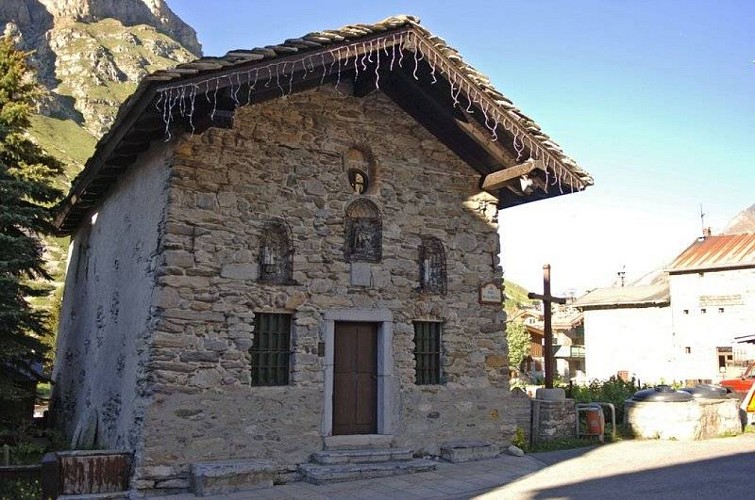
St Roch’s Chapel

St Roch’s Chapel stands on the square, a stone’s throw from the church. For a long time, the headrace that brought water to the adjacent mill flowed right in front of the chapel! (You can still see a millstone standing on the side). St Roch, Joan of Arc and the vicar of Ars can be seen in the recesses (the old statues were stolen). This chapel is mentioned during the pastoral visit in 1633. In 1790, a lawyer in Turin by the name of Boch gave a donation to enable 51 services to be held a year, i.e. one every Friday (what did he fear for the community and for himself we might wonder?). Nowadays, this chapel is still used as a chapel of rest.Who was St Roch?St Roch’s feast day is celebrated on 16 August. He was a hermit who spent his time embarking on pilgrimages. Often associated with St Sebastian, St Roch is invoked against plague. Veneration of him began to spread across Savoie in the mid 15th century, swiftly gaining ground through the 16th and 17th centuries, before almost completely disappearing in the 18th century. Plague was a terrible disease. Its pandemics took a devastating toll on populations. Yersin’s bacillus, the vector of the disease, was not identified until the 19th century. Rats carried the bacillus, and fleas, moving from the rats to humans, contaminated the population. In our mountain communities, which were crawling with hawkers, mule-drivers, merchants and smugglers, it’s hardly surprising that the disease often blighted the local populations. All it took was for a flea carrying the bacillus to jump inside the lapel of a cloak and the disease was there…

- Parc national de la Vanoise -
Consulter

Additional information

Public transport

Train services run as far as Bourg Saint Maurice.Find out more at: www.oui.sncf.comyou can then get a coach to Val d'Isère Bus Station. Find out more at: vente-bellesavoieexpress.fr/ Have you also thought about car-sharing?

Advice

Rando Vanoise has been designed to help you pick and choose your outings, but cannot be held liable where they are concerned. The mountain offers up a wide range of routes and trails for cyclists of all levels, but remember, it is a living, unpredictable environment and it is important that you head out suitably equipped. Ask advice from cycle rental operators.If in doubt, you can take an introductory lesson in how to ride an electric bike with an instructor.If you see a herd ahead, slow down and go round it. If there is a patou, a guard dog, climb down from your bike and walk, pushing it alongside you. Avoid making any sudden or aggressive gestures towards the dog and move away from the herd slowly and calmly. The dog will only be checking that you do not pose a threat to its herd. Respect the parkland and close gates behind you after you've gone through them.The mountain is living, please respect it by staying on the paths and tracks.

Advised parking

The underground car park in the centre (free parking in summer).

Access

From Moûtiers, take the RN 90 road towards Bourg Saint Maurice then turn on to the RD902 which will take you to the resort of Val d'Isère.

Arrival

Val d'Isère Tourisme, place Jacques Mouflier, 73155 Val d'Isère

Ambiance

This trail gives you an insight into the rich religious past of Val d'Isère and its hamlets, through the seven chapels that you'll pass along the way. There used to be more, but many have since disappeared, either owing to the wrath of the mountain (avalanches, floods) or for want of funds to maintain them. Le Manchet hamlet still harbours a few ruins that have survived over the centuries. Setting off from the resort of Val d'Isère, part of the circular route runs along lovely green sections, between woodland and the Isère riverbanks. Vanoise National Park is just beyond the mountain pastures you'll be riding through. On the final leg, by Le Fornet, you'll cycle over a magnificent bridge straddling the rushing River Isère.

Departure

Val d'Isère Tourisme, place Jacques Mouflier, 73155 Val d'Isère

Data author

Ratings and reviews

To see around
See more
Open
Close
Show
Show
Show
Show
Show
Show
Show
Show
Show
Show
Show
Caution!
We have no information on the difficulty of this circuit. You may encounter some surprises along the way. Before you go, please feel free to inquire more and take all necessary precautions. Have a good trip! 🌳🥾