Alert

Alerts

To see around
See more
Open
Close
Show
Show
Show
Show
Show
Show
Show
Show
Show
Show
Show

Oups... It would appear that Cirkwi does not have permission to use your location.

Presentation
Description
Map
Points of interest
Cirkwi brief's
Ratings and reviews
See around

Walk in Saint-Méry

Chemin du moulin des Voies
Chemin de la Pisserote
Charte du Randonneur FFR
Credit : CCBRC

Description

Located in a lush green setting and crossed by the Ancoeur stream, the village of Saint-Méry offers a refreshing countryside walk through lanes, fields, woods and streams.

Surrounded by greenery, the territory of Saint-Méry is crossed by the Ancoeur stream, the Moines stream and the Prée stream. This strong presence of water explains the large number of mills, washhouses, fountains and water pumps… The name of the village comes from Saint Médéric who is said to have stayed nearby around the year 695. This past is reflected in the name given to the inhabitants of Saint-Méry : the Médériciens and Médériciennes. The walking loop allows walkers to discover the last remains of a medieval past once organised around the church and the La Motte castle. Above all, it offers the discovery of an authentic rural heritage and a variety of landscapes.

The walk step by step…

1. From the parking area, head towards the village along Rue de Bombon (RD57). Continue straight ahead, cross Rue de la Garenne and take the green path called Chemin de l’Abreuvoir in front of you. Walk along the wall of the castle park, shaded by trees, and cross the Moines stream using the footbridge located on your left. At the end of the path turn right, then immediately left.
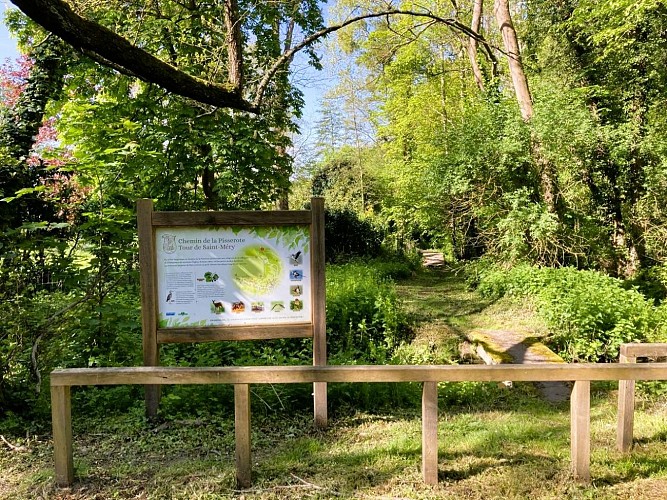
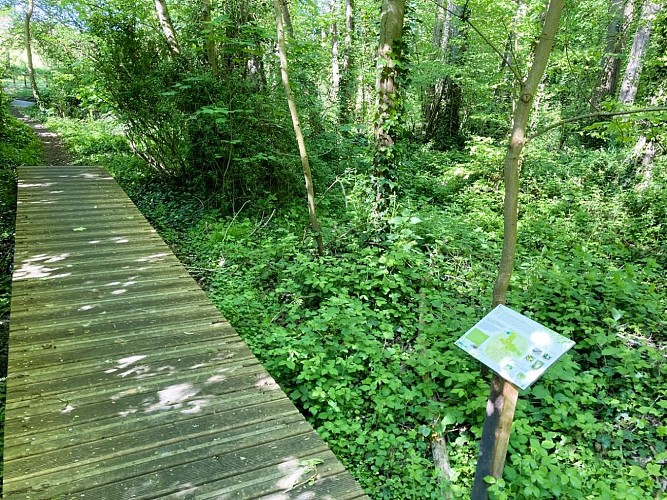
2. Follow the picturesque Chemin de la Pisserote for about 600 meters until you reach Rue du Gâtinais. A long time ago, this path allowed the monks from the collegiate church of Champeaux to reach the church of Saint-Méry through small family gardens. The walk begins by crossing a wetland area via a wooden footbridge, then you will cross the Prée stream. Before continuing along the old dry-stone walls, do not miss the beautiful countryside view of the church and the surrounding houses. Along the way, you will also enjoy views of the collegiate church of Champeaux and the wooded, rolling hills along the Prée stream.
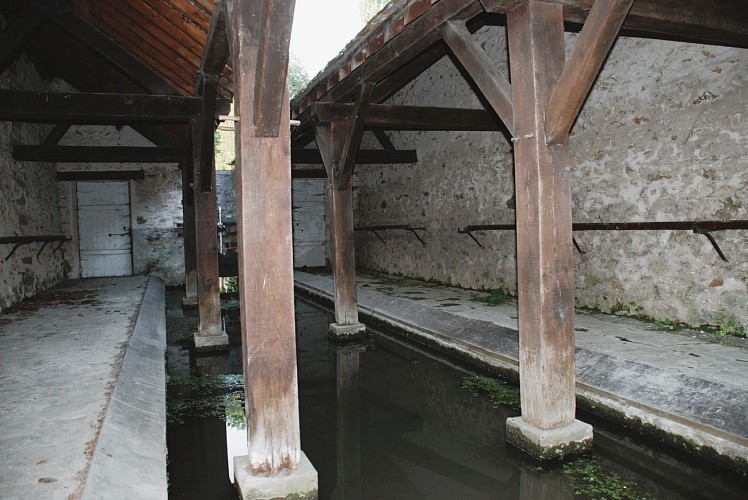
3. At the end of Chemin de la Pisserote, turn left onto Rue du Gâtinais (RD57) and continue until you reach the Pont des Planches. Shortly after the bridge, still along the street, on your left, you will find a covered washhouse with two rows, built at the end of the 19th century.
4. Return to the Pont des Planches and take the small path towards Flagy, which runs alongside the Prée stream near the Ville mill. Depending on the season, this naturally flower-filled area is particularly charming. Cross the Prée stream again and continue along a path beside a field. At the crossroads, enter the woodland and follow the path through it until you reach the Flagy mill. Turn left as you leave the path and walk up Rue de l’Ancien Moulin de Flagy (also part of the GR1 trail) and continue along the paved road until the first junction : turn left onto Route de Flagy, which offers beautiful views over the village.
5. At the second junction, you will see the Michaud watering place down below. Then continue your path along Route de Flagy. You will pass attractive farm buildings until you return to the center of the village.
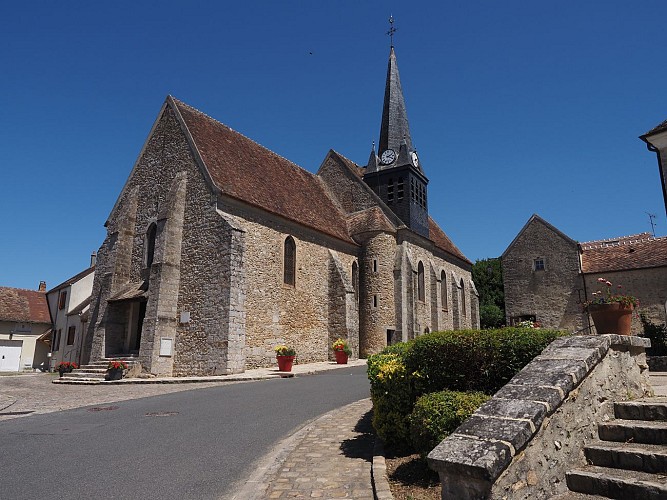
6. Continue left onto Rue du Jeu de Paume, then at the crossroads turn right onto Rue de l’Église. Pass in front of the Saint-Médéric church, listed as a Historic Monument since 1949, as well as the charming town hall. This church, originally built in the 12th century, is unusual in that it has two different levels due to later modifications. At the crossroads with Rue Montgimont, you will catch a glimpse of the gates of the La Motte Saint-Méry castle (closed to the public). Continue along Rue de la Garenne.
7. Turn right onto Rue aux Râles near the Saint-Méry primary school, then turn left onto Route de Mormant to return to the car park. A playground and picnic tables provide a well-deserved relaxing break, especially for children.

Municipality crossed : Saint-Méry
Distance : 3.7 km - Duration : 1h15 – Unmarked trail
Access to the map : www.cirkwi.com/fr/circuit/175741-balade-a-saint-mery

Technical Information

Walking
Difficulty
Very easy
Duration
1h15mn
Dist.
3.7 km
Show more

Altimetric profile

Starting point
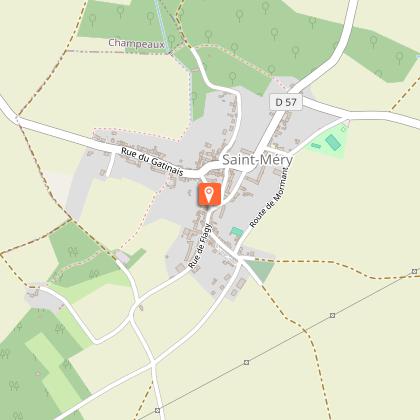
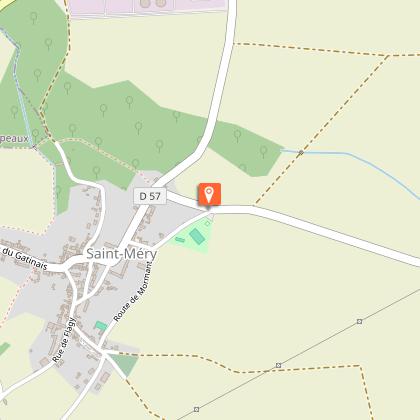
1 Croisement de la rue de Mormant et la rue de Bombon , 77720   Saint-Méry
Lat : 48.579303Lng : 2.831563

Points of interest

image du object

Église Saint-Médéric

L'Église Saint-Médéric à Saint-Méry est inscrite aux Monuments Historiques depuis 1949.Vers la fin du 7e siècle, Saint-Médéric, abbé de Saint-Martin d'Autun, partit en pèlerinage sur les tombeaux de Saint-Denis et Saint-Germain, à Paris, en compagnie d'un jeune moine du nom de Frodulphe. La route fut longue car l'abbé, vieillissant et fatigué, dut souvent s'arrêter pour prendre du repos. C'est ainsi que Médéric et Frodulphe firent halte en un endroit désert à proximité de Paris, où fut ensuite élevée une chapelle en souvenir de l'abbé pèlerin, dont la charité, la piété et les miracles avaient frappé les populations. Bientôt quelques maisons vinrent se grouper autour de l'édifice placé sous le vocable de Saint-Médéric dit Saint-Merry, Saint-Merri ou encore Saint-Méry. Comme de nombreux édifices religieux, l'église du village mentionnée dès le 12e siècle, a subi de multiples modifications au cours des siècles passés. Construite sur une pente à forte déclivité, elle est constituée de deux parties distinctes : une partie basse – la nef – et une partie haute comprenant le chœur, le collatéral sud et le clocher. La sacristie a été construite en 1824. - La nef comporte 4 travées de voûtes à croisées d’ogives, lesquelles cachent une charpente médiévale pouvant dater du 15e siècle. Cette voûte en briques de plâtre réalisée en 1888 a remplacé l’ancienne voûte romane de 5 travées. - Le chœur et le collatéral sont constitués chacun par trois travées de voûtes à croisées d’ogives du XVIe siècle. Celles-ci s’appuient sur les chapiteaux sculptés en feuilles contournées des piliers cylindriques et sur des consoles (masques) du 12e siècle. - Le clocher à grande flèche octogonale culmine à une vingtaine de mètres et n’abrite qu’une seule cloche, « Hélène Camille », installée en 1892. Les registres paroissiaux mentionnent deux baptêmes de cloches (1702 et 1742). L'église abrite de nombreux objets protégés au titre des Monuments Historiques : tableaux, bancs de fidèles, plaque funéraire, peinture monumentale... Le décor intérieur : - La peinture murale (du 16e siècle, repeinte au 19e) qui orne la voûte du chœur représente « Les Quatre Evangélistes ». Elle pourrait être l’œuvre de l’atelier d’un des maîtres de la Renaissance (le nom du Primatice a souvent été avancé, sans aucune certitude). - Les statues de Saint-Merry (à gauche de l’autel) et de saint Eloi (à droite) en bois polychrome datent du 16e siècle, repeintes au 20e. - La statue de Saint-Vincent (du 17e siècle) et un petit tonneau sculpté près de la chaire, rappellent le passé de Saint-Méry, autrefois village de vignerons. - L’autel en pierre sculptée et en mosaïque (1827) représente sur le devant la Cène des disciples d’Emmaüs et sur les côtés les figures allégoriques du Pain et du Vin. - Le banc d’œuvre en bois sculpté et doré, les bancs avec portillons, la chaire à prêcher et le confessionnal sont du 19e siècle. Le lutrin est peut-être du 18e siècle. - Les tableaux : « Jésus parmi les Docteurs de la Loi » réalisé au 17e siècle offre – pour certains spécialistes – des similitudes avec des œuvres de Le Sueur, « Saint Charles Borromée » et « Saint Jean tenant un calice ». Tous les vitraux datent de la fin du 19e siècle. A remarquer : la marche qui mène à l’autel provient du réemploi d’une ancienne dalle funéraire qui a été sciée. Cette dalle est celle de Bienvenue Reine de Champrond, décédée en 1547, épouse de Nicolas de Louviers, seigneur de la Motte-Saint-Merry.

18 Rue de l'Église 77720 Saint-Méry
- Communauté de Communes Brie des Rivières et Châteaux -
Consulter
image du object

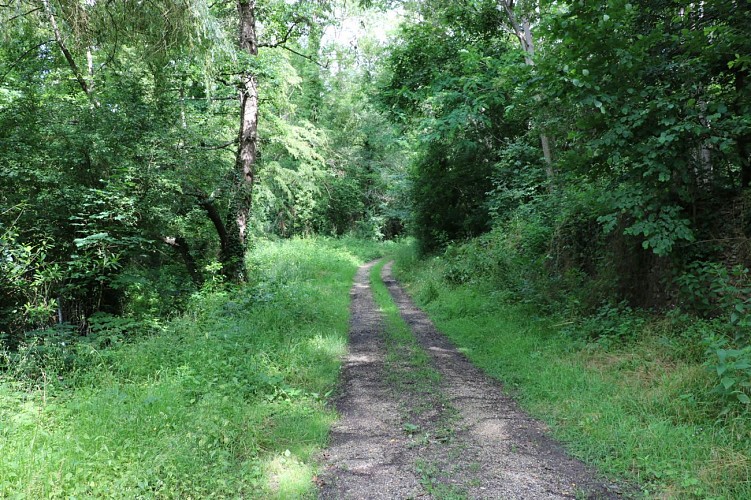
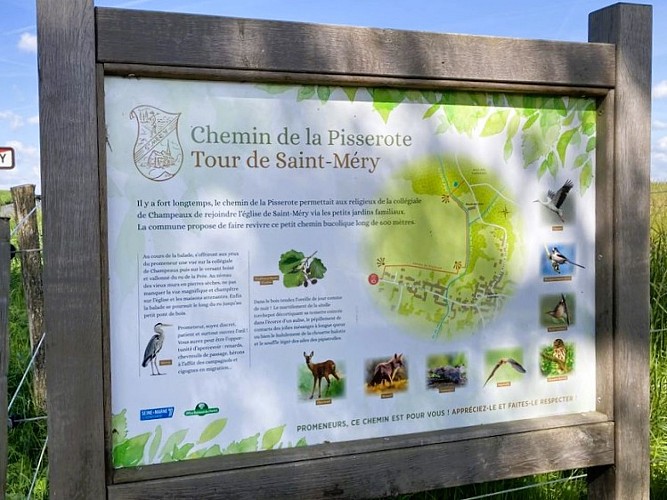
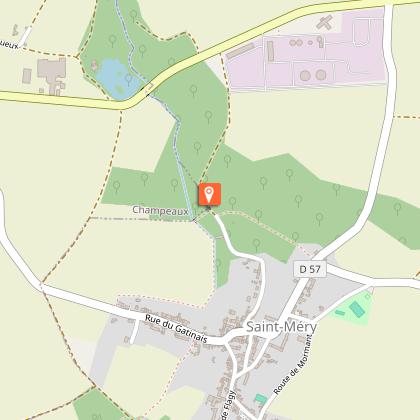
Le Chemin de la Pisserote

La commune de Saint-Méry a réhabilité le Chemin bucolique de la Pisserote, long de 600m, qui permettait, il y a fort longtemps, aux religieux de la collégiale de Champeaux de rejoindre l'église de Saint-Méry via les petits jardins familiaux...- Le Chemin de la Pisserote Tour de Saint-Méry débute juste à l'entrée du village, sur la RD57 (rue du Gâtinais), à hauteur de la première maison. - Au cours de la balade s'offriront aux yeux du promeneur une vue sur la collégiale de Champeaux puis sur le versant boisé et vallonné du ru de la Prée. - Au niveau des vieux murs en pierres sèches, ne pas manquer la vue magnifique et champêtre sur l'église et les maisons attenantes. - Enfin la balade se poursuit le long du ru jusqu'au petit pont de bois. Promeneur, soyez discret, patient et surtout ouvrez l'oeil ! Vous aurez peut-être l'opportunité d'apercevoir : renards, chevreuils de passage, hérons à l'affût des campagnols et cigognes en migration... Dans le bois tendez l'oreille de jour comme de nuit ! Le martèlement de la sitelle torchepot décortiquant sa noisette coincée dans l'écorce d'un aulne, le pépiement de contacts des jolies mésanges à longue queue ou bien le hululement de la chouette hulotte et le souffle léger des ailes des pipistrelles. Promeneurs, ce chemin est pour vous ! Appréciez le et faites le respecter !

chemin de la Pisserote 77720 Saint-Méry
- Communauté de Communes Brie des Rivières et Châteaux -
Consulter
image du object

La Petite Mouillère

En vous promenant sur le chemin de la Pisserote à Saint-Méry, vous traverserez une petite mouillère qui fait partie d'une zone humide plus vaste (étang de Varvanne, ru de la Prée, ru des Moines, ru d'Ancoeur). Une précieuse richesse pour le village !Elle joue un rôle important dans la prévention des risques naturels (inondations, sécheresse), purification de l'eau, mais aussi la conservation de la biodiversité (refuge de différentes espèces de végétaux et d'animaux ...) Un lieu de vie essentiel pour les Salamandres, Demoiselles, Libellules, Limnées, Grenouilles vertes, Ficaires, Reines des prés... En hiver : la zone humide se gorge d'eau comme une éponge et la retient grâce à différents éléments comme les végétaux (la tourbe). Elle limite ainsi les risques d'inondation pour le village. En été : la zone humide, qui a emmagasiné l'eau en hiver la restitue au ru de la Prée et aux arbres. Ces derniers participent aussi à la régulation du climat local en créant des "rivières de nuages" qui viennent rafraîchir le village et les alentours grâce l'évapotranspiration. Le village est ainsi préservé de la sécheresse ! Le saviez vous ? Les milieux humides sont capables de purifier l'eau contenant les excès agricoles ou chimiques (nitrates, phosphates et pesticides) en les piégeant ou en les transformant grâce à des processus biogéochimiques (notamment l'action des bactéries, des végétaux, des petits animaux et des caractéristiques du milieu lui-même). Les zones humides, sources de bien-être humain, remplissent de multiples fonctions et offrent de grands bénéfices face à la crise climatique, de l'eau et de la biodiversité, et constituent l'un des écosystèmes les plus utiles pour la vie en général, et la vie humaine en particulier, dans tous ses aspects, tant matériels que spirituels.

chemin de la Pisserote 77720 Saint-Méry
- Communauté de Communes Brie des Rivières et Châteaux -
Consulter
image du object

The Val d'Ancoeur : a protected site

The history begins like a fairy tale : "Once upon a time the Val d'Ancoeur..." with its castles, its legends and the 3 names of this small stream, which has become a myth, that from Ancoeur becomes Ancoeuil to end as the Almont... before flowing into the Seine.(Extract from the website of the Departmental Archives) The Ancoeur stream is a watercourse that has its source in the municipality of Grandpuits-Bailly-Carrois at an altitude of 125 m. It then takes the name of "Ancoeuil" in the municipality of Moisenay and joins, after a journey of 25 km from its source, the Bassin de la Poële of the Vaux-le-Vicomte castle. At the exit of this basin, it flows into the "Almont" 5 km downstream into the Seine at Melun. It constitutes, with its tributaries, a catchment area of approximately 306 km². The Ancoeur stream flows through the municipalities of Grandpuits-Bailly-Carrois, La Chapelle-Gauthier, Bréau, Bombon, Saint-Méry, Blandy-les-Tours, Moisenay, Maincy and Melun. Classified as an "Exceptional Site" since October 14, 1985 by the Regional and Inter-Departmental Directorate for the Environment and Energy of Île-de-France, the Ancoeur stream offers enchanting landscapes. The classified site covers 1,861 hectares. Along the watercourses — the Almont, the Ancoeuil (or Ancueil) and then the Ancoeur — the Val d'Ancoeur unfolds its panoramas : villages, forests, castles (Vaux-le-Vicomte, Blandy-Les-Tours...) but also, at the confluence of the Seine, urbanised areas. "The Ancoeur is a very low-flow river, highly irregular and regularly at risk of running dry. The annual runoff depth within its catchment area is 96 millimeters annually, which is among the lowest in France, more than three times below the national average, and above all well below the average for the entire Seine basin (approximately 240 millimeters). The constant flow of the Ancoeur has, however, for centuries made it possible to operate the many mills. The large number of hydraulic structures, such as canals, basins and ponds, small reservoirs and mills, give the landscape a particular identity centred on water and its management. This is to be understood in relation to the wet character of the land." A place of life, production and creation, the Val d'Ancoeur brings together major heritage sites across the entire territory : churches and works of art dating back to the 12th century, castles, farms, mills, rural dwellings, small rural heritage... It has also become a subject of reflection and aesthetic admiration thanks to the artists who have captured its beauty and interpreted it in their own way. - The Ancueil ("Anqueil" in its 17th-century spelling) gave its name for example to a majestic statue in the park of Vaux-le-Vicomte, located to the left of all the grottos (1659–1662), facing the Tibre installed to the right in 1659. - The painter Paul Cézanne immortalised the bridge called Pont de Maincy in 1879 (now held at the Musée d'Orsay). - And the sculptor Auguste Rodin dedicated magnificent drawings to the collegiate church of Champeaux (1890–1917), as testimony to his admiration. For several years, the Communauté de Communes Brie des Rivières et Châteaux and the Communauté d'Agglomération Melun Val de Seine have joined forces to develop a Landscape Plan, revealing the assets of the Val d'Ancoeur. An opportunity for the protection and enhancement of the landscape heritage. The perimeter, which is based on the classified site, encompasses 11 municipalities across an area of approximately 56 km². It extends over a straight-line distance of nearly 17 km.

- Communauté de Communes Brie des Rivières et Châteaux -
Consulter

Additional information

Environments

In the country

Updated by

Communauté de Communes Brie des Rivières et Châteaux - 05/06/2026
www.briedesrivieresetchateaux.fr
Report a problem

Open period

All year round daily.

Contact

Phone : 01 64 38 72 94

Email : mairie@saintmery.fr

Website : https://www.intramuros.org/saintmery

Data author

The Cirkwi brief

Discover Saint-Méry: A Refreshing Walk Through History


Nestled amidst verdant landscapes, the charming village of Saint-Méry, guided by the Community of Communes Brie des Rivers and Castles, invites explorers on a refreshing walk that beautifully melds the allure of the countryside with the whispers of its medieval past. Wander through the quiet streets, beside murmuring streams, and discover relics of a time gone by, including mills and the picturesque Saint-Médéric church, all the while being enveloped in a tapestry of rural splendor. This journey isn’t just a walk; it’s an invitation to step through time, amidst nature, and breathe in the tranquil atmosphere of Saint-Méry.

Key Details of the Route Unveiled


Spanning a distance of 3.2 kilometers with altitudes ranging from 77 to 101 meters, this picturesque trail through Saint-Méry embodies a gentle walk suitable for enthusiasts of all levels. Commencing at the crossroads of rue de Mormant and route de Bombon, participants navigate a path devoid of markers, yet rich in scenic beauty and historical appeal. This loop encapsulates a mild elevation change of 59 meters both ways, positioning it as an optimal choice for a leisurely and engaging hour-long exploration.

Tips for Year-Round Enjoyment


As your local guide, I recommend embarking on this gentle expedition through Saint-Méry during the early morning or late afternoon to capture the splendid natural lighting for photography enthusiasts. Spring offers a verdant, blossoming trail, while autumn showcases a riot of colors. Wear comfortable walking shoes, carry water, and remember that some paths may become slippery after rain. Although the trail is accessible year-round, always check the weather beforehand for a pleasant journey. Lastly, respect the tranquility and cleanliness of the area, ensuring it remains pristine for future visitors.

The Heart of Saint-Méry’s Rich Heritage


Saint-Méry stands as a testament to the profound historical and cultural richness of the Île-de-France region. With the village's name deriving from Saint Médéric, who resided nearby in the year 695, to the architectural marvel that is the Saint-Médéric church—listed as a historic monument since 1949—each corner of Saint-Méry echoes stories from its bygone era. This circuit not only offers a glimpse into the village's medieval past but also honors the legacy of its natural and architectural landmarks, preserving the essence of rural France.

Weather Insights for the Explorer


Île-de-France benefits from a temperate climate, making Saint-Méry a delightful destination throughout the year. However, for the optimal walking experience, I recommend visiting between late spring and early autumn, when weather conditions are mild, and the countryside is at its most vibrant. July and August can be warmer, yet the shaded paths offer respite from the sun. Always prepare for the chance of rain by carrying appropriate gear, ensuring the weather doesn’t dampen the spirit of your adventure.
Automatically generated.

Ratings and reviews

To see around
See more
Open
Close
Show
Show
Show
Show
Show
Show
Show
Show
Show
Show
Show
Caution!
We have no information on the difficulty of this circuit. You may encounter some surprises along the way. Before you go, please feel free to inquire more and take all necessary precautions. Have a good trip! 🌳🥾