Alert

Alerts

To see around
See more
Open
Close
Show
Show
Show
Show
Show
Show
Show
Show
Show
Show
Show

Oups... It would appear that Cirkwi does not have permission to use your location.

Presentation
Description
Map
Points of interest
Ratings and reviews
See around

Lyon’s must-see attractions in a day

Lyon’s must-see attractions in a day

Description

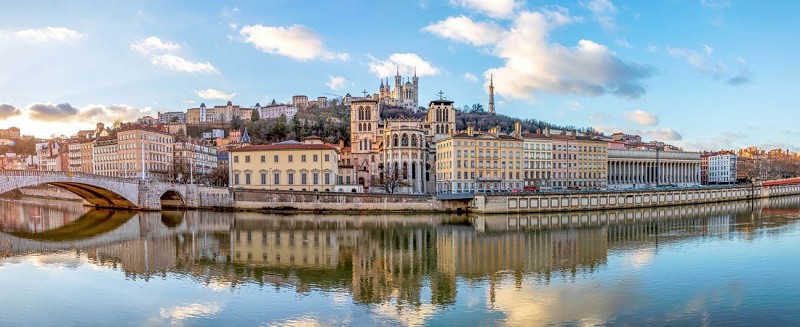
From Bellecour to Vieux Lyon, via the Presqu’île and Fourvière, the Lyon Tourist Office offers a 6-kilometre walking tour to help you discover the city’s must-see sights in just a day.

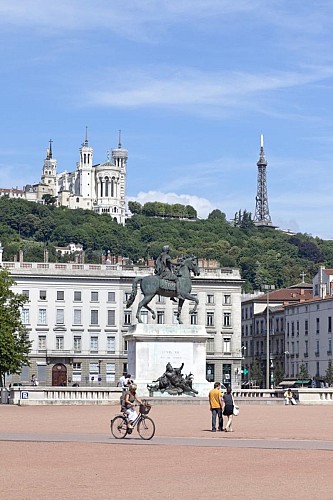
- 1. Start at Place Bellecour. After stopping by the Tourist Information Office, where you’ll receive information about your route, leave the square via Rue de la Barre, heading toward the Basilica of Fourvière, which you can see in the distance, then cross the Bonaparte Bridge to reach Old Lyon.

- 2. Avenue Adolphe Max: At the end of the bridge, continue straight ahead on Avenue Adolphe Max. The Vieux Lyon station is at the end of this avenue, on your left.

- 3. Vieux Lyon Station: Take the F1 funicular toward Saint-Just and get off at the Minimes – Théâtres romains stop.

- 4. Fourvière Archaeological Site: Upon exiting the station, enter the archaeological site and walk through the Gallo-Roman Grand Theater and the Odeon.

- 5. Rue Roger Radisson: At the top of the Grand Théâtre, after climbing the steep steps, head to the intersection of Rue Cléberg and Rue Roger Radisson and continue toward the Basilica of Fourvière.

- 6. Notre-Dame de Fourvière Basilica and Esplanade: Make your way to the basilica; take this opportunity to explore the interior of this gem of Neo-Byzantine architecture before heading to the esplanade to admire the exceptional panoramic view of Lyon.

- 7. Jardin des Hauteurs: From the esplanade, take the path to the left of the basilica and walk down the paths of the recently renovated Parc des Hauteurs.

- 8. Montée des Chazeaux: Continue downhill by taking the stairs of the Montée des Chazeaux.

- 9. Rue Tramassac: At the bottom of the hill, turn right onto Rue Tramassac, then left onto Rue de la Brèche.

- 10. Saint-Jean-Baptiste Cathedral: Walk across the square and take the opportunity to visit the magnificent Saint-Jean Cathedral, which blends Romanesque and Gothic styles.

- 11. Archaeological Garden: As you leave the cathedral, walk around it via Rue Saint-Etienne (to the left if you’re facing the cathedral). Walk along the Saint-Jean Archaeological Garden, which features the ruins of two 5th-century churches, then head to Quai Romain-Rolland.

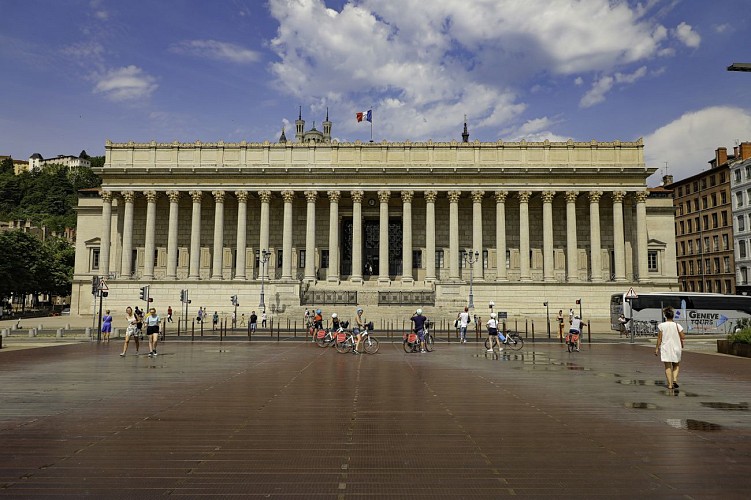
- 12. Historic Courthouse: Continue north along the courthouse, then head back toward the heart of Old Lyon.

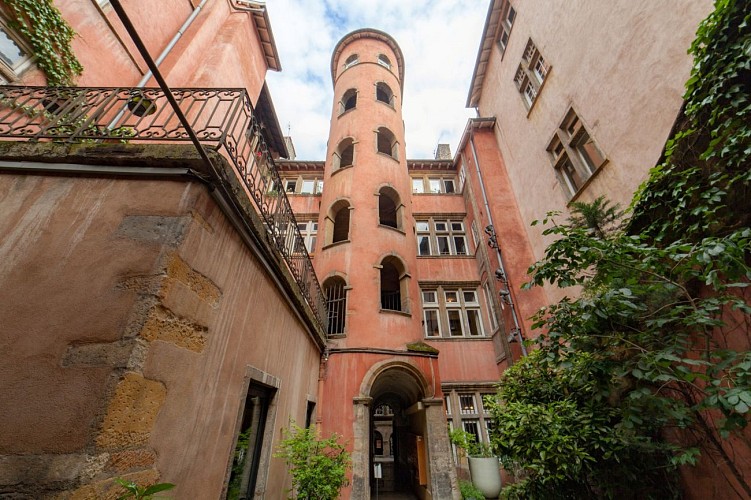
- 13. Rue du Bœuf: Go around the Courthouse via the street of the same name, then cross Place Neuve Saint-Jean before turning right onto Rue du Bœuf. On this street, take a short detour through the traboule at number 16. It leads to a charming courtyard and the Tour Rose (behind you as you enter the courtyard).

- 14. Gadagne Museums: Continue along Rue du Bœuf until you reach the Charvet clock, featuring automatons reminiscent of the world of Guignol. Right next to it is a magnificent Renaissance complex housing the Lyon History Museum and the Museum of Puppetry Arts.

- 15. Rue de la Fronde: Turn right onto Rue de la Fronde, then right onto Rue Saint-Jean, and continue north.

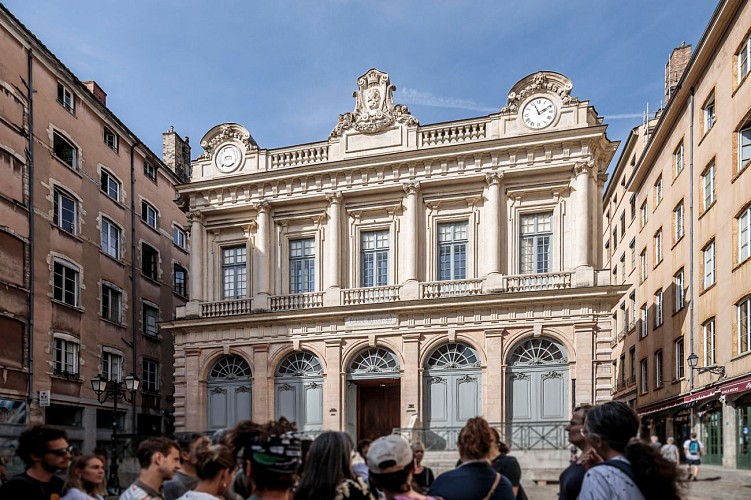
- 16. Temple du Change: The Temple du Change is on the left at Place du Change. Formerly the site of the stock exchange, it has been a Protestant church since 1803. After admiring it, continue straight ahead on Rue de la Lainerie.

- 17. Saint-Paul Station: Follow Rue de la Lainerie to Saint-Paul Station, then walk past the station.

- 18. Rue du Docteur Augros: After the station, turn right onto Rue du Docteur Augros, past the Vélo’v station.

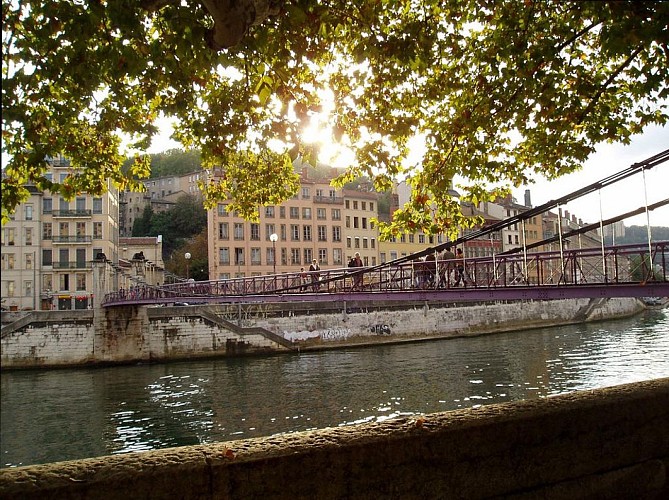
- 19. Saint-Vincent Footbridge: Cross the Quai de Bondy and take the Saint-Vincent Footbridge to reach the other bank of the Saône.

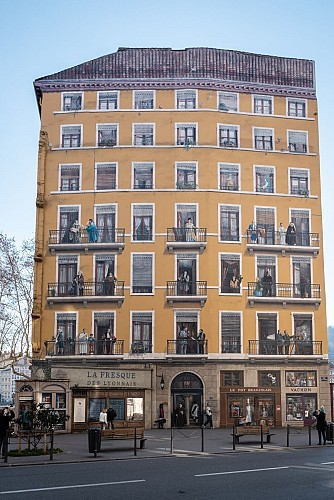
- 20. Mural of Famous Lyonnais: At the foot of the footbridge, continue straight ahead onto Place Saint-Vincent and turn around to see one of Lyon’s most famous and largest murals: the “Mur des Lyonnais”

- 21. Rue de la Martinière: Continue along Rue de la Martinière (to the right when coming from the footbridge) and walk past the Lycée de la Martinière.

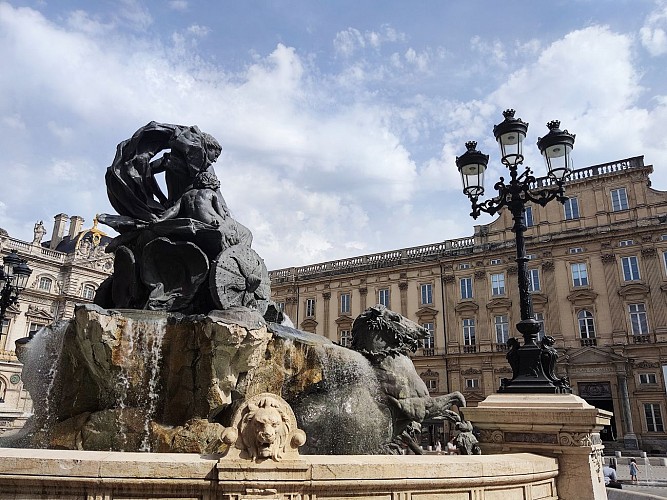
- 22. Rue Lanterne: Turn right onto Place Tobie Robatel, then turn left onto Rue d’Algérie to reach Place des Terreaux.

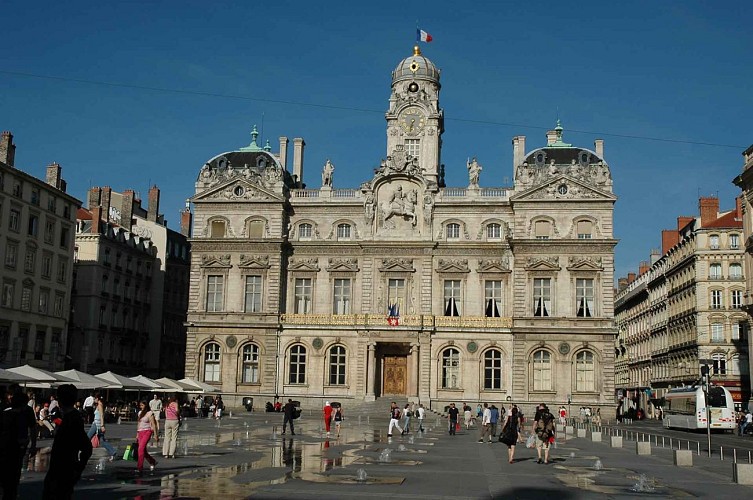
- 23. Place des Terreaux: Explore City Hall and the Palais Saint-Pierre, which houses the Museum of Fine Arts.

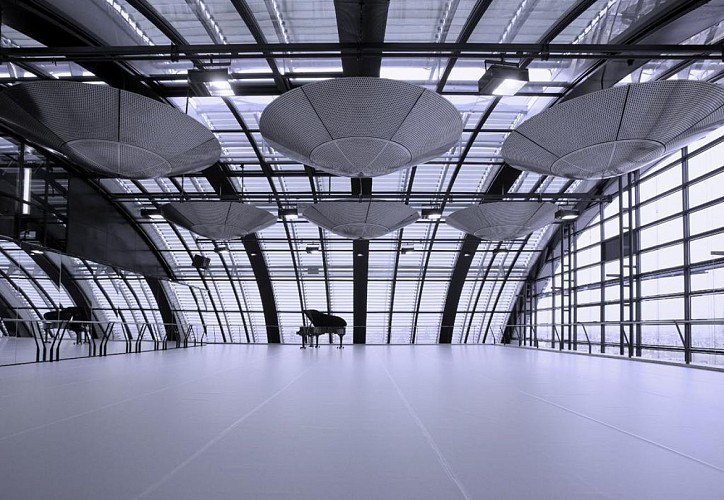
- 24. Lyon Opera House: Walk along the City Hall on Rue Joseph Serlin (to the right of City Hall), then stop at Place de la Comédie to admire the Lyon Opera House, redesigned by architect Jean Nouvel in 1993.

- 25. Rue de la République: From Place de la Comédie, take Rue de la République south. Continue to the Palais de la Bourse, located in the Cordeliers district.

- 26. Rue Grolée and Rue du Président Carnot: When you reach the Palais de la Bourse, turn onto Place des Cordeliers, then turn right onto Rue Grolée, before taking Rue du Président Carnot to Place de la République.

- 27. Grand Hôtel-Dieu: From Place de la République, take Rue Marcel-Gabriel-Rivière and enter the Grand Hôtel-Dieu.

- 28. Cours du Grand Hôtel-Dieu: Cross the various courtyards heading south, following the interior passageways: Cour du Cloître, Cour Saint-Louis, Cour Saint-Henri, Cour Sainte-Élisabeth, Cour Saint-Martin, and Cour du Midi.

- 29. Rue de la Barre: Exit the Grand Hôtel-Dieu via Rue de la Barre, then head toward Rue du Président Édouard-Herriot.

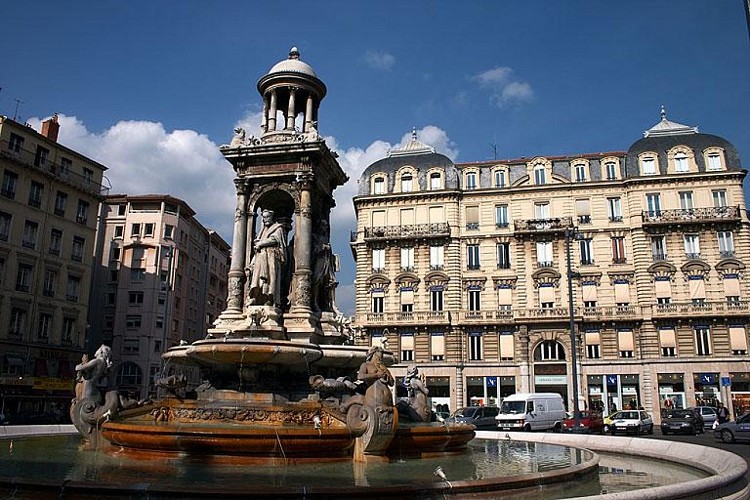
- 30. Place des Jacobins: Turn right onto Rue du Président Édouard-Herriot and continue toward the charming Place des Jacobins, which appears on your right.

- 31. Théâtre des Célestins: Leave the square via Rue Jean-Fabre, then head to Place des Célestins and its theater.

- 32. Rue Émile-Zola: Take Rue des Archers, directly across from the theater, and turn right onto the pedestrian street Rue Émile-Zola.

- 33. Arrival at Place Bellecour: Continue on to Place Bellecour—you’ve arrived!

Technical Information

Walking
Difficulty
Not specified
Dist.
6.6 km
Show more

Altimetric profile

Starting point

6 Place Bellecour , 69002   Lyon
Lat : 45.75708Lng : 4.83303

Points of interest

image du object

Lugdunum Roman Theatres of Lyon

The place in which Lugdunum was founded in 43 BC by Munatius Plancus includes the Grand Théâtre (tragedies and comedies), the Odéon (music, reading), the foundations of a temple to Cybele and the remains of a hand-crafting area.Classified as a "Historical Monument" in 1905, this exceptional site gathers the remains of the Grand Theater and the Odéon, which can be visited all year round and free of charge. Once a place of entertainment and culture, they were transformed into quarries at the end of Antiquity. Many stones were moved to build Lyon below. It was not until the 20th century that theaters were rehabilitated and partially rebuilt. The Great Theatre, the oldest in France, built by Augustus in 15 BC and divided into 3 sections: the "cavea" (a vast shell with 25 stands leading to the pit) built on a gallery. In bad weather, a "velum" (awning) was stretched over the "cavea", tied to the backstage wall. The "cavea" had several "vomitorias" (doors leading to the stands). The "balteus" was the wall separating the Plebs from the Patricians. Finally, the semi-circular pit was the most ornate part with multi-coloured geometric patterns. This was where the choir, dancers and actors performed. It is 27 m in diameter. In the theatre's stands, blocks of white limestone give us an idea of what the monument originally looked like. The stage supported by a wall, the "pulpitum", has been fitted with floorboards to allow use of the theatre today. It is decorated with a few columns and the statue of a woman. Each column was there to commemorate an emperor, with his ashes stored in the base. The theatre was dedicated to tragedies and comedies. It could hold 4,700 people. It was extended under Hadrian's rule to 10,700 seats in 120 AD. The Odeon, the smaller theatre (3,000 seats) was for political or philosophical orators, music, poets and an intellectual elite. Odeons had a small seating capacity. The one in Lugdunum could only seat 2,500 people. It was built under Antoninus, Hadrian's successor in the mid-second century AD. The Odeon stood to the west against a 6 m thick wall, supporting the roof of the "cavea", 73 m in diameter, consisting of stands leading to a pit paved with geometric designs: diamonds, squares, rectangles, circles highlighted by strips. White, pink or beige marbles, blue or grey granite, green or red porphyry were brought from Italy, Greece or Egypt. Today, the two buildings host concerts, festivals, guided tours and other events. Every summer, the multidisciplinary festival Les Nuits de Fourvière takes place in the antic theatres.

6 rue de l'Antiquaille 69005 Lyon 5ème
- ONLYLYON Tourisme & Congrès -
Consulter
image du object

Basilica of Fourviere

This eclectic-style building overlooks Lyon; from the outside, it resembles a "Marian fortress," while the interior is adorned with mosaics, stained-glass windows, and marble. From the esplanade, the panoramic view is breathtaking.The name Fourvière is thought to derive from the Latin “Forum Vetus,” meaning “old forum,” as the Fourvière hill was the site chosen by the Romans for the founding of Lyon in 43 B.C. Construction began in 1872 thanks to a public fundraising campaign; it was inaugurated in 1896, but the interior decoration work was not completed until after World War II. Since the Lyon architect Pierre Bossan (1814–1888) died before construction was completed, his disciple Louis Sainte-Marie Perrin (1835–1917) oversaw the completion of the project. A mystical citadel dedicated to the Virgin Mary, it features four corner towers representing the four cardinal virtues (Prudence, Temperance, Fortitude, and Justice). Inside, it features a very rich interior decoration, using materials such as white Carrara marble, pink granite from northern Italy, blue Savoy marble, green onyx, flecks of silver and gold, ebony, and ivory. There is also a cycle of six wall mosaics, totaling 50 square meters, depicting the history of the Virgin Mary in the history of France and the history of the Church. The monumental double-helix Staircase of Wisdom connects the upper church to the crypt. The crypt, dedicated to St. Joseph, is more austere than the upper church. In fact, it is more of a lower church than a crypt in the classical sense of the term, since it is not entirely underground and is partially lit by tall windows adorned with stained glass. Its floor area is the same as that of the upper church. It houses a statue of “St. Joseph with the Child” by Fabish and stained-glass windows by Bégule depicting the symbols of the Eucharist. On the floor of the sanctuary, mosaics depict the seven deadly sins, which visitors tread upon to symbolize the victory of good over evil. The basilica is 86 meters long and 35 meters wide. Its height at the top of the towers is 48 meters. Its organ was built in 1896 by Michel Merklin and restored in 1996. Adjacent to the basilica, the Chapel of the Virgin was built in 1174, demolished during the Wars of Religion, then rebuilt, and restored in 2007. Its Baroque altar bears the signature of Delamonce. Inside, visitors can see a stained-glass window depicting the aldermen’s vow (1643), created by Bégule. A bronze statue of John Paul II blessing the city during his visit to Lyon in October 1986 (3.05 m tall), created by Elisabeth Cibot, was erected on October 4, 2011, on the basilica’s forecourt. An unusual rooftop tour is included with the Lyon City Card.

8 place de Fourvière 69005 Lyon 5ème
- ONLYLYON Tourisme & Congrès -
Consulter
image du object

Museum of the History of Lyon - Gadagne Museums

With its 30 exhibition rooms, the Lyon history museum invites you to discover the key stages in the city's history. Drawing on the 80,000 items in its collection, for anyone keen to discover Lyon, this is a place to begin your exploration of the city.Located in the heart of Vieux-Lyon, the Gadagne ensemble is a magnificent Renaissance structure that houses two major museums: the museum of the history of Lyon and the museum of puppets of the world. Thanks to an approach that presents the overall picture, from the capital of the Gauls to the 21st century, the museum of the history of Lyon is a resource that encompasses the city and all its facets. The visit starts with the "musée de l'oeuvre" that evokes the history of the setting: the Gadagne buildings, the largest Renaissance ensemble. The visitor then travels back through Lyon's history: Antiquity, Middle Ages, Renaissance, 17th, 18th, 19th and 20th centuries. A presentation of the landmarks in Lyon's territorial and urban development enable an understanding of changes and specific features in the city's economic, social, religious and cultural landscape. Free audioguides and multimedia devices complement the visit and explain different aspects of the collections presented. The museum offers numerous activities: themed tours, shows, workshops for children and adults, walks through the city, etc. Services: educational workshops, small theatre, terrace gardens, Gadagne café. And soon, a research centre will be available by appointment.

1 place du Petit Collège 69005 Lyon 5ème
- ONLYLYON Tourisme & Congrès -
Consulter
image du object

Grand Hôtel-Dieu

A jewel of Lyon’s architectural heritage, the Grand Hôtel-Dieu has always been synonymous with life and modernity. Formerly a hospice, hospital and maternity hospital, it now has many facets and is a symbol of fashion, design, taste and well-being.> Grand Hôtel-Dieu: an important part of Lyon’s history Spanning 375 metres, its striking façade on the banks of the Rhône was designed to impress visitors arriving from the left bank. More than two centuries have passed by since it was built and the sight of the Grand Hôtel-Dieu, one of Lyon’s most iconic structures, remains every bit as spectacular. Listed as a Historic Monument in November 2011, the building is an architectural treasure. Now a lively leisure attraction in the city centre, the Grand Hôtel-Dieu continues to tell the 900-year story of Lyon’s tradition as a centre of medical expertise. This former hospital built in the twelfth century was governed first by the Frères Pontifes (Bridge-Building Brotherhood) and then by the monks of Hautecombe, followed by the monks of Chassagne-en-Bresse, before being sold to the City of Lyon in 1478. A certain François Rabelais worked at the Hôtel-Dieu in 1532. The writer was still in Lyon when he published the novels Pantagruel and Gargantua. In 1755, the architect Jacques-Germain Soufflot designed the iconic Grand Dome adorning the building’s roof, which was completed in the nineteenth century. > Shops, restaurants and cafés in the Grand Hôtel-Dieu: spoilt for choice A new chapter in the building’s history began in 2010 when the hospital was closed. Its metamorphosis, imagined by the architects Albert Constantin and Didier Repellin, required four years of works: at the time it was the biggest private renovation project in Europe! After opening to the public once again in 2019, the Grand Hôtel-Dieu is now a place for shopping and leisure. This exceptional monument, with its 21 wings and 7 courtyards, is home to nearly 20 fashion, well-being and decor brands. There is a wide choice of food on offer with a variety of cafés and restaurants. You can enjoy a drink at Le Dôme, the bar of the InterContinental hotel, for a magical experience! For entertainment, you will also find the Véritable Théâtre Guignol de Lyon (authentic Guignol puppet theatre) and the Musée de l'Illusion (museum of illusions). Because the Grand Hôtel-Dieu is also a gathering place, activities are regularly organised (some of which are free), with a specific programme in the summer (including outdoor film screenings, DIY workshops, summer market, concerts and more). > How to visit the Grand Hôtel-Dieu? If you would like to explore the city’s medical past, you can take one of the fascinating guided tours of Lyon's Grand Hôtel-Dieu. You can discover the Apothecary (ancestor of the pharmacy), which was built in the late seventeenth century, and is now located beneath the Dôme des Quatre-Rangs. Its history is closely linked to that of the former Hôpital de la Charité, which was closed down in the 1930s. Several of the rooms were saved and reconstructed, to serve as exhibits in the heart of the Grand Hôtel-Dieu. If you would like to visit it without a guide, this historical part of the building can be accessed for free on the first Sunday of the month from 10 am to 7 pm. You can also learn about the building’s history and architecture with the audio-guides developed by the Grand Hôtel-Dieu. Lastly, on the site of the Hospices Civils de Lyon, you can take a virtual tour of the Chapelle de l'Hôtel-Dieu via 14 panoramas, you can get a 360° view of the building and click on works to enlarge them as a 2D image. Built in the seventeenth century, the chapel has conserved its original purpose, which is to receive the public and hold religious celebrations.

1 place de l'Hôpital 69002 Lyon 2ème
- ONLYLYON Tourisme & Congrès -
Consulter

Additional information

Updated by

Lyon Tourisme et Congrès / ONLYLYON Tourisme - 04/09/2026
www.visiterlyon.com/
Report a problem

Open period

All year round daily.

Type of land

Hard coating (tar, cement, flooring)

Ratings and reviews

To see around
See more
Open
Close
Show
Show
Show
Show
Show
Show
Show
Show
Show
Show
Show
Caution!
We have no information on the difficulty of this circuit. You may encounter some surprises along the way. Before you go, please feel free to inquire more and take all necessary precautions. Have a good trip! 🌳🥾