Alert
Alerts
In the footsteps of Admiral de Rochegude

Description
Let's set off together to discover Albi, its historic heritage and above all its natural heritage. Immerse yourself in a sensory experience in this remarkable garden and discover the biodiversity potential of our city.
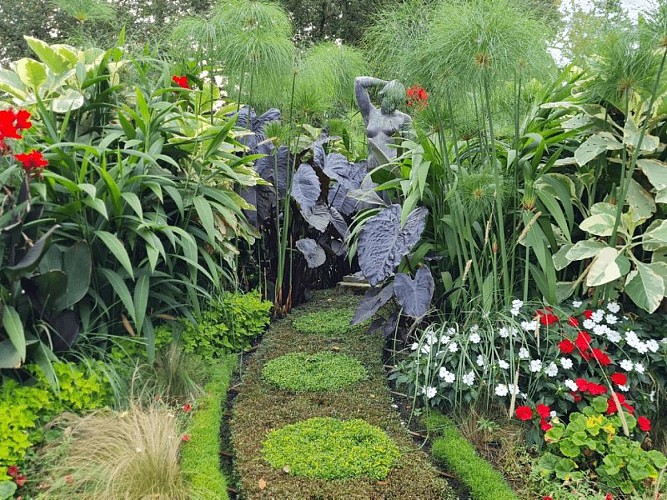
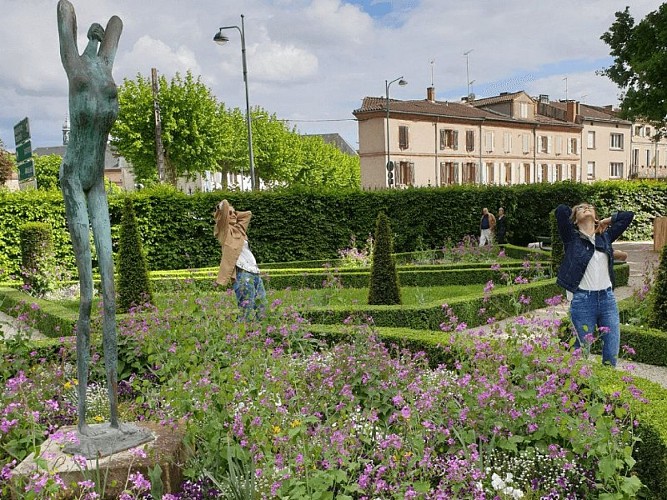
ENTRANCE TO THE PARK AND ITS HUNDRED-YEAR-OLD OAK TREEWelcome to the Rochegude Park. Follow in the footsteps of Admiral de Rochegude... Located in the Cordeliers cultural district, this 4-hectare park has been classified as a ‘Remarkable Garden’ by the French Ministry of Culture since 2010.A classical French garden, an English garden, a bird island, remarkable trees, a waterfall... everything in the Rochegude park invites you to relax. Created in the 19th century, this public park was originally a private park belonging to Admiral Henri Pascal de Rochegude.An avid botanist, Rochegude asked the town to plant dozens of remarkable trees in return for his bequest: libocedra, California umbellaria, sequoia sempervirens, plane trees, magnolias and bald cypress.Romantic statues, with women as their subject of inspiration, are to be found in the flowerbeds.As soon as you enter the park, you'll see a sculpture called ‘Bany’, created by Marta Solsona Bellara. In 1895, a statue of Sophocles dancing was installed here. Unfortunately, it was removed during the German occupation and melted down.On the left, an oak tree more than a hundred years old is one of the few remaining reminders of the park's origins.Small panels dotted around the park present the species, with enclosed areas for resident animals (ducks, geese, etc.). Playing hide-and-seek, sliding down the slides, watching the birds or the fish... or simply taking the time to enjoy this outdoor break on one of the many benches or on the grass are all pleasures to be shared in the Parc Rochegude.Enjoy the walk!
THE LABYRINTH GARDENOn your left, you will enter the ‘Labyrinth’ garden. Here you can discover or rediscover 12 varieties of rose, 25 varieties of peony and 45 varieties of sage. Be surprised by the Sichuan pepper plant. Pick one of these seeds, crush it between your fingers and smell the pepper aromas. This Sichuan pepper plant (Zanthoxylum piperitum), also known as Sansho pepper or Japanese pepper, appeals both to gardeners for its hardiness and to cooks for its powerful, highly aromatic flavour. The Sichuan pepper plant is a small tree, around 5 m tall, well known to Asian food lovers. It has large thorns. Its berry husks are used to season dishes. The small spring blossom produces the famous red berries with explosive notes of lemon, mint, lemongrass and pepper.
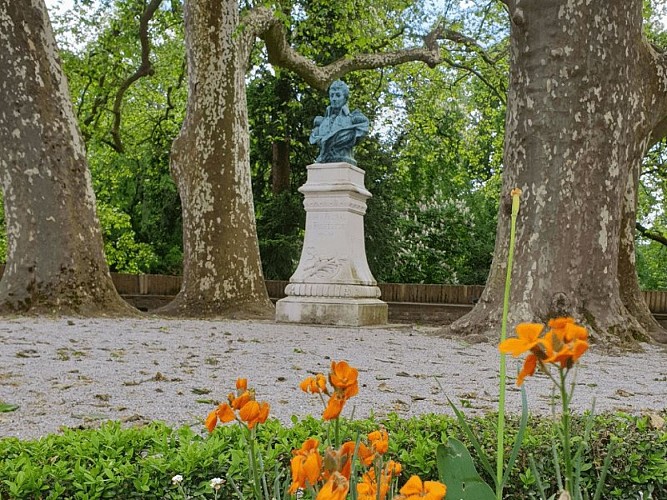
THE BUST OF ROCHEGUDE AND THE 4 HUNDRED-YEAR-OLD PLANE TREESAs you continue on your way, you will come across Admiral Henry Pascal de Rochegude. He was born in Albi on 18 December 1741, the same year as the navigator Jean-François Galaup de Lapérouse. Both were educated at the Jesuit College. Rochegude's career as a sailor began in 1757, when he entered the Ecole de la Marine, and ended in 1800 with the rank of rear-admiral. In the meantime, he was elected deputy for the Tarn region, voted in favour of Louis XVI's appeal to the people and was appointed inspector of the Navy's ports and arsenals. After the dissolution of the Convention, he gave up politics for good, devoting himself exclusively to linguistic studies, and more specifically to the study of the langue d'Oc. In 1819, he published two books:- le parnasse occitanien- Essai d'un glossaire occitanien’.Henry Pascal de Rochegude epitomised the ‘man of the Enlightenment’: atheist, liberal, Voltairean, Freemason, man of letters and philosopher, but also a great connoisseur of the natural sciences, passionate about astronomy and always driven by innovative ideas in many fields.
THE PRIVATE MANSION AND ITS FORMAL GARDENOn 27 October 1787, Admiral de Rochegude moved into the property. He laid out the rear garden and had the park planted, inspired by the gardens laid out by Le Nôtre. He planted the trees, choosing them with the greatest care. When he died without issue, he bequeathed his possessions to the City of Albi, including his private mansion with outbuildings, the park and his personal manuscript collection, comprising more than 12,500 books accumulated between 1760 and 1830. Reserving the usufruct of his property to his great-grandniece, the Comtesse de Saint-Juéry. The town took effective possession of these assets in 1886 after her death.One of the treasures of this library was the manuscript of La Mappa Mundi, listed in 2015 as a UNESCO World Heritage Site under the title of Memory of the World, which is now housed in Albi's Médiathèque. A facsimile can be seen in the Treasury of Sainte-Cécile Cathedral.
STATUE ‘L'IMAGINAIRE’ BY LOUIS DERBRE
SOURCE DE MERVILLEThis spring originates in the heart of the park. This stream, known as ‘Merville’, flows quietly through the park and ends very close to the Bamboo Grove. However, its flow is not sufficient to supply the water reservoirs used by the Anatidae (ducks).
CASCADEThis waterfall is the arrival point of a long upstream flow of water from the Tarn via a pumping system starting at Bondidou. This water is used to supply the various pools where the 2-legged ‘little inhabitants’ of the park meet. As you explore the park, you'll discover just who they are...
THE ROSE GARDENThis area features a selection of old roses and English roses. 66 roses of 26 different varieties have been planted. The colour scheme is a subtle combination of warm (yellow, orange) or cool (pink, purple), saturated (bright red, bright yellow) or cool (red, purple) colours.(bright red, bright yellow) or unsaturated (pale pink, pale yellow), offering a wide range of tones and scents. Metal structures created by the department's gardeners punctuate the garden and provide support for climbing roses.It's up to you to find the most striking varieties:- Munstead Wood": this rose gives off a fruity fragrance, a warm blend of wild blackberry, blueberry and plum.- Darcey Bussel': the best red rose grown to date, and certainly the brightest!- Strawberry Hill': a superb pink rose with a fine fragrance of myrrh, honey and lemon. A sure-fire winner!- Lady of Shalott': a subtle combination of red and orange, the flowers give off a sweet scent of tea, spiced apples and cloves.
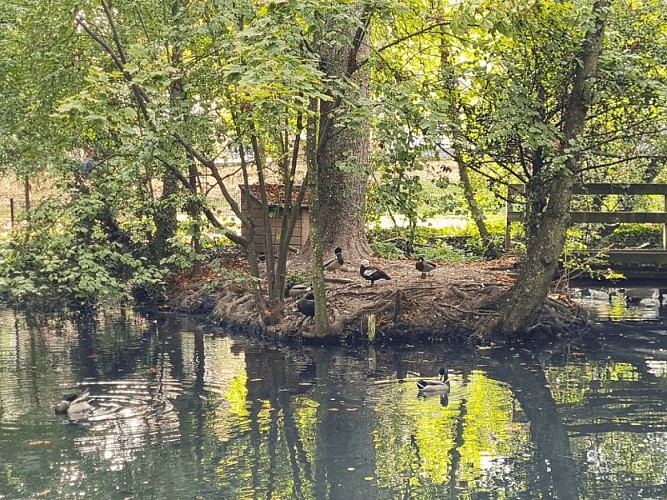
PONDS AND THEIR WILDLIFEA few years ago, the LPO du Tarn inventoried 44 species of birds. Most of the avifauna is made up of small passerines (the grey flycatcher and the common grosbeak). Despite this, they appear to nest occasionally in the park.Of the birds of prey observed, only the Tawny Owl breeds here. The Kestrel and the Sparrowhawk are regularly seen here. They don't hesitate to come and hunt birds in the middle of the day!The various waterholes attract two species of heron in search of food: the Grey Heron and the Black-crowned Night-Heron. As for the Gallinule, the moorhen, it has adapted perfectly to the context of urbanurban waterholes. Despite the regular presence of users, it takes advantage of the fenced enclosure and low vegetation to hide and raise its offspring. Finally, strange as it may seem, the kingfisher sometimes makes an appearance in this remote spot!As you make your way through the park, you'll be able to admire watercolour paintings of birds by JM Salacroup, gardener and designer of the various flowerbeds in the Parc Rochegude and the City of Albi.
THE PIGEONNIERIn order to regulate the pigeon population, the City of Albi has set up pigeon lofts in various parts of the town, where the pigeons can find a space suited to their lifestyle. The technique used to regulate the pigeon populationThe technique adopted to regulate the pigeon population is to rear a few individuals in a loft (known as a breeding loft) in order to obtain decoys to capture and retain the individuals present in the area. This control technique complements the two pairs of peregrine falcons present in the area. The Rochegude dovecote can be home to up to 200 pairs. Staff from the Plant Heritage and Environment Department distribute a daily food ration of 30 grams of seed per bird, as well as food supplements, and carry out health checks with professionals. Eggs are systematically collected (2 out of 3) and destroyed. Eventually, pigeon populations will stabilise and then decline.
THE VEGETABLE GARDENA keen botanist, Rochegude was keen for the town to continue planting trees and shrubs to introduce new plants to the people of Albacete. In his will, he wrote (codicil dated 5 July 1832): ‘... I would like the librarian... to give an annual botany course and that part of the garden and enclosure included in his will be made available for this purpose.I would like the librarian... to give an annual botany course and that part of the garden and enclosure included in my bequest be made available for this purpose, without however being allowed to cut down the trees there...’.Every year, the City of Albi's gardeners replant a vegetable garden where the harvest is freely accessible and where everyone can discover varieties of tomatoes, cucurbits and aromatic plants... Signs indicate the state of ripeness of each plant. Now it's your turn to taste!
THE BALD CYPRESSAmong the species and trees that Rochegude wanted to install was the bald cypress, or Louisiana cypress. This is a species of tree in the Taxodiaceae family native to the south-eastern United States. It is a remarkable species for its adaptation to damp environments.
THE WILD MEADOW AND THE STATUE OF ‘THE CONSOLING MUSEIn this area, nicknamed the ‘wild meadow’ because of its luxuriant vegetation, you can see the romantic statue of the ‘Consoling Muse’. In 1903, the Ministère de l'Instruction Publique et des Beaux-arts acquired the plaster cast of the ‘Muse consolatrice’ for the marble translation that the artist Jules Pendariés (1862-1933) was to make. In 1906, the statue was included in the exhibition of works handed over to the Fine Arts Administration. Itwas installed in the park in 1907.
THE LIED OAKExperience it for yourself. Touch the bark of this tree and try to find out what its purpose is...
THE MAGNOLIA AND ITS MEADOWNot far from this magnificent Yulan Magnolia, with its white flowers at the end of winter, take a break on the lawn and why not lie down?Look up at the sky between the trees and try to guess the shape of the clouds. From time to time, a few musicians come to play their scales in this park.Perhaps you can benefit from their talent?
THE HONEY TREEThis little-known tree (Tetradium danielli), which is very hardy, is interesting for its white flowers in summer, which are very fragrant and much appreciated by bees. It is followed by small red fruits, turning black, arranged in clusters. Its aromatic leaves have a bluish underside and turn yellow in autumn.Try approaching this tree in midsummer. You'll feel like you're in the middle of a swarm of bees.
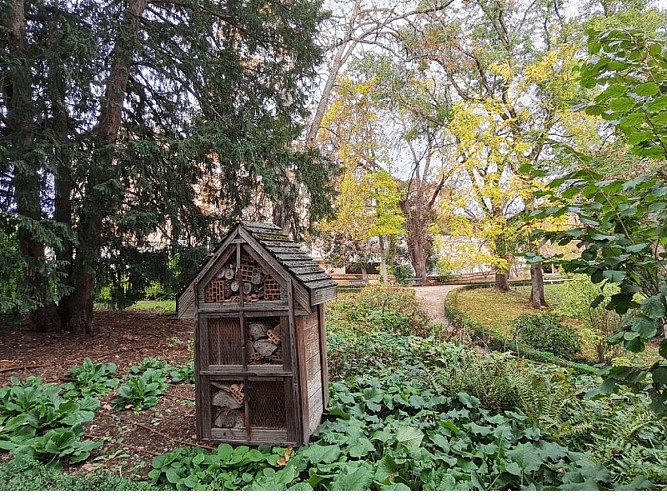
THE SHADE GARDEN AND ITS INSECT HOTELThe aim of this shade garden is to offer a range of plants suited to shade or even semi-shade. Yew, chestnut, maple, hazelnut and tulip tree give this garden an undeniably undergrowth feel. To enhance the garden, 1,100 plants of 29 species and 20 different genera have been planted.The ash trunk left on site serves as a refuge for animals and other insects, and complements the ‘insect hotel’ located nearby.Insect hotels help to conserve biodiversity and are a great way of raising awareness. Of course, insects need to find food for themselves and their larvae, but they also need shelter at different times in their lives:- to spend the night or the day- protect themselves from bad weather- shelter during the long winter,- breeding in the spring...Little game: Go in search of the tree nicknamed ‘the monkey's despair’ or the Chilean Araucardia.To complete your visit: Albi insect guide, also available free of charge from the Tourist Office.
THE BAMBOO GROVEA naval officer under the Ancien Régime, Rochegude took part in a mission to India in 1768-1769 aboard the ship nicknamed ‘La Garonne’. Rochegude's mission was to gather intelligence in India. His stay in India ended in Pondicherry. Perhaps during his stay in India he could have brought back some bamboo shoots, the symbol of Asian countries?In this place, you can enjoy an experience. Lie down on the grass next to the bamboos and listen to the sound of the wind in the foliage, an interlude conducive to well-being and meditation.
Technical Information
Altimetric profile
Starting point
Additional information
Advised parking
Les Cordeliers underground car park - Le Lude car park - Jean Jaurès car park
Ambiance
Few people are aware of the history and biodiversity potential of Parc Rochegude. As you stroll through the park, you'll be introduced to Albi's 2nd most famous navigator after Captain Jean-François Galaup de Lapérouse. Let's set off together in the footsteps of the illustrious creator of this magnificent park, Admiral Henri Pascal de Rochegude: over 230 trees, 85 varieties, 4 hectares, a birdwatching trail, a play area...
Arrival
Bamboo grove in the heart of Parc Rochegude
Departure
Parc Rochegude - Main entrance (Boulevard Carnot)
Data author
