Alert
Alerts
The mysteries of the city of Albigensia

Description
Let's set off together on a soothing discovery of Albi, where history meets nature. Let yourself be carried away by an immersive experience that will awaken your senses, revealing the richness of our historical heritage and the diversity of our natural environment.
DEPARTURE FROM THE TOURIST OFFICEYour starting point will take you directly to the Tourist Office, where you can pick up a map of the town and a guide to birds and insects.Now make your way to the entrance of the Episcopal Palace...
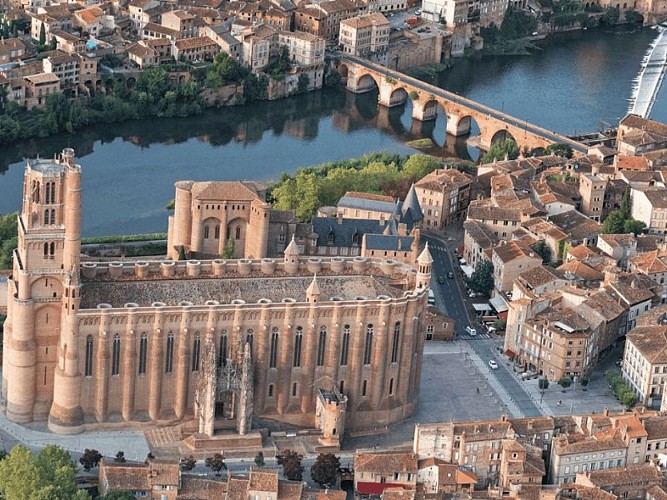
THE BERBIE PALACEFor your 1st stop, go through the gates of the Palais épiscopal and stop at the foot of the stairs...Of all the mansions built by the bishops of the south of France during the Middle Ages, there are few on the scale of Albi's Episcopal Palace.Known as the home of the Toulouse-Lautrec museum, the palace is also known as the Palais de la Berbie, a deformation of the Occitan name Bisbia, meaning bishopric. The oldest part of this impressive fortress was built by the bishops who succeeded each other in the Albigensian see during the 13th century.The Berbie Palace was built around 1250-1260 on a high, fortified site dating from the Gallic period and overlooking the Tarn, under the episcopacy of bishops Durand de Beaucaire and Bernard de Combret.At that time, the bishops of Albi were also the lords of the town.A civil structure in terms of its military architecture and religious in terms of its function, the initial palace took the form of an imposing brick keep (known as the Sainte-Catherine keep) flanked by four corner towers. Bishop Bernard de Castanet (1277-1308) gave it the scale and monumentality we know today.The palace was enlarged by the addition of a second keep (the Saint-Michel keep) and a vast rectangular wing with powerful walls.Alongside the Berbie, he began work on a new cathedral which, with its powerful brick architecture and slender Gothic style, formed the matrix of the Episcopal City and its urban coherence.
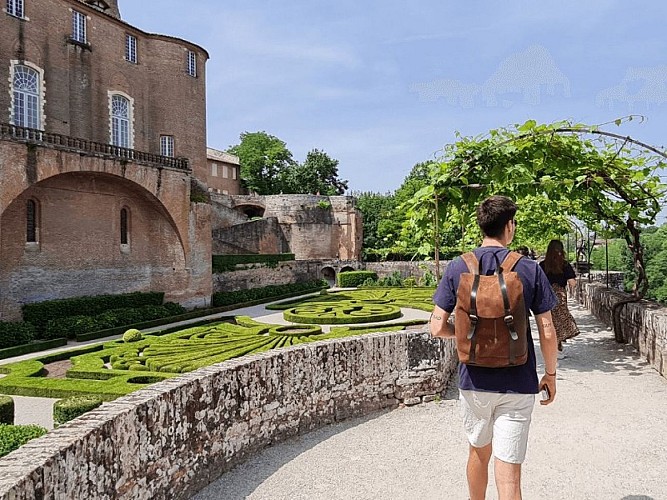
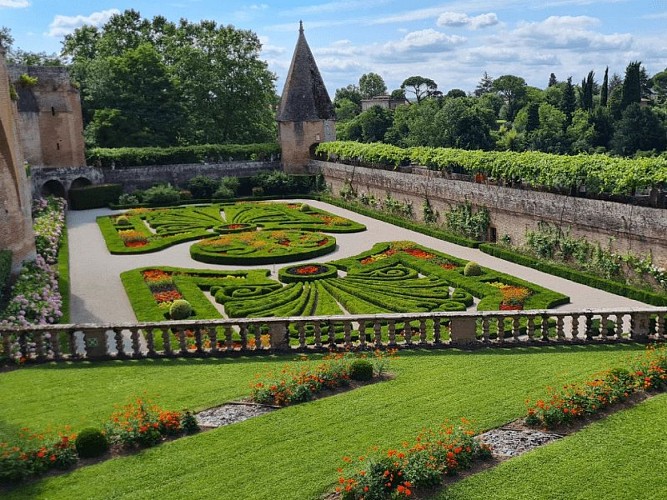
THE GARDEN OF THE BERBIE PALACEDuring this stopover, we recommend that you take a stroll along the ramparts of this garden, which has been awarded the ‘Remarkable Garden’ label by the French Ministry of Culture. The brainchild of the first archbishop of Albi, Hyacinthe Serroni, the two terraces and the ‘classical’ garden known as ‘Le Notre’ at the Palais de la Berbie were created at the end of the 17th century and oriented the life of the palace towards the banks of the Tarn and its vistas, reflecting the taste for nature and the picturesque that was prevalent at the time. These gardens are known as ‘à la française’, in the classical style of Versailles.The gardens as we see them today are the result of the transformation, between 1687 and 1703, of the palace's former bailey into a place of pleasure.Three levels were created: the upper terrace, the counter-terrace and the gardens themselves in the lowest part. At the end of the 18th century, Mgr. de Stainville, Choiseul's brother, had the marble statues representing the seasons added to the promenoir, which can still be seen today.With the same goal in mind, the bishops had the enormous buttresses on the north side of the Suffragants wing cut down and used the buttress towers of the Sainte-Catherine tower to install large terraces designed to open up the rooms in this part of the palace, which had been refurbished for the occasion, towards the gardens.
PLACE TRÉBAILLE AND THE REMAINS OF THE ROMANESQUE CATHEDRALOn leaving the Cité épiscopale, turn right and follow the cathedral on your left. This will take you to Place Trébaille.Place de la Trébaille refers to an ancient gateway of the same name, built into the wall known as the ‘Chanoines’, which ran past the bell tower to the curtain walls of the Berbie. This fortification separated Castelviel from the rest of Albi. Its destruction in the 19th century provided a convenient link between the two. What remains of this wall is the section that borders the square to the east.
THE CATHEDRAL AND ITS INHABITANTSTurn towards the cathedral and look up. You may be able to see ‘our inhabitants’ of the cathedral. But who are they?Sainte-Cécile cathedral was built from 1282 onwards in response to the Cathar heresy, as a fortress symbolising the power of the Catholic Church.The largest brick cathedral in the world, 113 metres long and 35 metres wide, it dominates the city with its 78-metre bell tower, completed in 1492 shortly after the consecration of the choir in 1480: 200 years of continuous work!It was listed as a World Heritage Site in July 2010.
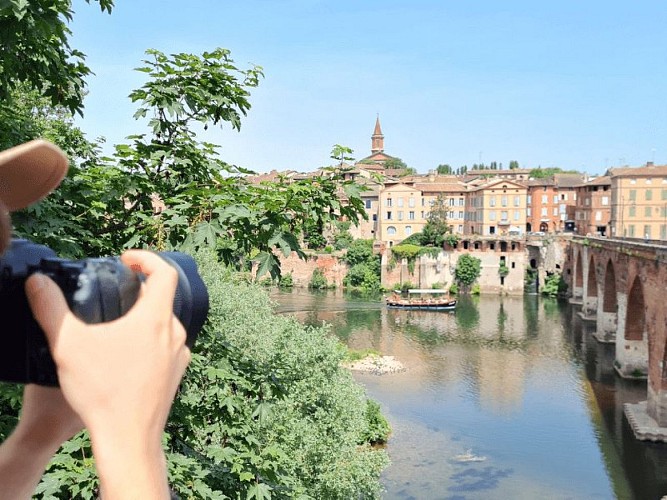
THE BANKS OF THE TARNDescend the stairs leading down to the Tarn and take the time to discover this river that saw our mysterious navigator set sail on its waves...The river has been a trade and goods route since ancient times. Navigation was carried out using flat-bottomed boats with square sails, known as ‘gabarres’. Woad, saffron and wine were transported by water. While the current helped sailors to get from Albi to Bordeaux, the return journey was very difficult and had to be done by tow. In the 19th century, a barge service was even set up to transport coal from Carmaux. The arrival of the railway signalled the end of this navigation.In the past, the river was towed by horse and cart, using human power. Tie-up rings can still be seen all along this route.The attached old photograph shows how the river banks were laid out in the 19th century.
THE OLD BRIDGENow head towards the bridge and get some height...The Pont-Vieux was built between 1035 and 1042 (although the oldest parts visible today date from the 13th century). Initially, it was too narrow for carts to pass over, so goods were carried on the backs of men or animals.The bridge withstood all the floods of the Tarn, but it was badly damaged in the early 15th century and it was decided to strengthen it by various means, in particular by building houses to reinforce its structure. These houses, which often belonged to merchants, were gradually destroyed after the flood of 1766. Thanks to the Pont-vieux, one of the few bridges over the Tarn in medieval times, Albi became a commercial crossroads (from the Mediterranean to Cahors and Paris; from Toulouse to Rodez and Lyon).The Porte du Tarn, part of the city walls, was also a toll plaza for goods passing through the Pont-Vieux. Ordinary travellers paid no tax.
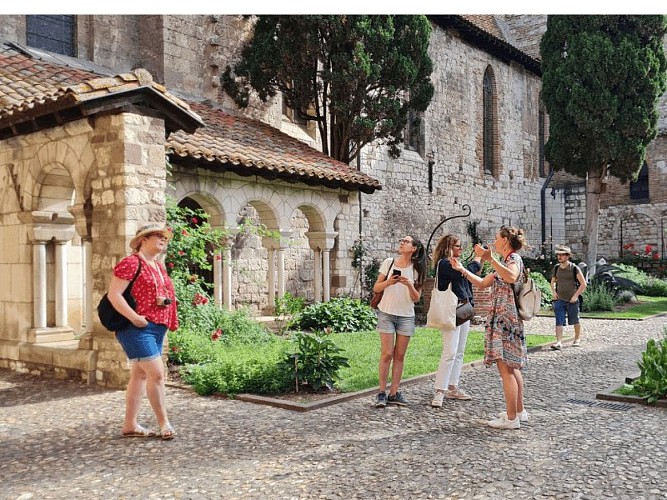
THE CLOISTER OF THE COLLEGIATE CHURCH OF SAINT-SALVIWalk up the Quai Choiseul towards the Collégiale Saint-Salvi, visit it and take the side door to reach the cloister.Together with the collegiate church, the cloister forms a remarkable ensemble just a hundred metres from Sainte-Cécile cathedral and the Palais de la Berbie.On the south side of the collegiate church was a cloister, three of whose galleries were destroyed during the Revolution and the Empire. Only the southern gallery remains. Built from 1270, it combines Romanesque forms (round arches) with Gothic capitals.The cloister was built under the direction of Vidal de Malvési, who was authorised by the canons to have a highly original coffin built for his burial, resembling a small chapel.
PLACE DU VIGAN AND ITS FOUNTAINSLeave the cloister via rue Peyrolière and walk up rue de l'Hôtel de Ville to reach Place du Vigan. Here too, water is our common thread...In the spring of 1999, excavations in the Place du Vigan in Albi unearthed several elements of fortifications, linked to the nearby presence of a gateway, integrated into a barbican-type complex. Archaeological analysis has enabled us to attempt a chronological reconstruction of this defensive complex. The first system, essentially based on ditches, appears to have been put in place during the 14th century. Various modifications were then made up until the 16th century, in line with developments in weaponry and siege techniques. From this date onwards, the defensive complex slowly began to fall into disuse. Despite renewed interest in the area with the construction of a ceremonial gateway in the mid-seventeenth century, this slow abandonment came to an end with the definitive dismantling of the defences in the second half of the eighteenth century (Extract from the book ‘Archéologie du Midi médiéval : Les fortifications médiévales de la place du Vigan à Albi’ by Laurent Grimbert).
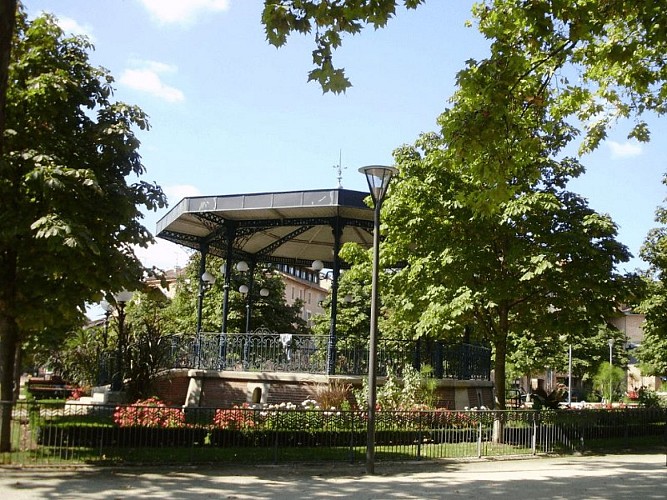
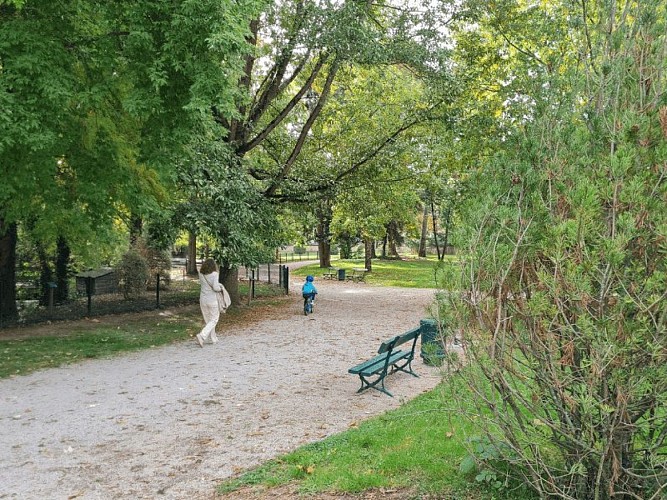
THE NATIONAL GARDEN AND ITS FOUNTAINA few metres further on and you're in the National Garden. Here we find a spot of freshness thanks to its trees, flower beds and ponds.This garden was built on the ditches around the ramparts that surrounded the old fortified town.With its enclosed square and streamlined flowerbeds, a blend of the past and the present, the national garden is organised around white calda stone promenades and a circular escutcheon pond adorned with a statue by Joseph Rivière, ‘La baigneuse’.The bandstand: it was in 1875 that the town council put forward the idea of a bandstand in the Royal Garden (which would later become the National Garden). As this was not a priority at the time, it wasn't until 1898 that the idea of ‘rebuilding the bandstand’ was mooted, which would suggest that there had been one before... The town council travelled to Toulouse to meet the manager of the Saint-Éloi workshops (Maison Girard Frères). This company, which specialises in iron constructions, produced the statue for an exhibition in the pink city. The bandmaster of the 143rd infantry regiment, who was part of the delegation, also seems to have agreed in principle. The space provided by the bandstand should be sufficient to accommodate the musicians of his band.
PLACE LAPÉROUSE AND ITS FOUNTAINNow walk along the lices towards Place Lapérouse. We're getting closer to our goal and finally discovering who the mystery navigator of our escape is...To create this ‘fountain’, the city of Albi decided ‘not to call on a fountain-maker, but on an artist’. Jeppe Hein, 38, graduated from the Royal Academy of Fine Arts in Copenhagen and now works in Berlin. In Albi, he will be creating ‘an aquatic work’ called ‘Encircle’. This ‘water pavilion’ will be made up of several circles of different diameters, partly juxtaposed and partly intersecting, creating new spaces. The walls of water will feature 2.2-metre-high jets. This contemporary work of art has 720 jets.
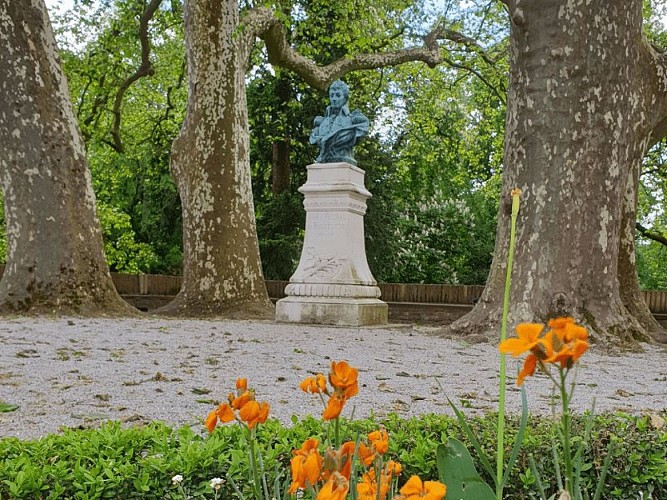
THE ROCHEGUDE PARK AND ITS POOLSAs you leave the Place Lapérouse, you'll pass by Albi's grand theatre. Don't hesitate to take a walk on the roofs of this theatre to admire the city from above... This last stage of our adventure will end here and you will finally discover our famous character...Go through the gates of this park and head for the town house and statue of its founder, Henri Paschal de Rochegude.Located in the Cordeliers cultural district, this garden has been classified as a ‘Remarkable Garden’ since 2010.A classical French garden, an English garden, a bird island, remarkable trees, a waterfall... everything in the Rochegude park invites you to relax. Created in the 19th century, this public park was originally a private park belonging to Admiral Pascal de Rochegude.Three distinct parts, - the Hôtel Renaissance, which became the municipal library, then an exhibition space, and now the LAIT contemporary art centre - the French-style gardens of pruned boxwood punctuated by orangery tubs - and the English-style gardens below, on the site of the former farm, with vegetable garden, meadow and orchard.An avid botanist, Rochegude asked the town to plant dozens of remarkable trees in return for his bequest: libocedra, California umbellaria, sequoia sempervirens, plane trees, magnolias and bald cypress.
Technical Information
Altimetric profile
Starting point
Additional information
Ambiance
Many people are unaware of the link between Albi and the oceans. During this exploration, you will have the opportunity to discover Albi's second most famous navigator, just after Capitaine de Vaisseau Jean-François Galaup de Lapérouse.Our journey will last around 1.5 hours, with the vital element of water as the main theme.
Arrival
Parc Rochegude, Boulevard Carnot
Departure
In front of the Albi Tourist Office, 42 rue Mariès
Data author
