Alert
Alerts
L'échappée verte, an idea for a city walk on the GR 36
Description
The Echappée Verte is a 7km round trip walk in the heart of Albi, partly on the GR36. It then stretches along the Tarn and the Caussels stream. The walk takes you through an unspoilt natural environment.
Let's set off together to discover Albi, its historic and natural heritage. Enjoy this natural interlude and the potential biodiversity of our city.Follow the 21 discovery points step by step:
THE START OF OUR ESCAPADENow that you're in front of the Tourist Office, we suggest you pick up the following booklets from the tourist advisers:- City map- insect guide- Bird guideYou can now begin your escapade by making your way to the starting point, Place Trébaille, around the Cathedral of Sainte-Cécile, in the World Heritage area. Our walk will last around 2 hours and you'll cover 4 km one way (and then the other). This walking tour is not particularly difficult. We do, however, recommend that you wear good shoes. Take your time to look around, you're going to discover some hidden treasures.
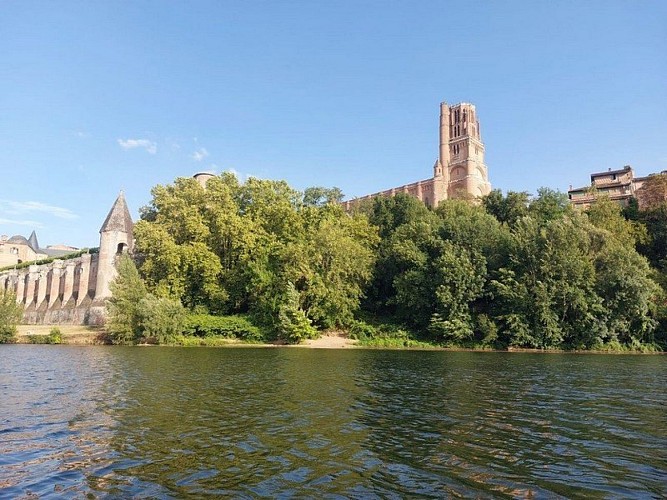
THE TRÉBAILLE SQUARE AND FOUNTAINThe Place Trébaille evokes an ancient gateway of the same name, built into the wall known as the ‘Chanoines’, which passed in front of the bell tower to cling to the curtain walls of the Berbie. This fortification separated the Castelviel district from the rest of Albi. Its destruction in the 19th century provided a convenient link between the two areas. What remains of this wall is the section that runs along the eastern edge of the square. A fountain has been added to make this small square more pleasant.The remains of the Romanesque cathedral cloister can also be seen in the square. Like an invitation to descend to the banks of the Tarn, these remains of the cloister with its horseshoe arches form an open window onto the landscape. They bear witness to the Romanesque cloister of the former cathedral, which existed between the current monument and the Palais de la Berbie.To do: Turn towards the cathedral and look up. You'll be able to hear or observe the pair of peregrine falcons that have been present on the site since 1988, giving birth to a few young each year.Continue your visit by taking the stairs and path that lead down to the banks of the Tarn...
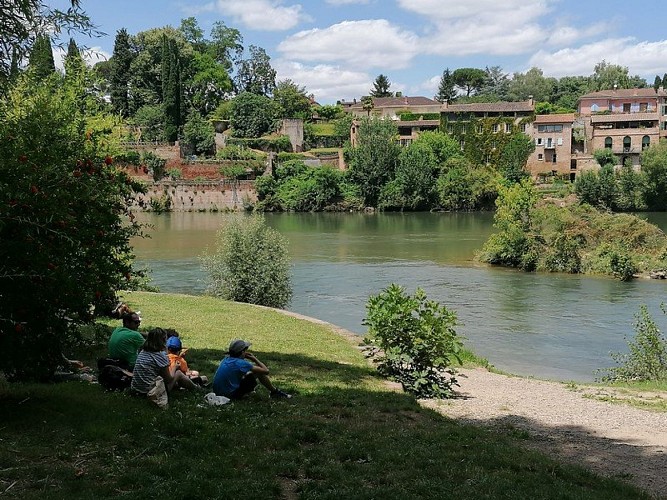
THE TARN AND THE TOWPATHAs you make your way down to the banks of the Tarn, you start to catch a glimpse of the river.The river has been a trade and goods route since ancient times. Navigation was carried out using flat-bottomed boats with square sails, known as gabarres. Woad, saffron and wine were transported by water. While the current helped sailors to get from Albi to Bordeaux, the return journey was very difficult and had to be done by tow. In the 19th century, a barge service transported coal from Carmaux. The arrival of the railway signalled the end of this navigation.In the past, the river was towed by horse and cart, using human power. Tying rings can still be seen all along this route.
IN SEARCH OF BEAVERSAll along the banks of the river, and particularly on the wild islet, you might spot our friend the beaver...The beaver is back on the banks of the Tarn. Threatened with extinction at the beginning of the 20th century, it had completely deserted the banks of the Tarn rivers. That was until 17 April 2009, when a resident of rue Porta rescued a stray beaver and handed it over to technicians from the Office Départemental de la Chasse et de la Faune Sauvage (ONCFS). The animal, a 14kg adult, was released well upstream on the river. This flat-tailed pioneer must have passed on the message to his fellow beavers, as traces of a family of 6 to 8 beavers were found on the banks of the Tarn, near the town of Castelnau-de-Lévis.This large rodent occupied a place of honour on rivers and populated France in the Middle Ages. It was hunted for its fur and then for its meat.
THE OLD BRIDGEBuilt around 1040, ‘for the common benefit of the town and the Albigeois’, this bridge enabled the development of the district on the right bank, known as the faubourg du Bout-du-Pont or de la Madeleine, and increased trade.A toll bridge, it featured a fortified gate tower, a chapel in the centre, a drawbridge and the ‘ravelin’. From the 14th to the 18th century, the bridge carried houses on its piers, which were demolished after the terrible flood of 1766. In 1820, to adapt to the new transport needs of the industrial revolution, the roadway was straightened and widened.Listed as a historic monument, it is now one of the oldest bridges in France to be used for traffic.Take a look at the Right Bank: and immerse yourself in the history of the bridge on the Timescope virtual reality terminal.
THE WATERFALL IN THE HEART OF THE TOWNYou can now see the Chapitre hydroelectric power station.This power station produces 9 million kilowatt-hours a year, equivalent to the annual electricity output of 8,000 inhabitants.It prevents 7,800 tonnes of carbon dioxide, the gas responsible for most of the world's pollution, from being released into the atmosphere. We would need to plant 450,000 trees to achieve an equivalent reduction in carbon dioxide.
THE VERMICELLI FACTORYOpposite you, on the other bank of the Tarn, is the Vermicellerie... more commonly known as ‘Les Moulins Albigeois’. A former pasta factory, it occupied the site of a flour mill that could date back to the 12th century. The site was remodelled from the 17th century onwards and transformed into a pasta factory in 1850. It fell into disuse in the second half of the 20th century. The factory was listed as a historic monument on 11 October 1984.Things to see during your stay: photo spotlight on the Episcopal City and the Lapérouse Museum
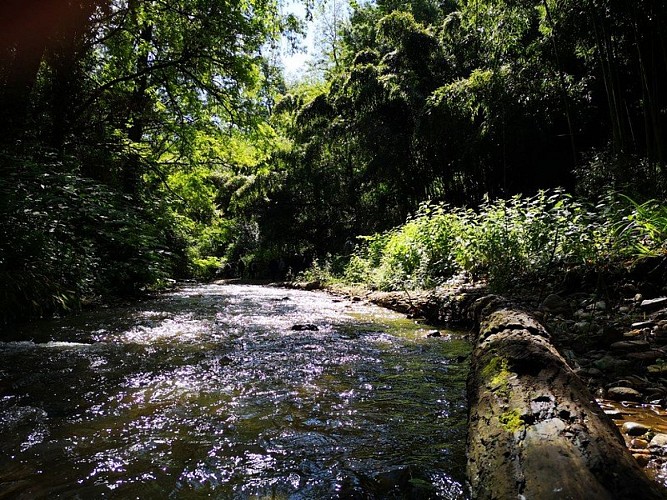
LA BAMBOUSERAIE: A MOMENT OF ZENYour wild escape begins here, on the banks of the Caussels. Enter the heart of this bamboo grove along the signposted GR36 path.In the middle of this bamboo grove, a sculpted tree trunk spans the Caussels stream.Take the time to sit by the stream and listen to the sound of the wind in the bamboo.
THE WETLANDWhen the Echappée verte trail was created in 2004, the local authority discovered a cultivated area in the heart of a forest of giant bamboo. This plot of land, which belonged to the town, had been tended since the early 1980s by a family of Laotian origin who were present from time to time. It was decided to let them occupy this space so as not to deprive them of their food crops and preserve the landscape interest of this atypical plot on the edge of the path.A bamboo fence and small wooden structures add an exotic touch to the area, located 500 metres from the town centre.The experimental creation of an artificial peat bog began in January 2018.
THE FORD CROSSING Continue on your way and cross the ford. In high water, the path is impassable. It's a real feat of balancing over the stream, which will amuse children and adults alike.It's up to you to play the balancing act!
FISH AND FLORAContinue your adventure. You'll be walking alongside the Caussels, one of the Tarn's many tributaries.The Tarn, like most of its tributaries, is classified as a second category fish river. This means that it is mainly home to cyprinids. These fish, such as carp, chub, bleak and roach, live in lowland rivers where the water is calm and warm. They live alongside zander, perch and eel.In spring, you'll be able to spot Lathraea clandestina all along the stream: these flowers, which are on average three to four centimetres long, form a clump or disc that can reach a diameter of fifty centimetres for the largest!
FRUIT TREESYou have now reached the heart of the Domaine de la Mouline. Here, all your senses will be activated as you discover the wealth of biodiversity in our town...A huge variety of ‘remarkable’ fruit trees await you here... cherry, apple and pear trees alongside chestnut, almond and plum trees. There are over 44 varieties to choose from! It's up to you to taste them!
LES LIBELLULESNot far from the educational pond, on your left, a small spring will allow you to observe the 14 species of dragonflies that have been recorded on the site. Commonly known as dragonflies, these primitive carnivorous insects form the order Odonata.Odonates are classified into two suborders:- the Anisoptera (= dissimilar wings) or true dragonflies, with powerful flight- the Zygoptera (joined wings) or damselflies, with match-shaped bodies and hesitant flight.
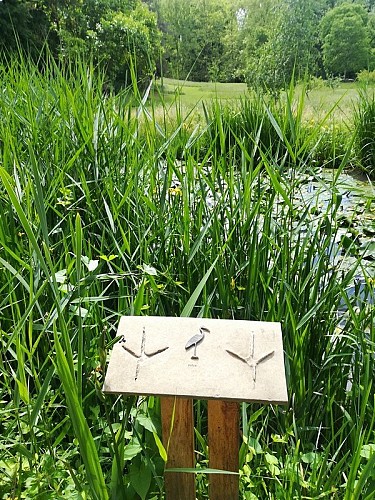
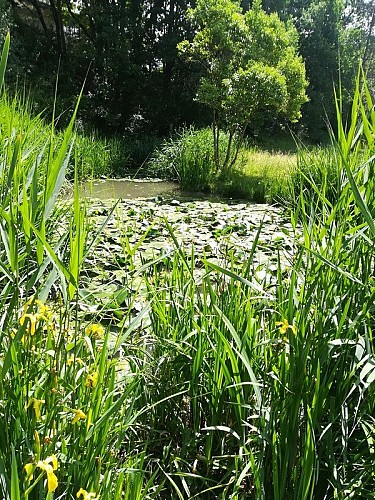
THE EDUCATIONAL PONDAn educational pond below the Mouline leisure centre has been developed to make it more accessible to the public and to facilitate observation of a rich and fragile ecosystem.A wooden pontoon has been installed so that visitors can observe the various plants adapted to this environment and present on the Echappée verte. This area is of great benefit to wildlife such as amphibians, birds and dragonflies.Rushes, reeds, water lilies, phragmites and other species have colonised the area, giving it a natural appearance.
THE INSECT HOTELThere are a few simple principles to follow when setting up an insect house: it should face south or south-east, be protected from the prevailing winds and be 30 cm higher than the ground.The main insects housed are: ladybirds, lacewings, osmids, carabid beetles, hoverflies, which look like wasps but belong to the fly family, and earwigs.
THE PIGEONDovecotes are very common in the Tarn (around 1,700 recorded). Light wooden structures, usually built of brick, stone, cob or adobe, their architecture, derived from feudal towers, embodied nobility and prosperity. In Albi, the pigeon lofts that have been renovated in recent years are designed to regulate pigeon populations by collecting eggs.
FISH SPAWNING GROUNDSA spawning ground is the place where fish reproduce. Spawning grounds are often found on the sandy or sandy-muddy bottoms of rivers, ponds, lakes, marshes, estuaries and even very deep marine areas.They are essential to the good ecological status of rivers and catchment areas. They can be threatened by water or sediment pollution, the artificialization of watercourses (canalisation and rectification in particular), poaching, siltation and sometimes by clogging by algae or ‘encrusting’ and ‘calcifying’ bacteria.
IN THE FOOTSTEPS OF ALBIGENSIAN WILDLIFENot far from the pond and the fruit trees, you'll be able to spot various signs describing the animal species you'll come across along the way. Listen carefully and keep your eyes wide open!You might come across a fox, a heron or a roe deer, to name but a few...
THE BIRDS OF L'ÉCHAPPÉE VERTEA privileged area for observing and hearing many species of birds, you'll be able to recognise: the Hoopoe, the Grey CuckooOak Jay, Kingfisher, Cattle Egret and many more...
THE DAMAs you continue your adventure, you'll come across a dam on the Caussels.No one knows why this dam exists. Was it installed to power an old mill on the Mouline site? It probably was.
CENTURY-OLD TREESOur route ends at the foot of these ancient trees, in this clearing. We have just completed this green escape together. We hope you enjoyed it and that you were able to discover or rediscover your 5 senses. Don't hesitate to recommend it and share your impressions...
Technical Information
Altimetric profile
Starting point
Additional information
Advised parking
Cathedral car park
Ambiance
The starting point for the Echappée verte walking trail is just a stone's throw from the cathedral, on the banks of the River Tarn. After a visit to the city's heritage, what could be more pleasant than to immerse yourself in nature right in the heart of the city? Take your first step on the path at the foot of the Palais de la Berbie and the Pont-vieux, to fully understand the city's position in relation to the river....
Arrival
Same place as start
Departure
Leaving from the Tourist Office, Place Sainte-Cécile
Data author
