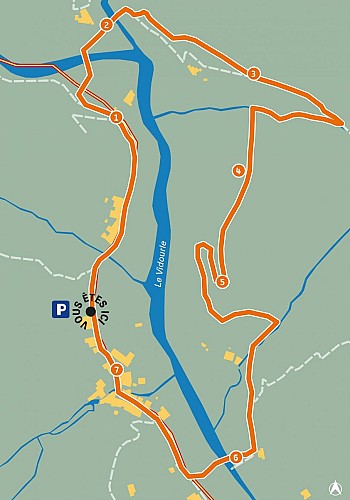
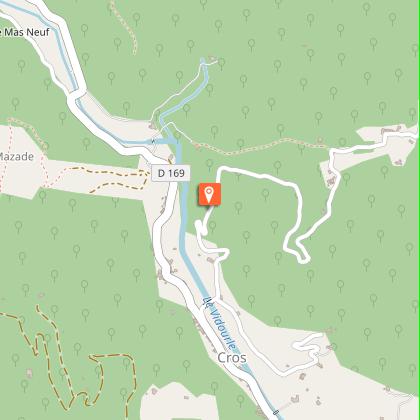
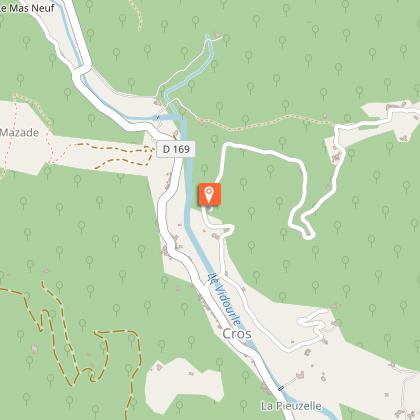
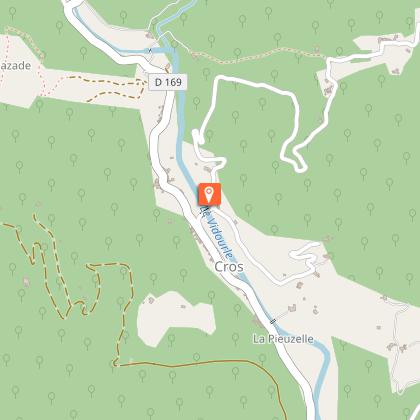
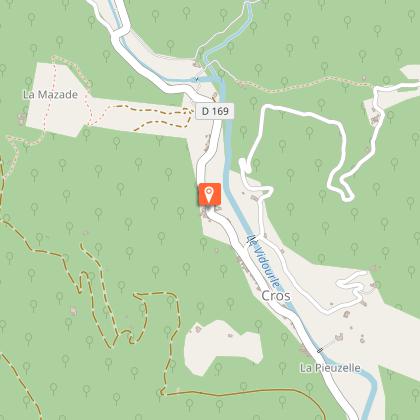
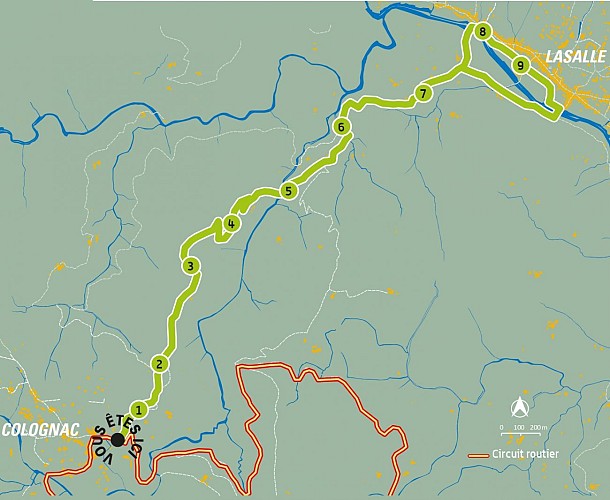
Departing from the village Temple parking lot, the Silk Trail is an easy 2 km walk that allows you to discover silkworm breeding. Silkworms were an important resource for the village's economy before they disappeared.
A 7-station route around the village of Cros.
The presence of the mulberry tree in Cros can be traced back to the early 18th century. It all began with this tree, whose leaves were needed to feed the manhan (the Occitan name for the silkworm, Frenchized as "magnan").
The boom in sericulture is generally attributed to the terrible winter of 1709, which froze the chestnut trees to the ground.
Breeding lasts a few weeks, from April to July, and requires a large workforce or specialized rooms known as "magnaneries". When the magnan "encabana" in the heather twigs to weave its cocoon, rearing is complete and the cocoons must be "descoconar", removed from the twigs to be treated before the chrysalis pierces them.
In the 18th century, cocoons were treated in "basins". In the 19th century, the cocoons were taken to spinning mills, reflecting the industrialization of the Cévennes. The two spinning mills in Cros supply raw silk (which still contains the silkworm's secretion, grès) to traders in the Cévennes, Nîmes and Lyon. The silk thread is then strengthened by twisting, and the sandstone is removed. Dyeing is then possible.
From the early 17th century, silk from the Cévennes was used for weaving, but above all for making stockings, worn by men and women alike.
Despite Louis Pasteur's intervention in Alès in 1865 and in Saint-Hippolyte-du-Fort in 1869, diseases decimated the farms: up to 80% losses in Cros in 1876 and 1878.
Sericulture continued in Cros until the 1960s, when the cocoons were taken to the Maison Rouge spinning mill in Saint-Jean-du-Gard, the last silk spinning mill in France, which closed in 1965. Hosiery continued to exist in the Cévennes valleys in the 20th century. Today, only a few workshops bear witness to this industrial past.
industrial past. In 1876, silk directly employed 13% of the working population of Cros.
The golden age of sericulture in Cros lasted until the early 19th century, as evidenced by the evolution of the village's population.
INTERPRETATION STATIONS
1 - The Italiennes oustalet.
2 - The Arnaudes mill.
3 - From crops to forest.
4 - The Mas Bourguet terraces.
5 - The hamlet of La Mazade.
6 - The Vidourle.
7 - The spinning mills.
We have no information on the difficulty of this circuit. You may encounter some surprises along the way. Before you go, please feel free to inquire more and take all necessary precautions. Have a good trip! 🌳🥾
Are you sure you want to delete your account?
This operation is irreversible and will permanently delete all data associated with your account, including routes, points of interest, widgets, statistics...Deletion will be effective across all applications published by Cirkwi and on Cirkwi web platforms.
Are you sure you want to delete your account?
Warning, you will be logged out, and your account deletion will take immediate effect.Do you confirm the permanent deletion of your account?You have 30 days to reconnect and reactivate your account before its permanent deletion.